
Articles
52 pieces on the money behind the Premier League: every club rebuilt from its accounts, the rules explained, and the analysis in between.
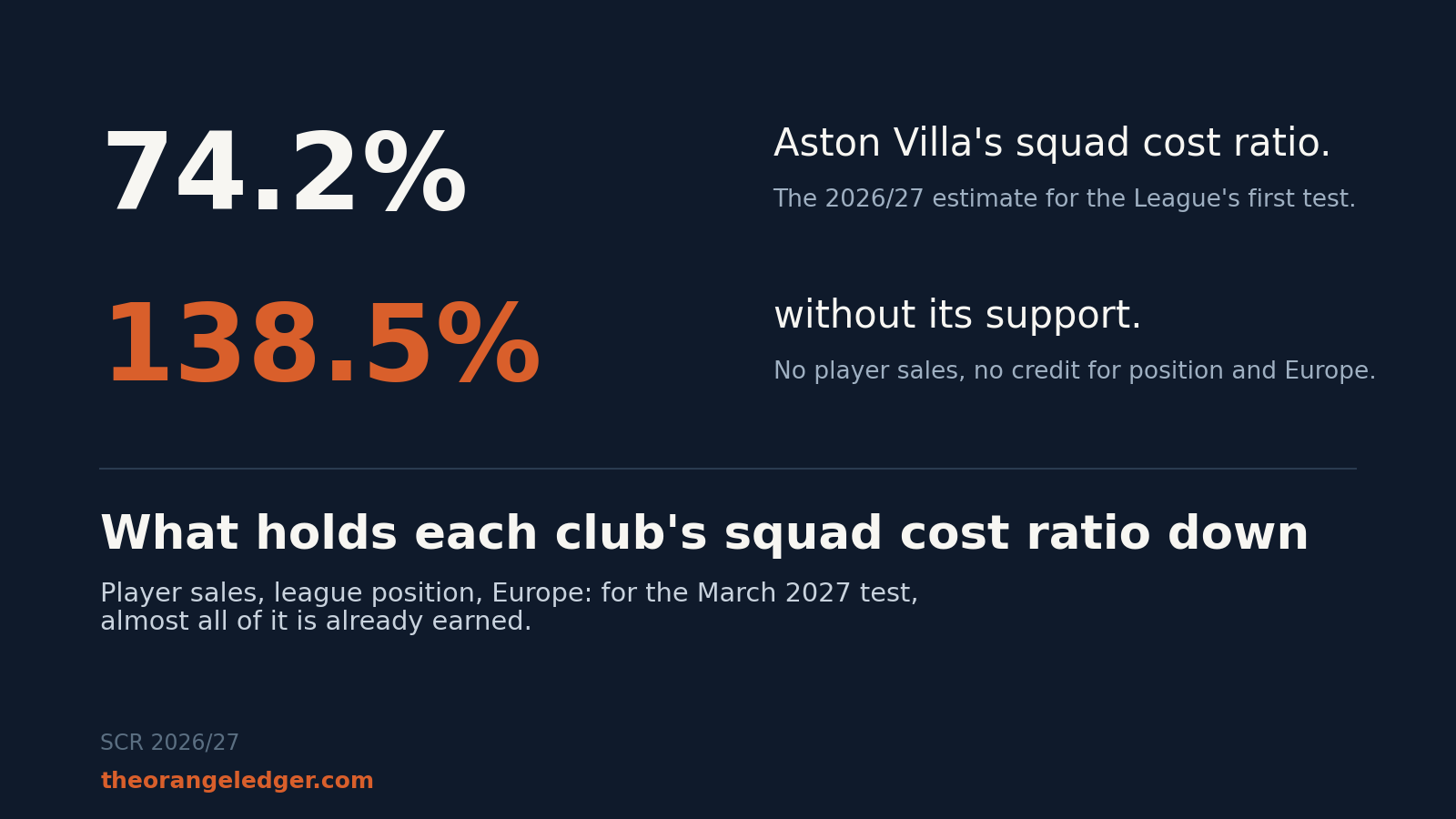 What holds each club's squad cost ratio downEvery club's figure under the Premier League's new spending rule leans on something besides its everyday business: profit from selling players, or the revenue the rule credits for league position and Europe. For the first test, in March 2027, almost all of that support is already earned. The question is what each club leans on when it starts to roll off.Read the piece →
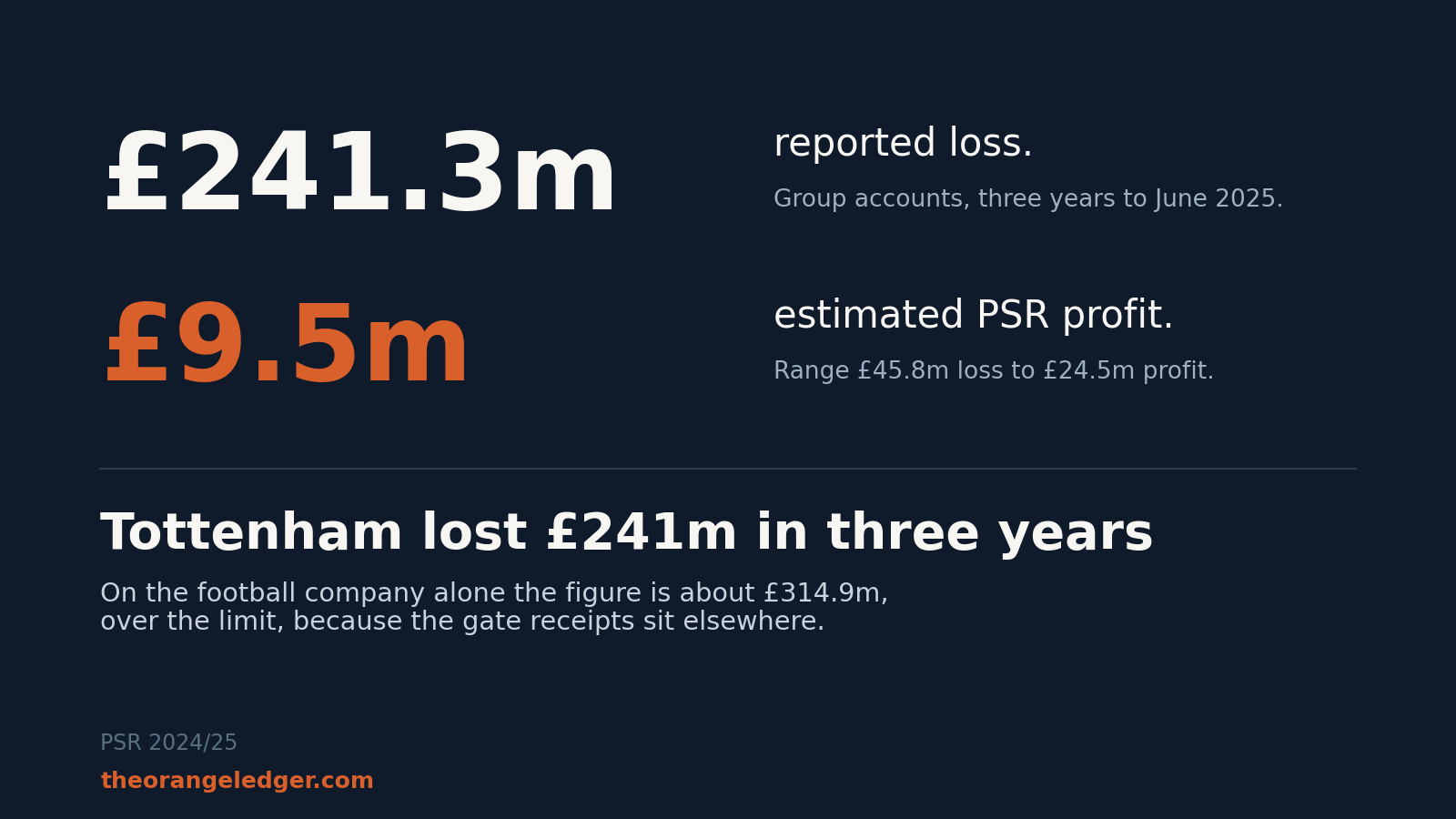 Tottenham lost £241m in three yearsTottenham won a European trophy in a season that ended with the club's largest loss of the three, and the accounts show why a club can lose that much and still sit inside the Premier League's limit. The rules allow the cost of the stadium, the women's team, the academy and community work to be taken out, and which company's accounts are tested changes the answer.Read the piece →
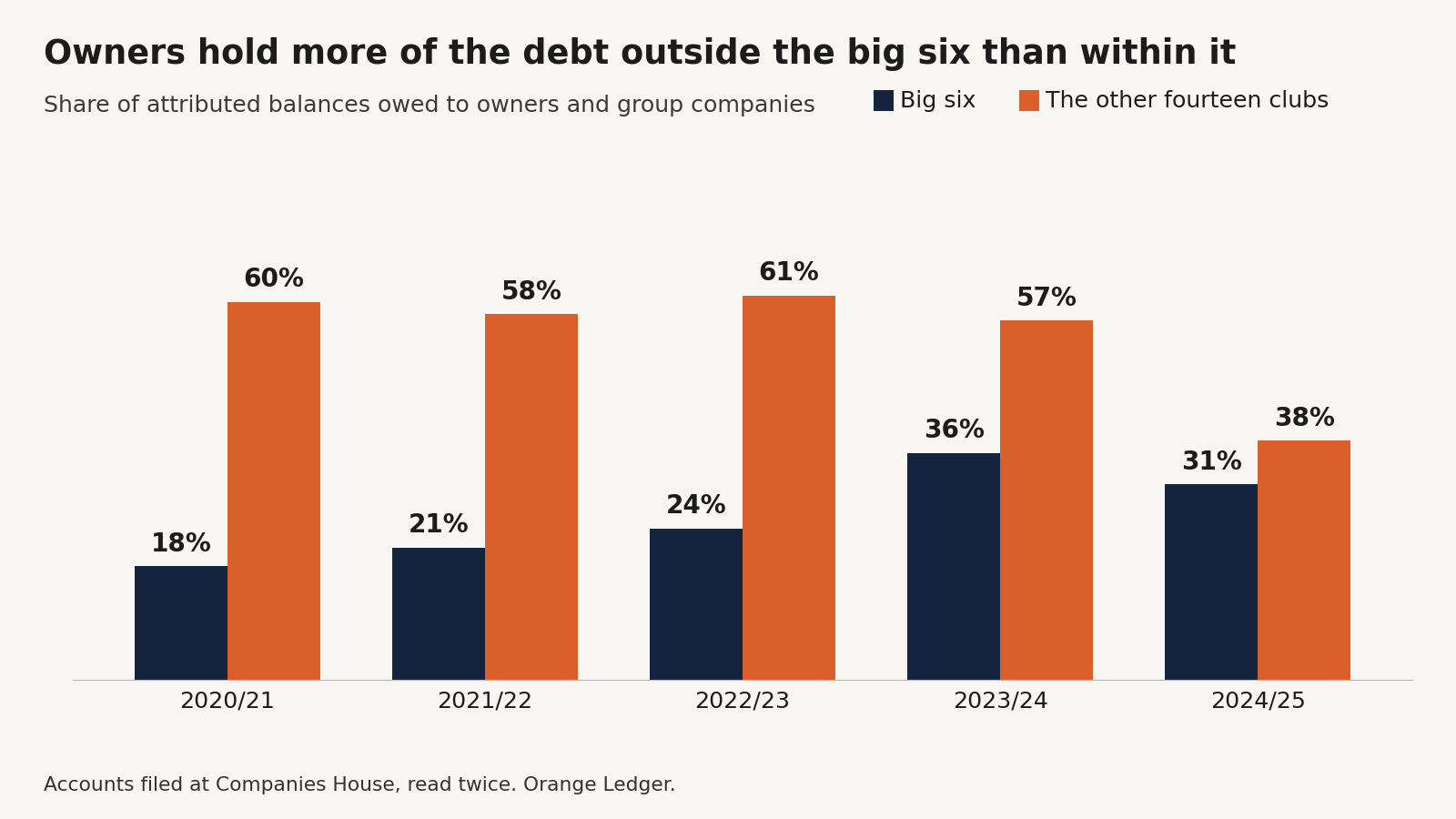 Who the clubs owe: Premier League debt, and how much of it the owners holdIn December 2024 Everton turned £450.8m of loans into shares. The money was owed to a company controlled by the club's outgoing owner, and the loans had already been counted as equity. Five seasons of Premier League balance sheets show how much of the clubs' attributed debt is owed to their owners, how many clubs cite that support in their going-concern assessment, and what negative net assets do and do not mean.Read the piece →
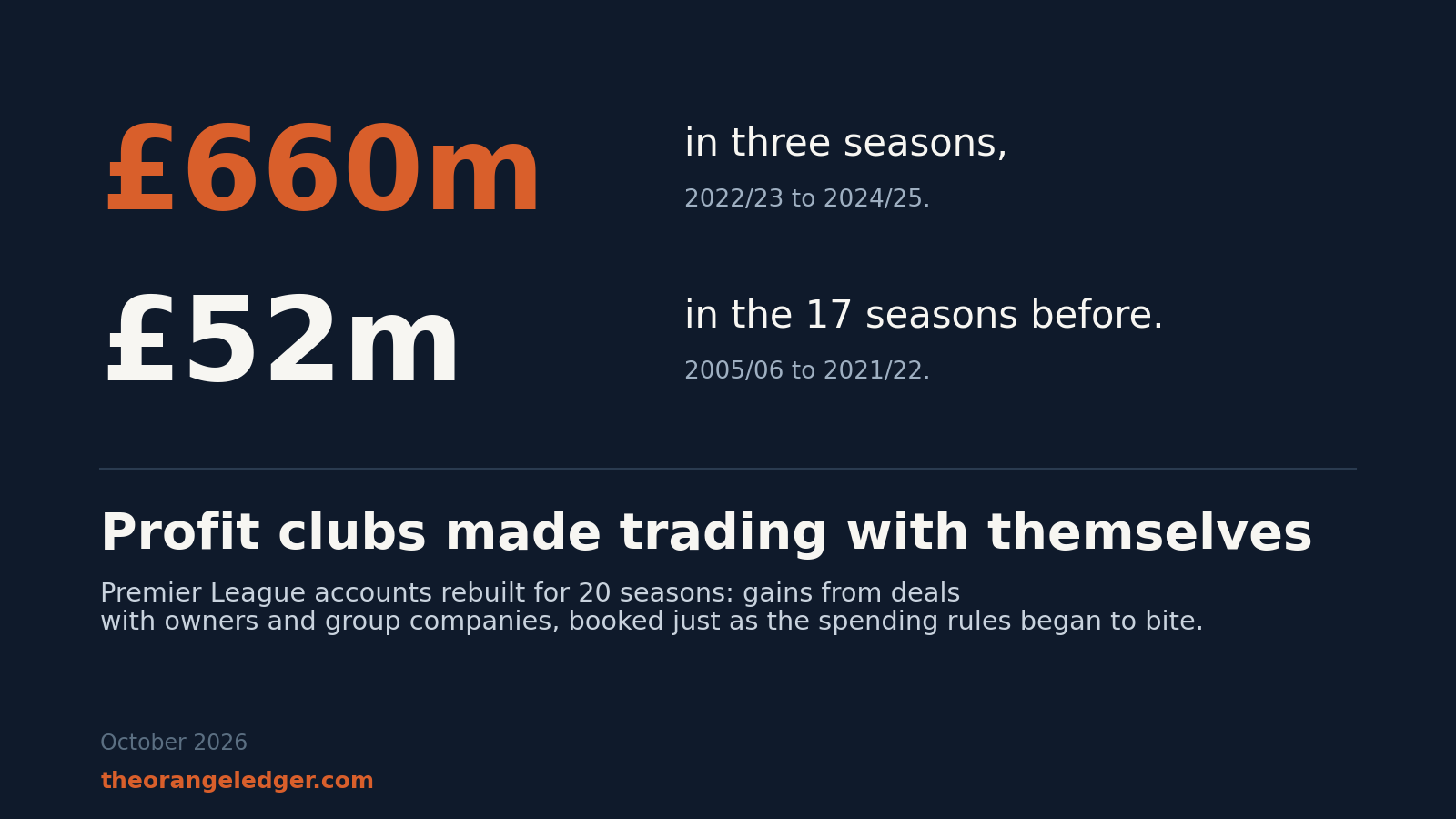 A £17m profit or a £97m loss? The £660m Premier League clubs made by trading with themselvesIn 2024/25 Aston Villa reported a £17m profit. The company above it reported a £97m loss. Both are audited. The Orange Ledger rebuilt 20 seasons of Premier League accounts and found £660m of profit in the last three seasons that came from deals inside the owners' own groups, against £52m in the 17 seasons before, booked just as the spending rules began to bite. The rule-makers have since stopped counting it.Read the piece →
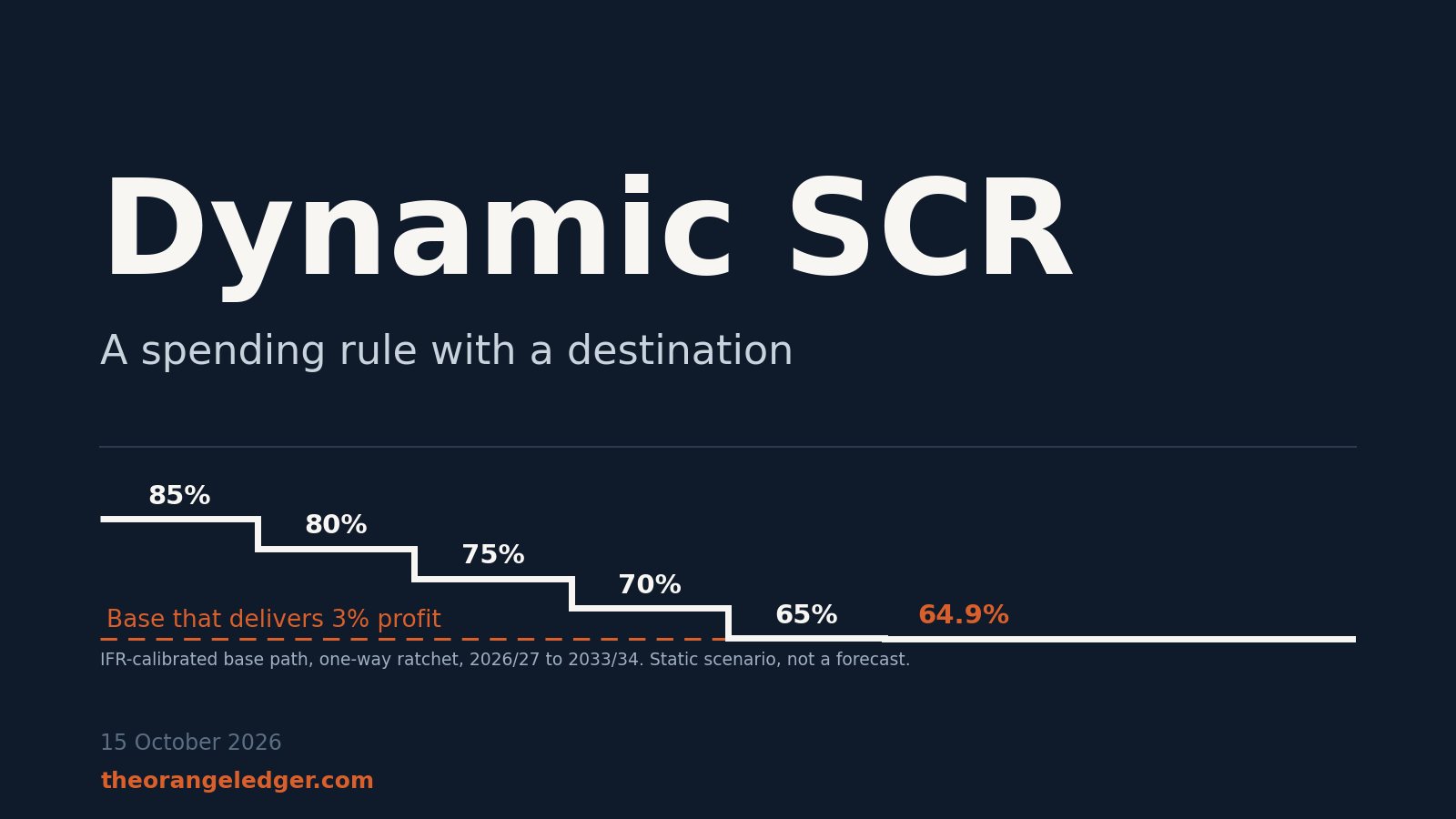 Dynamic SCR: a spending rule with a destinationThe Premier League's clubs earned about £7.5bn in 2025/26 and lost about £880m doing it. Dynamic SCR keeps the squad cost ratio, and gives it a destination: a league-wide profit before tax of 3% of revenue.Read the piece →
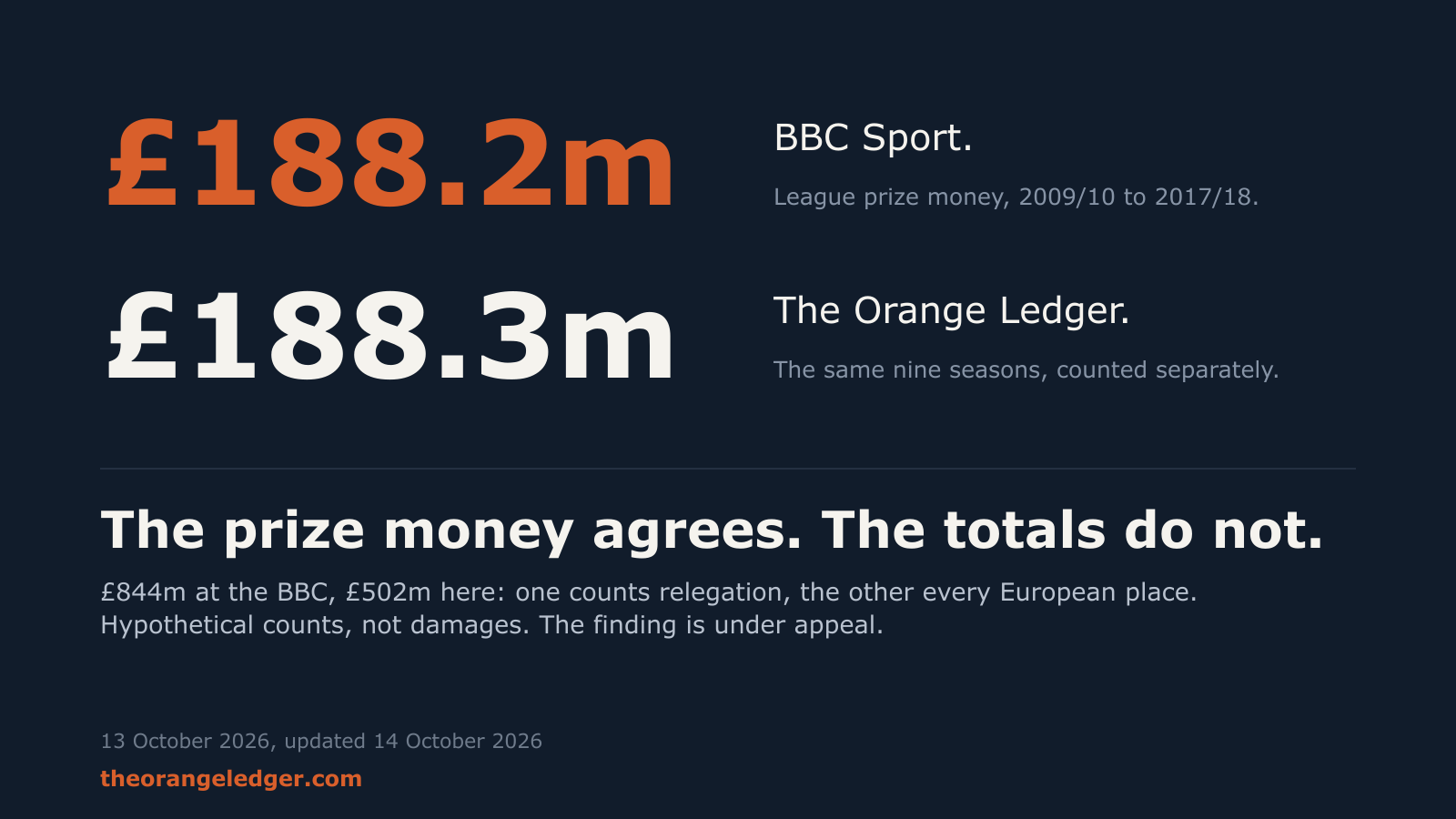 BBC Sport and The Orange Ledger on Manchester City: the prize money agrees to £0.1m, the totals do notBBC Sport counts £844m for the nine seasons of the commission's finding. On the same nine seasons, with no rate applied, we count £501.6m. The League prize money in the two counts agrees to £0.1m in total and club by club. The rest differs because the two counts ask different questions: the BBC includes relegation and cup finals, we follow every European place down the table and leave relegation out.Read the piece →
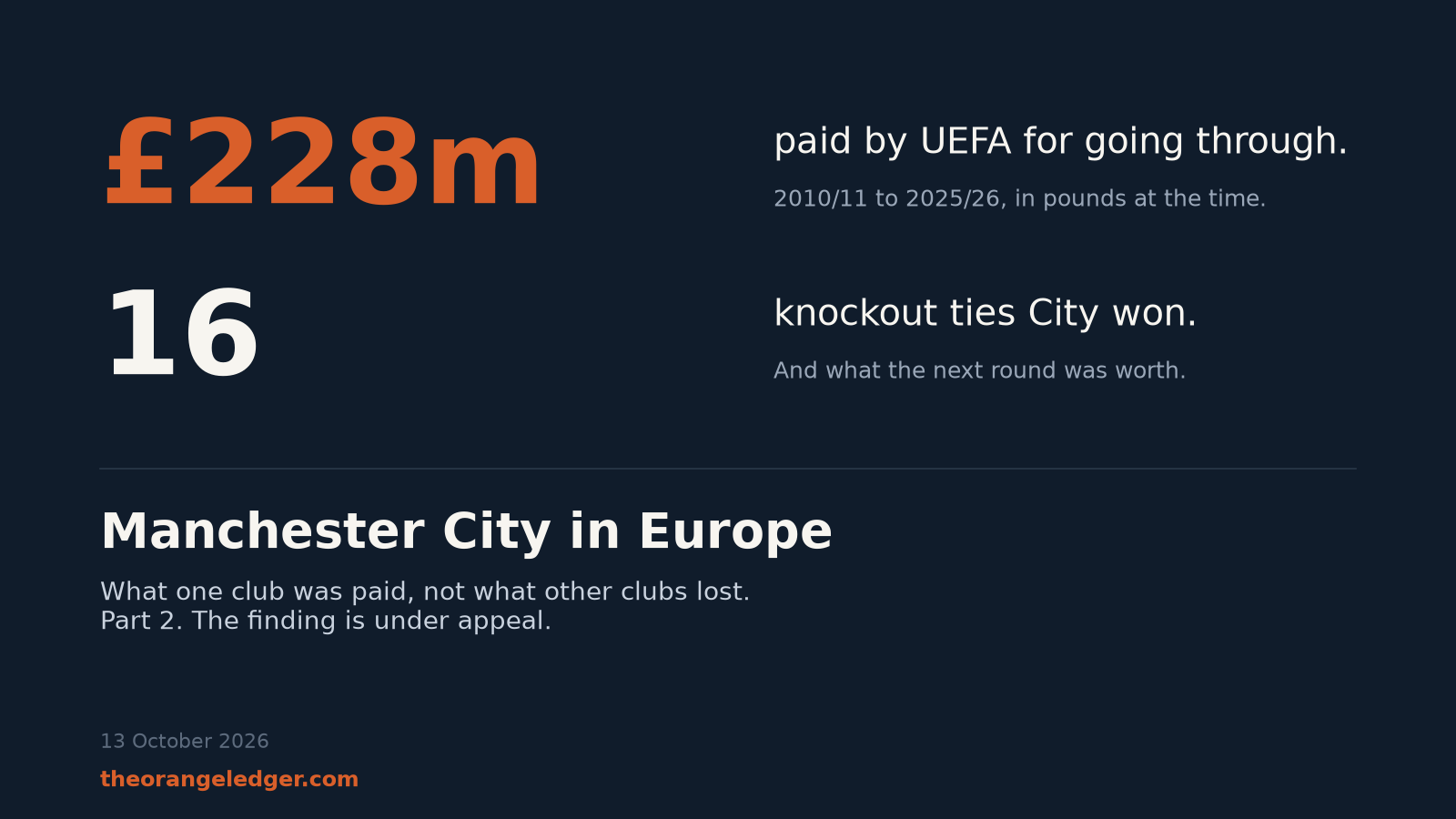 Manchester City in Europe: £227.7m for going through, and the clubs on the other sidePart 2. A count from UEFA's own payments, not a measure of what other clubs lost. UEFA paid Manchester City £227.7m (€264.7m) for going through rounds of its competitions from 2010/11 to 2025/26. What the next round was worth in the sixteen knockout ties City won, why Sevilla twice did better in the Europa League than a Champions League round of 16 would have paid, what followed from the 2023 treble, and why none of it is added to part 1. The commission's finding is under appeal.Read the piece →
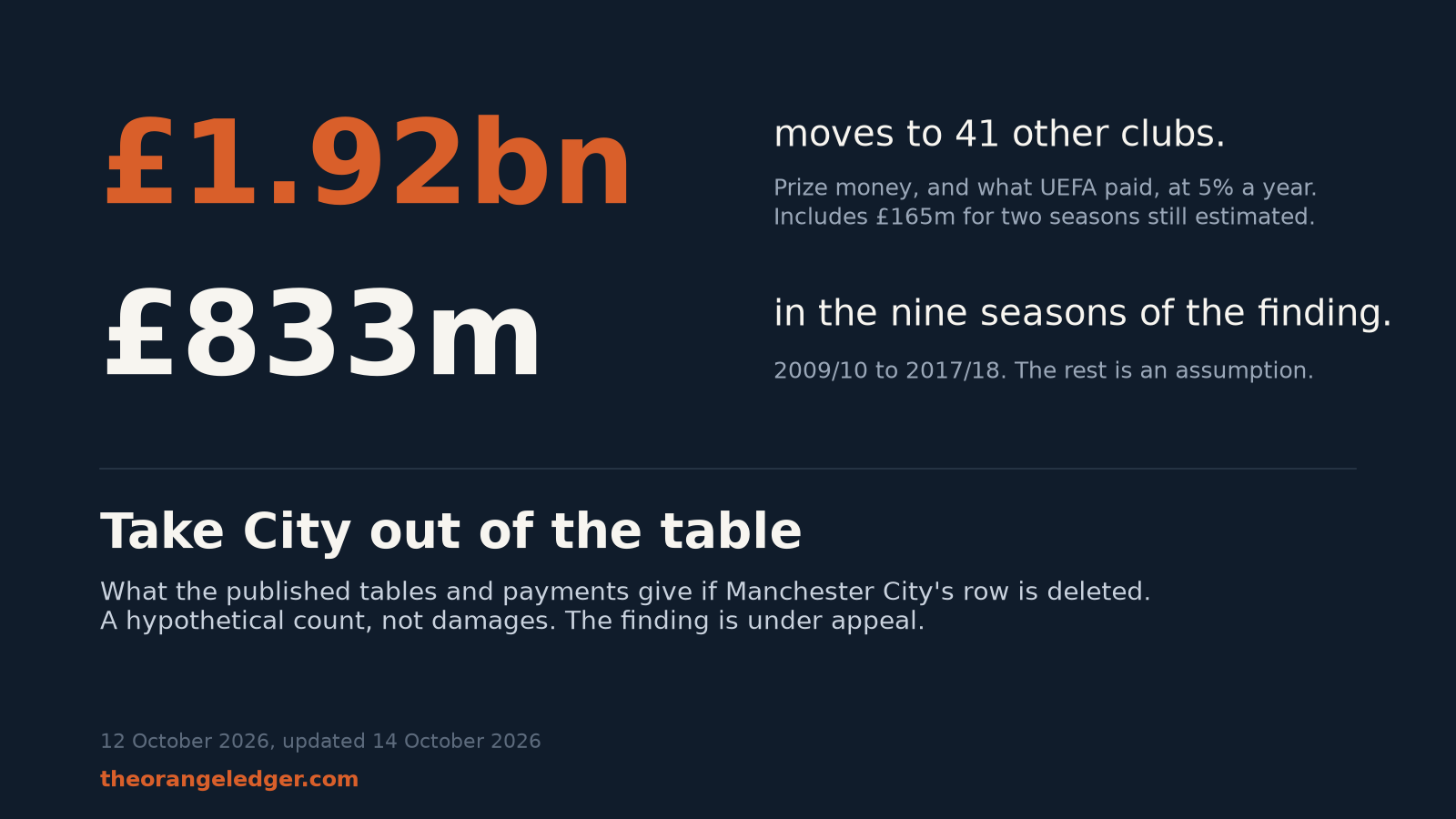 Take Manchester City out of the table, and £1.92 billion moves to the rest of English footballWhat if Manchester City had never been in the table? Take them out of every Premier League season from 2009/10 to 2025/26 and every club below them moves up a place: more prize money and, for some, a place in Europe. Added up across 41 clubs, with the money carried forward to today, it comes to £1.92 billion. It is a what-if count, not a claim for damages.Read the piece →
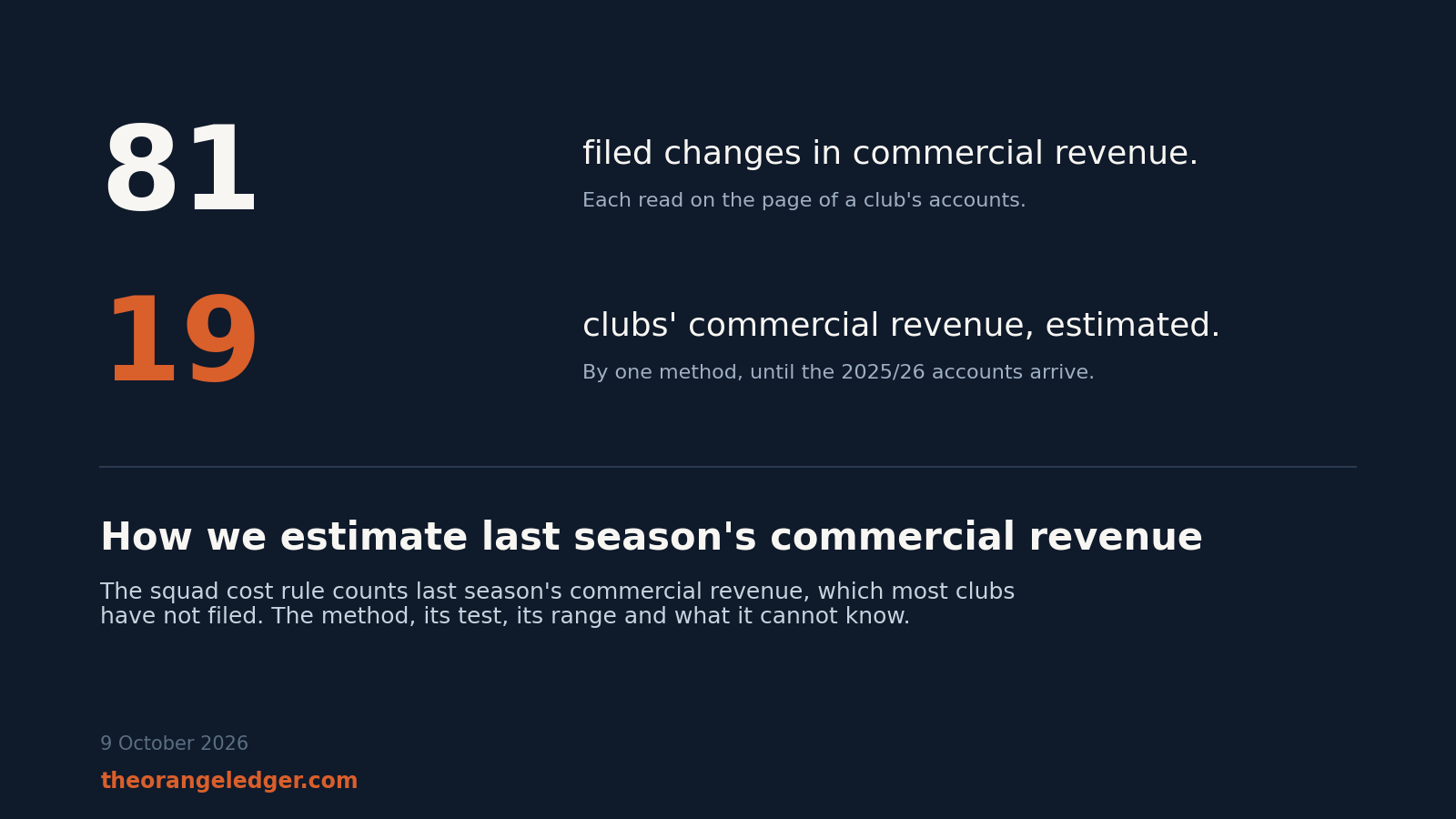 How we estimate last season's commercial revenueThe squad cost rule counts a club's commercial revenue for last season, and nineteen of the twenty clubs have not filed those accounts yet. Until now each of our figures was a judgement. This is the method that replaces it: what it is fitted on, how it was tested against two alternatives, how wide its range is and why, where we overrode our own rule, and what it cannot know.Read the piece →
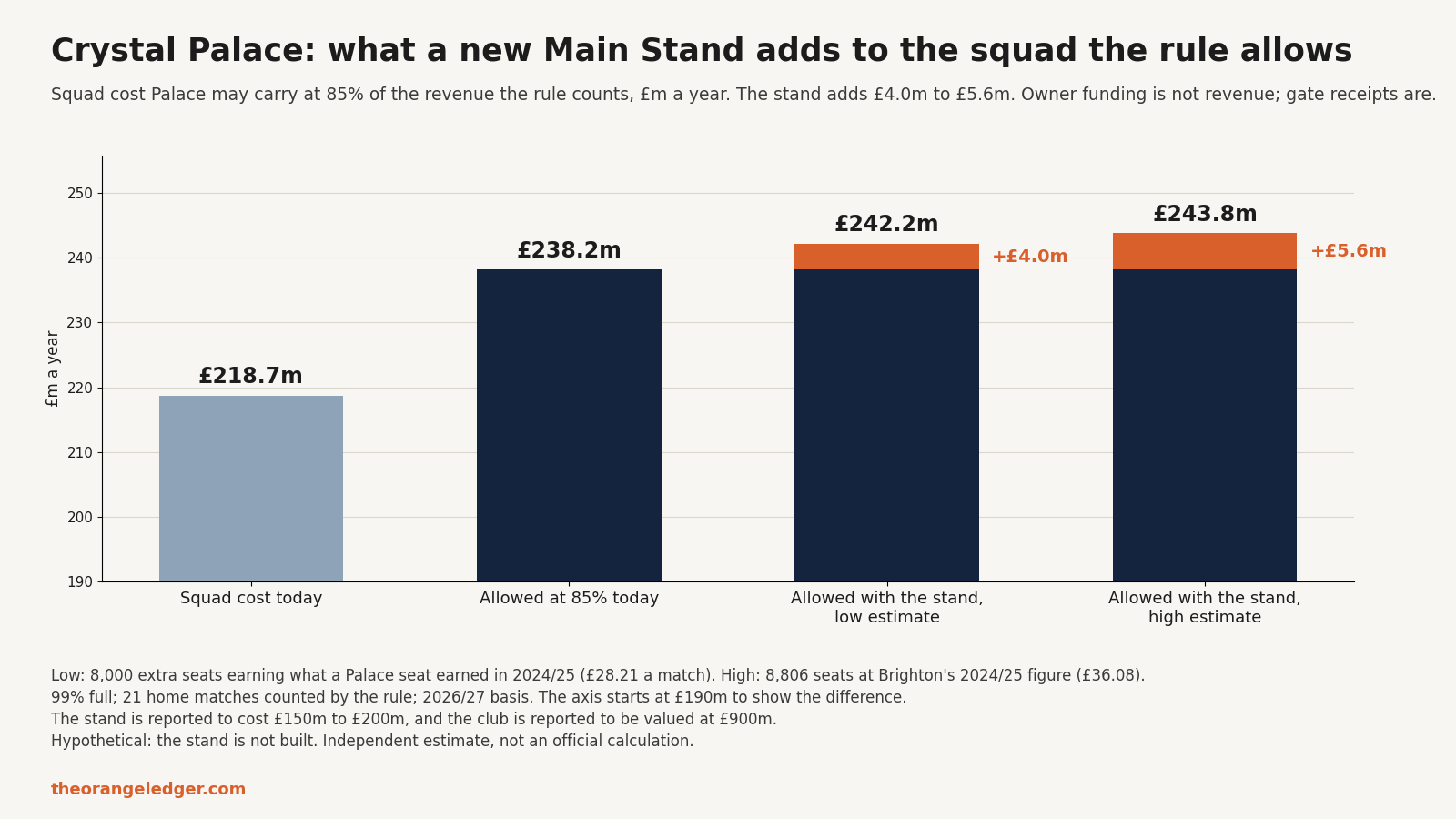 What £900m buys at Crystal Palace under the squad cost ruleCrystal Palace's owners are reported to value the club at £900m. Under the Premier League's squad cost rule a new owner's money cannot be spent on the squad directly. It can be spent on the stadium, and a bigger stadium raises what the squad may cost. We size that for the new Main Stand: a few million pounds a year.Read the piece →
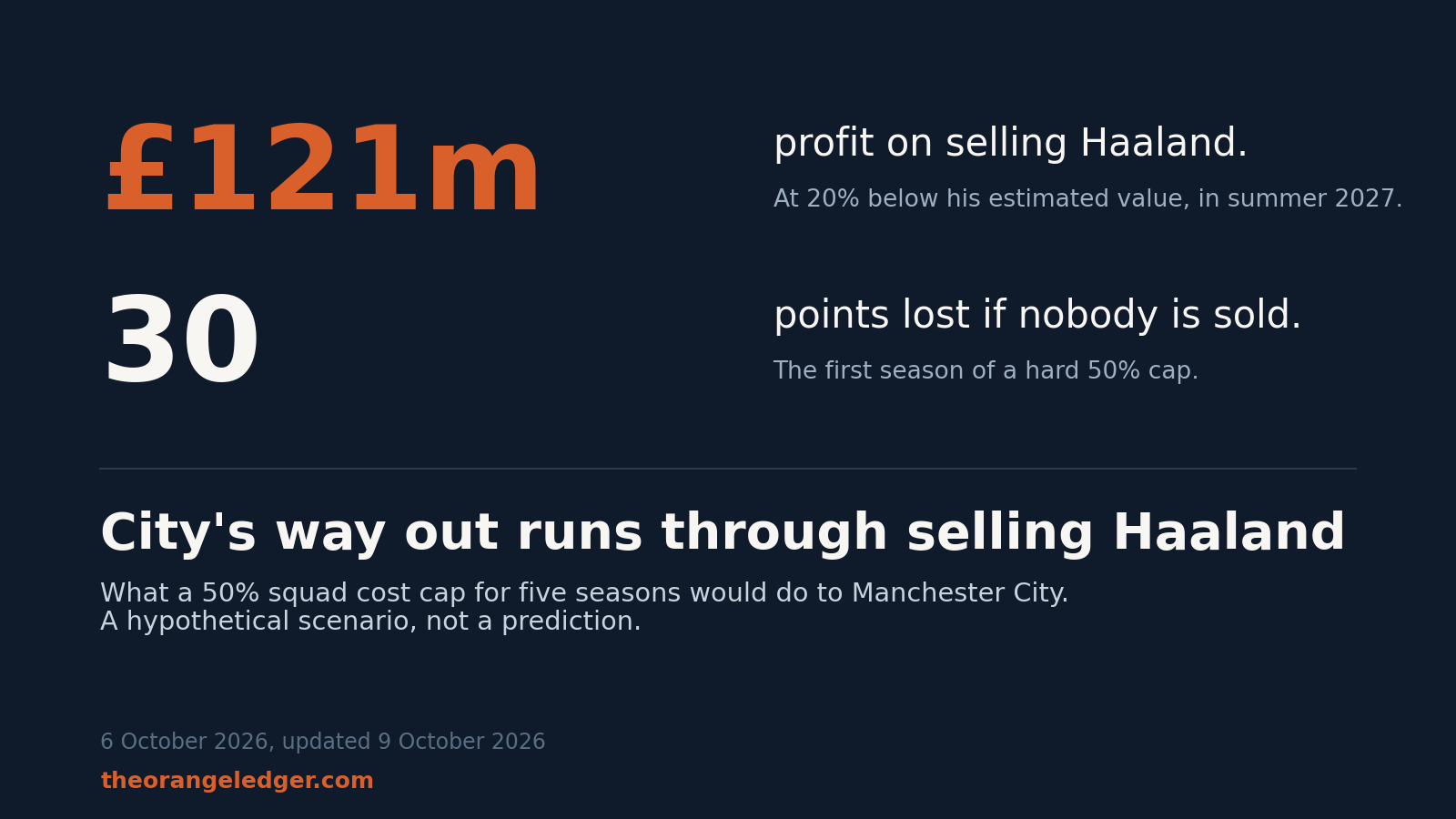 Under a 50% cap, Manchester City's way out runs through selling HaalandA hypothetical scenario, not a prediction. What would happen to Manchester City if the squad cost ratio were capped at 50% for five seasons, as Paul Quinn of theesk has proposed? With nobody sold City loses 30 league points in the first season. In our model the only strategy that keeps every point is selling from the top of the squad, starting with Erling Haaland.Read the piece →
 The history of financial rules in football, Part 6: the drop into the ChampionshipPart 6 of the Orange Ledger's series on football's financial rules, and the second part in the author's own voice. Clubs relegated from the Premier League in the last four years lost 42% of their revenue on average, falling from about £137m to £79m, and still ended up with almost three times as much as a Championship club without a parachute. Leicester City, Burnley and Sheffield Wednesday show what happens at the edge, and what could be done instead.Read the piece →
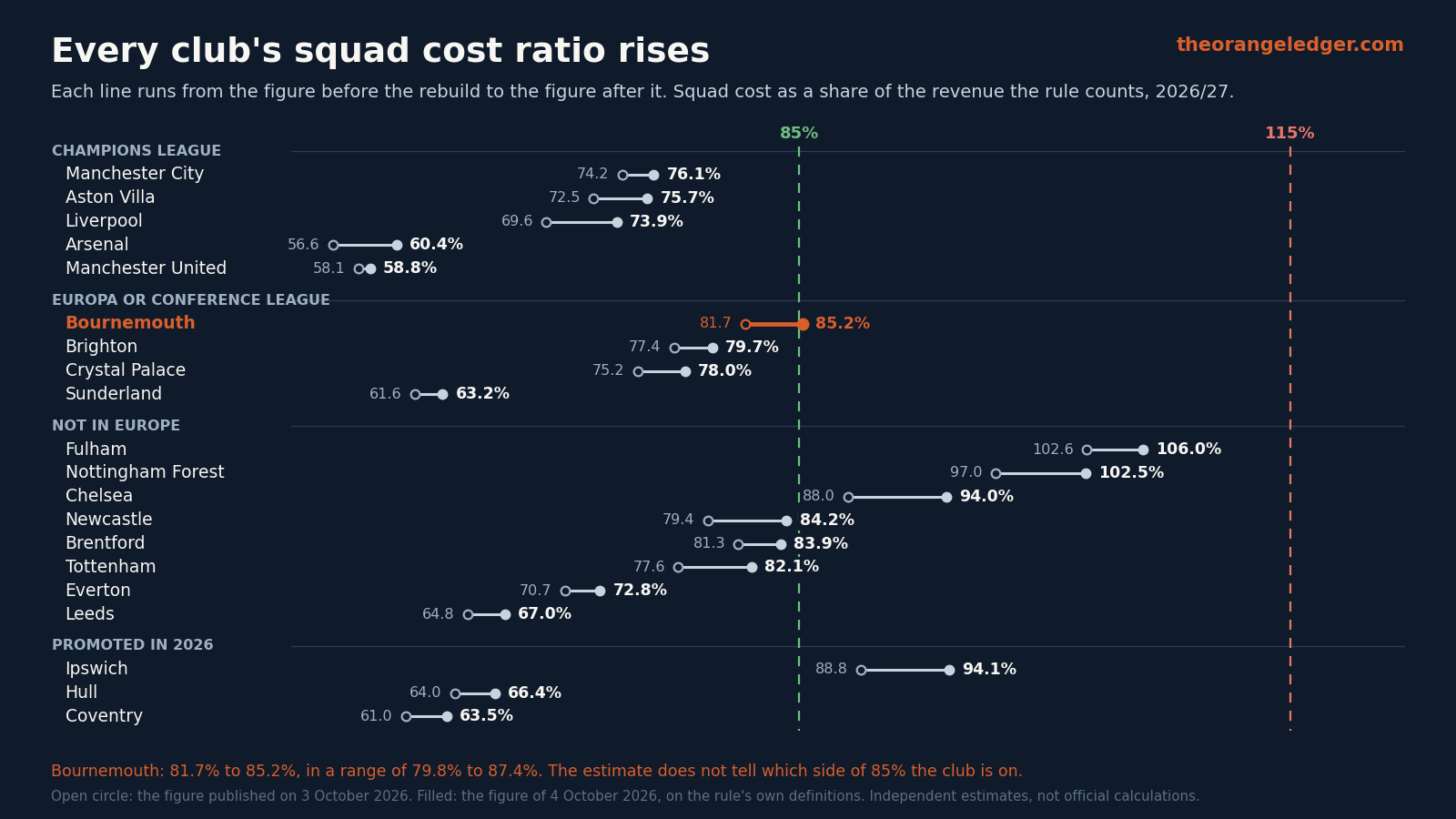 Every club, rebuilt on the rule's own definitionsWe have rebuilt all 20 squad cost ratios on the definitions in the Premier League's rule itself. Every ratio rises, Bournemouth now sit on the 85% line, and three clubs' squads cost more than 115% of what the rule counts before player trading.Read the piece →
 Three definitions in the squad cost rule, and what they changeThe squad cost rule defines the cost of a player's registration, gate receipts and commercial revenue in its own terms. We had followed the clubs' accounts. This sets out what the rule says in each case, what we now count, how we estimate what the accounts do not give, a fourth correction to cup prize money, and what it does to every club's figure.Read the piece →
 The history of financial rules in football, Part 5: a better rule for the Premier LeaguePart 5 of the Orange Ledger's series on football's financial rules, and a signed opinion piece. The Premier League's clubs lost almost £1bn before tax in 2024/25, and clubs well inside the new 85% squad cost limit are still cutting jobs. My proposal: bring the limit down to 60% over five years, give promoted clubs extra room, squeeze the clubs that stay at the top, the way Formula 1 gives its strongest teams the least development time, and build a real-time financial monitoring system around it.Read the piece →
 How we estimate matchday revenueThe squad cost rule counts last season's gate receipts per home match, times this season's home matches. Most clubs have not yet filed last season's accounts, so the receipts are an estimate. This is how the Orange Ledger counts the matches and estimates the money, what we got wrong before October 2026, and how far the estimate could be out.Read the piece →
 The history of financial rules in football, Part 4: the anchor that was voted downPart 4 of the Orange Ledger's series on football's financial rules. When the Premier League's clubs voted in the squad cost ratio in November 2025, they also voted on a cap that would have tied the richest clubs' spending to the income of the club finishing bottom. Sixteen clubs had voted to explore it; only seven voted to adopt it. This is what anchoring was, what it would have changed for the biggest clubs, why support fell away, and the question it leaves behind.Read the piece →
 The history of financial rules in football, Part 3: the new system, SCR and SSR from 2026/27Part 3 of the Orange Ledger's series on football's financial rules. From 2026/27 the Premier League has split the two questions PSR tried to answer with one number. The Squad Cost Ratio asks whether a club's squad is affordable against its revenue; the Sustainability and Systemic Resilience rules ask whether the club can survive a shock. This is how both work, what they count, and what they still cannot see.Read the piece →
 The history of financial rules in football, Part 2: the Premier League's own rules, PSR 2013 to 2026Part 2 of the Orange Ledger's series on football's financial rules. In 2013 the Premier League wrote its own version of UEFA's rules: a limit of £105m of losses over three seasons. This is how the Profitability and Sustainability Rules worked, how clubs learned to manage them, the points deductions that followed, the legal fight over deals with owner-linked companies, and why the League replaced them from 2026/27.Read the piece →
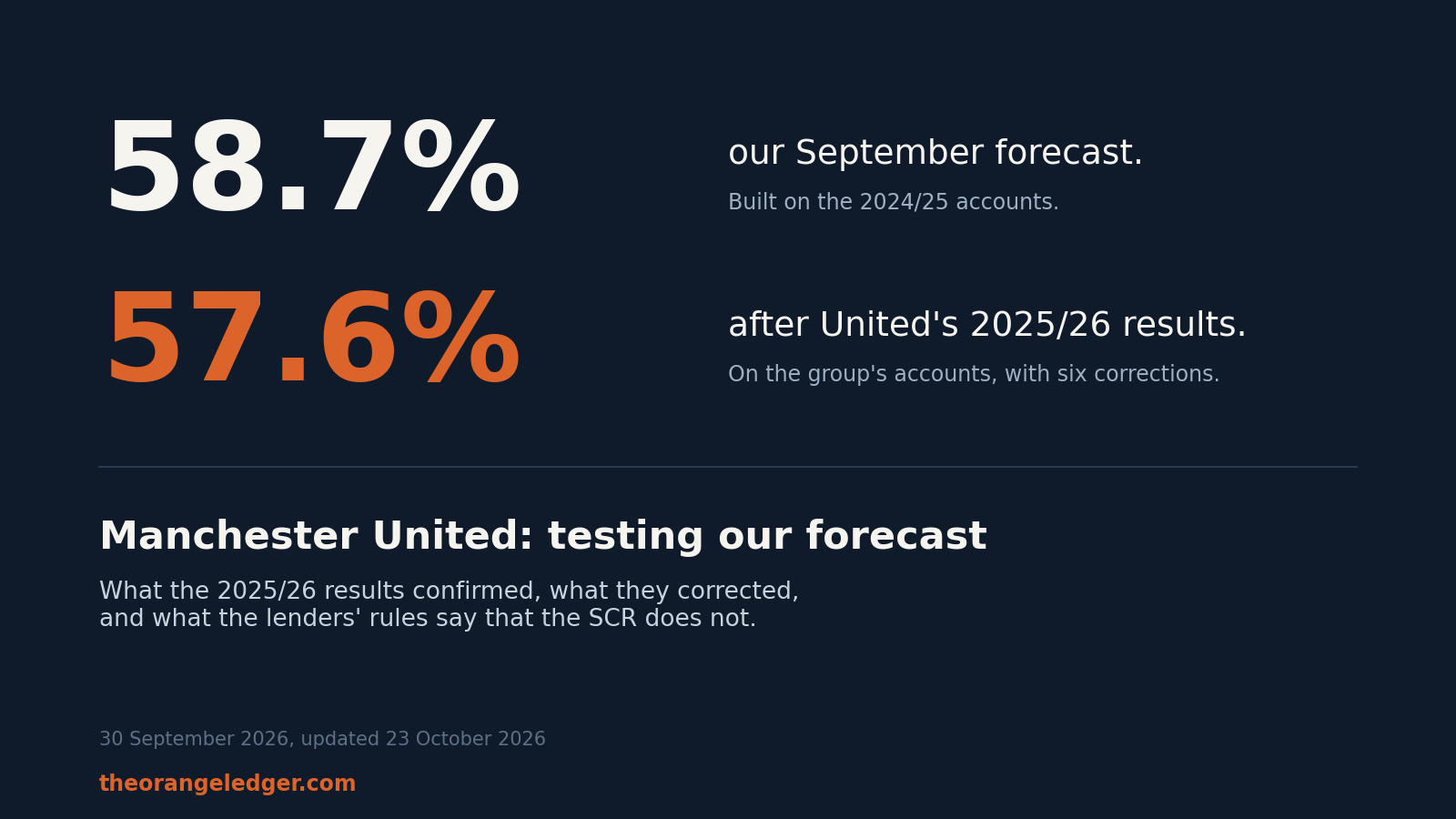 Testing our Manchester United forecast, on the group's accountsIn September the Orange Ledger estimated Manchester United's squad cost ratio (SCR) for the 1 March 2027 test at 58.7%. United's 2025/26 results, audited in the plc's annual report, let us test that forecast against real numbers. The updated estimate is 59.0%, with a range of 56.1% to 61.5%, built on the group's accounts. The results confirmed the revenue estimates, showed a book value of registrations above the September projection, gave a higher estimate of player wages, and led us to correct how loan wages are counted, a correction now worth 0.4 points downward, which is set out here in full. The SCR is comfortable. The rules United's lenders impose are not.Read the piece →
 The history of financial rules in football, Part 1: the Bosman era to UEFA's Financial Fair PlayPart 1 of the Orange Ledger's series on football's financial rules. Before the Premier League's new squad cost ratio, before PSR, there was a simpler problem: clubs across Europe were spending money they did not have, and players and staff were going unpaid. This is how UEFA's Financial Fair Play began, how it worked, how it was tested against Manchester City and Paris Saint-Germain, and why it was rebuilt in 2022 around a cap on squad costs.Read the piece →
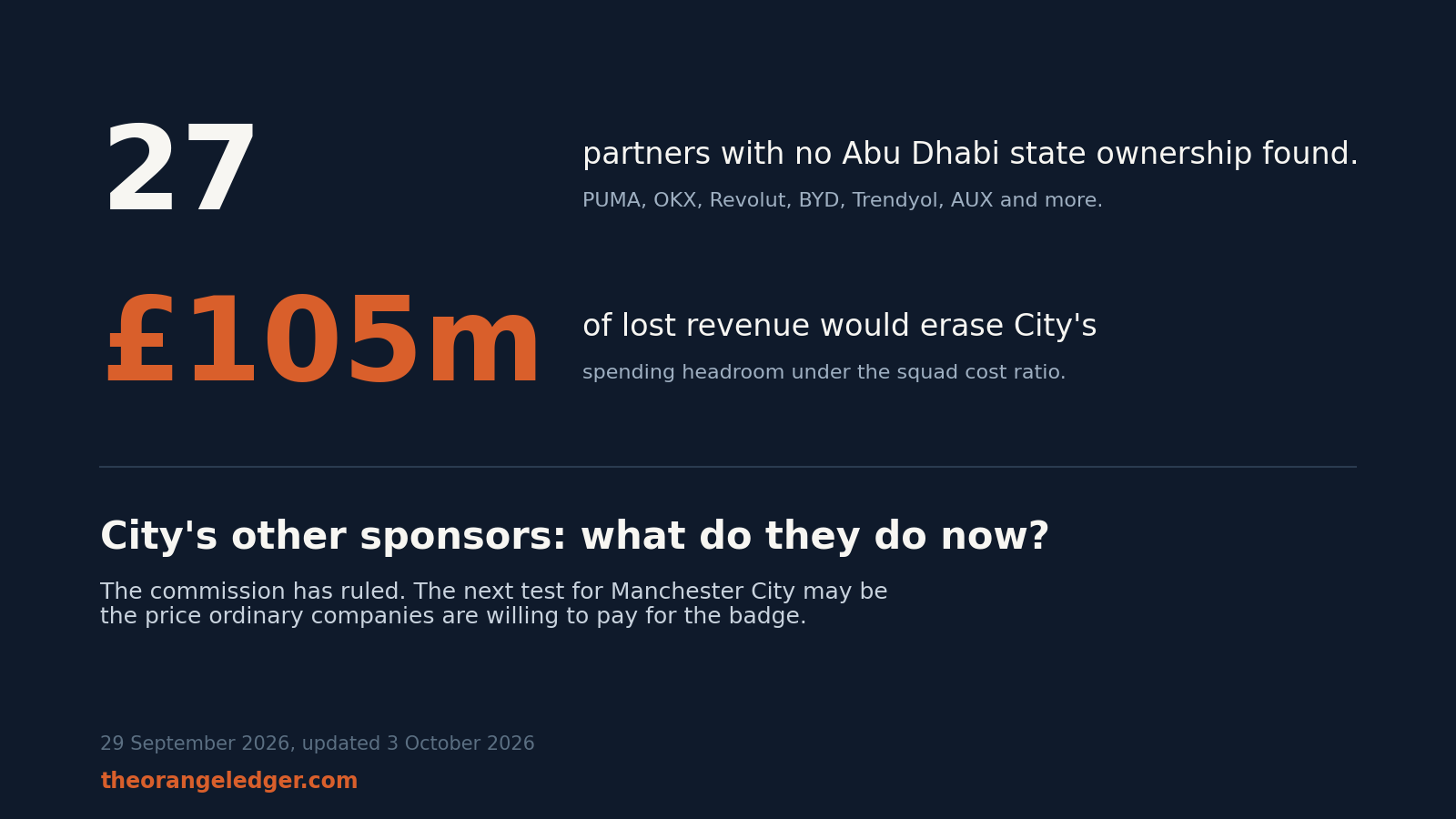 City has 27 sponsors with no Abu Dhabi state ownership identified. What do they do now?The independent commission has ruled on Manchester City's past. The next test is commercial: whether the companies that pay City for reasons of their own still want to pay the same price. Most of City's 34 global partners have no Abu Dhabi state ownership identified, and several signed while the case was pending. The Orange Engine shows what lost sponsorship would do to City's spending room, alone and combined with a sanction.Read the piece →
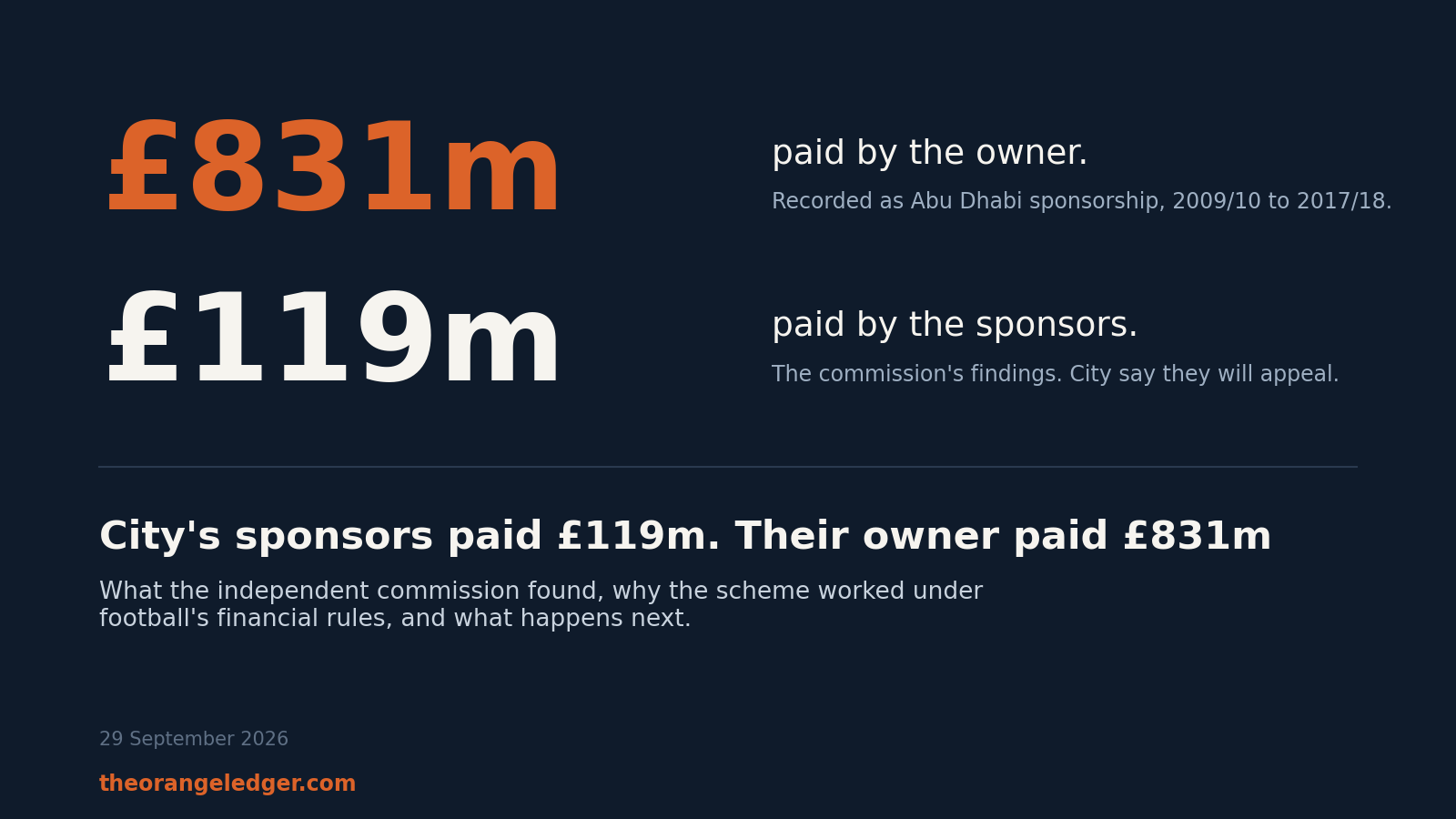 City's sponsors paid £119m. Their owner paid £831mThe independent commission has found every charge against Manchester City proven except one. Its findings cover nine seasons of misstated accounts from 2009/10 to 2017/18, breaches of UEFA and Premier League financial rules, and later failures to cooperate with the League's investigation. At the centre is what it calls a Disguised Funding Scheme: sponsorship deals with Abu Dhabi companies, recorded well above their value, with the club's owner secretly paying most of the fee. This is what the 40-page decision says, why the scheme worked under football's rules, and what happens next. City dispute the findings and have appealed.Read the piece →
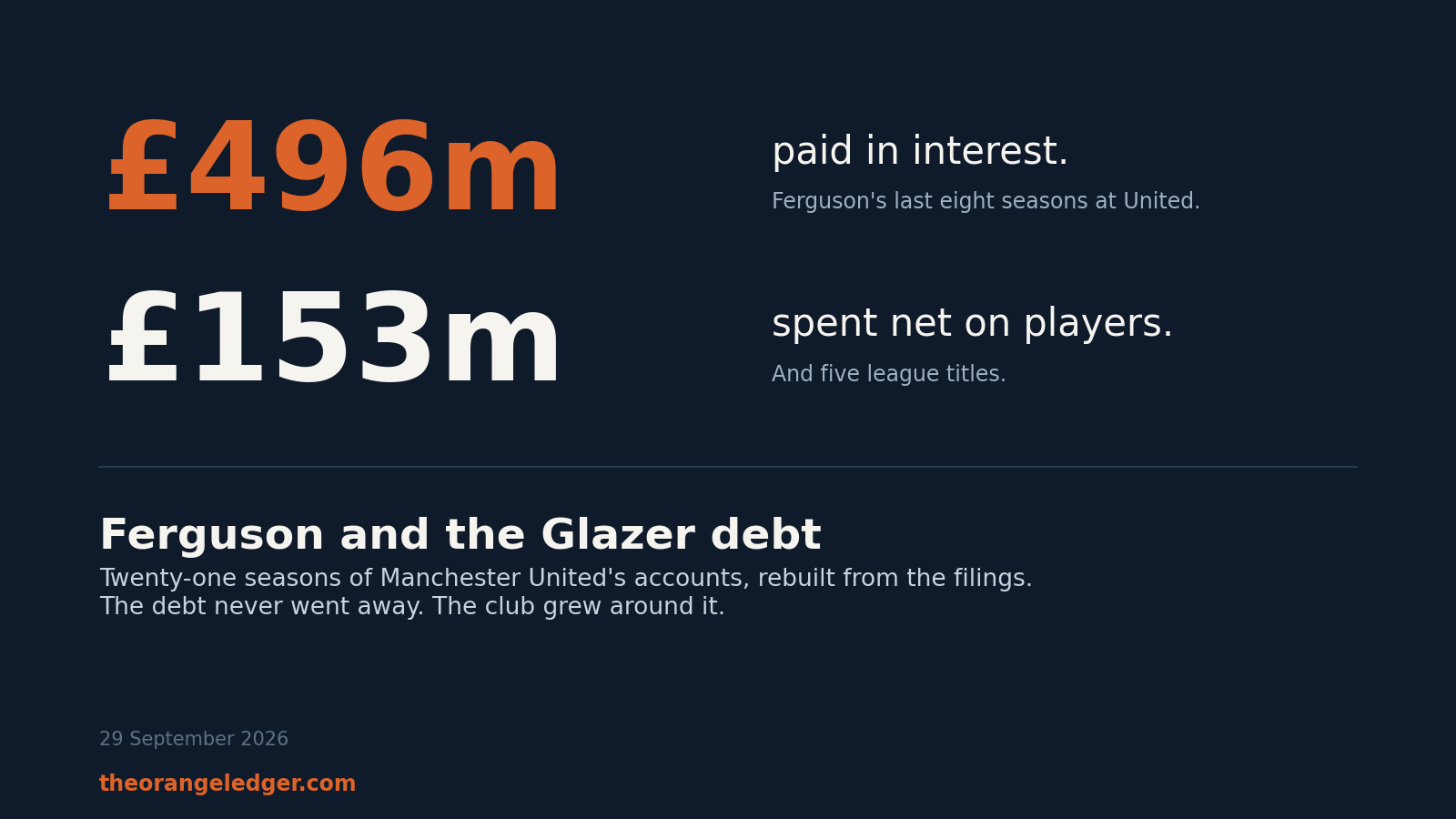 Under Ferguson, Manchester United paid more in interest than they spent on playersTwenty-one seasons of Manchester United's accounts, from the Glazer takeover in 2005 to this summer, rebuilt from the filings. In Sir Alex Ferguson's last eight seasons the club paid £496m of interest and spent £153m net on players, and won five titles. After he left, the pattern reversed: £348m of interest, £1.68bn net on players, and no title. Now the borrowing is climbing again, to its highest level since 2010, and the Premier League's new spending rule cannot see any of it.Read the piece →
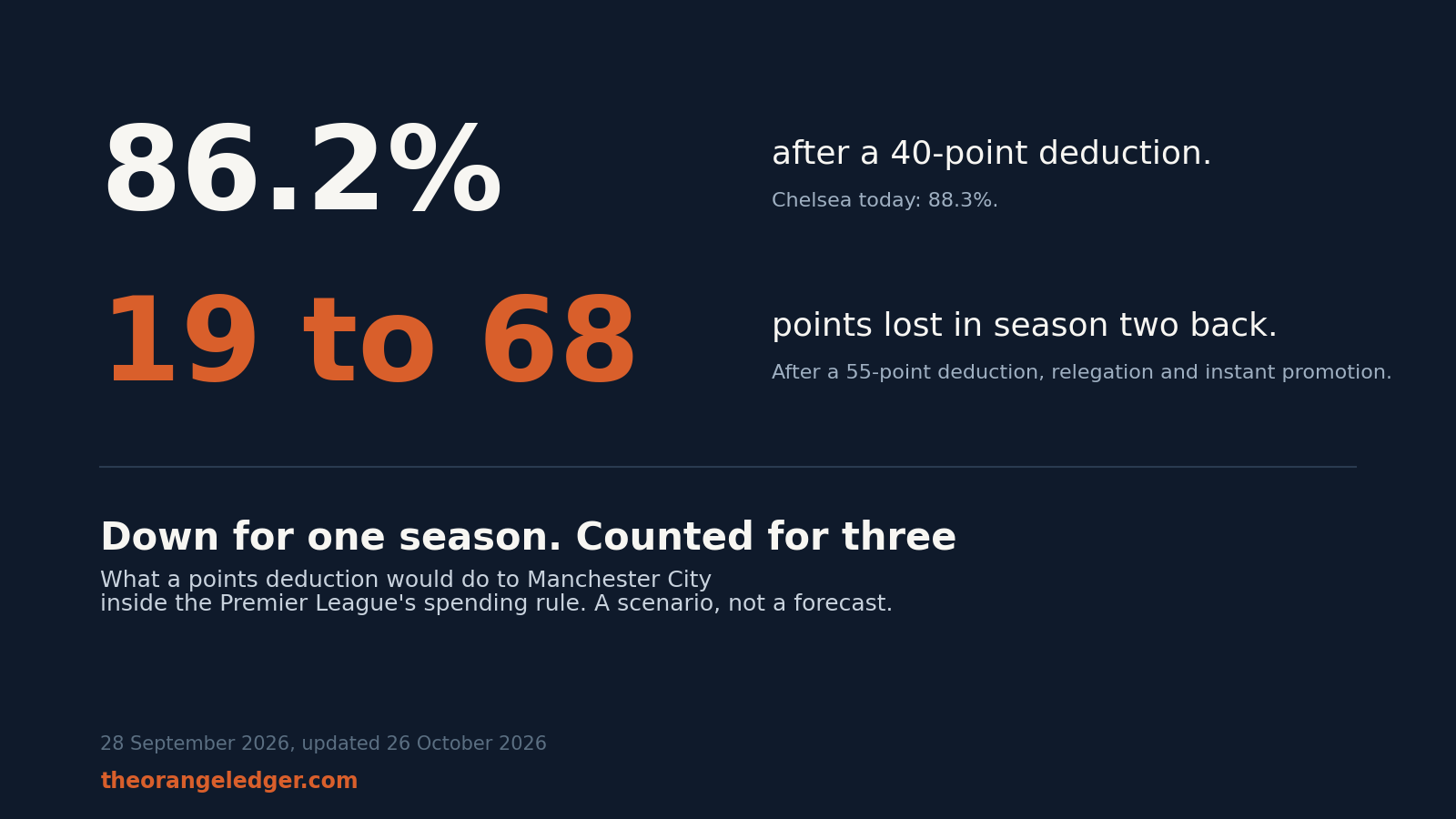 A 40-point deduction would turn Manchester City into Chelsea. Fifty-five would follow them back upA scenario, not a forecast. An independent commission has found Manchester City guilty of the Premier League's charges; City have appealed, and no sanction has been set. If a points deduction did follow, the Premier League's spending rule would feel it a year late and remember it for three. A 40-point deduction would take City back over the spending line and leave them, like Chelsea now, relying on player sales. A 55-point deduction would send them down, and even if they came straight back, the rule would still be taking points from them in their second season back.Read the piece →
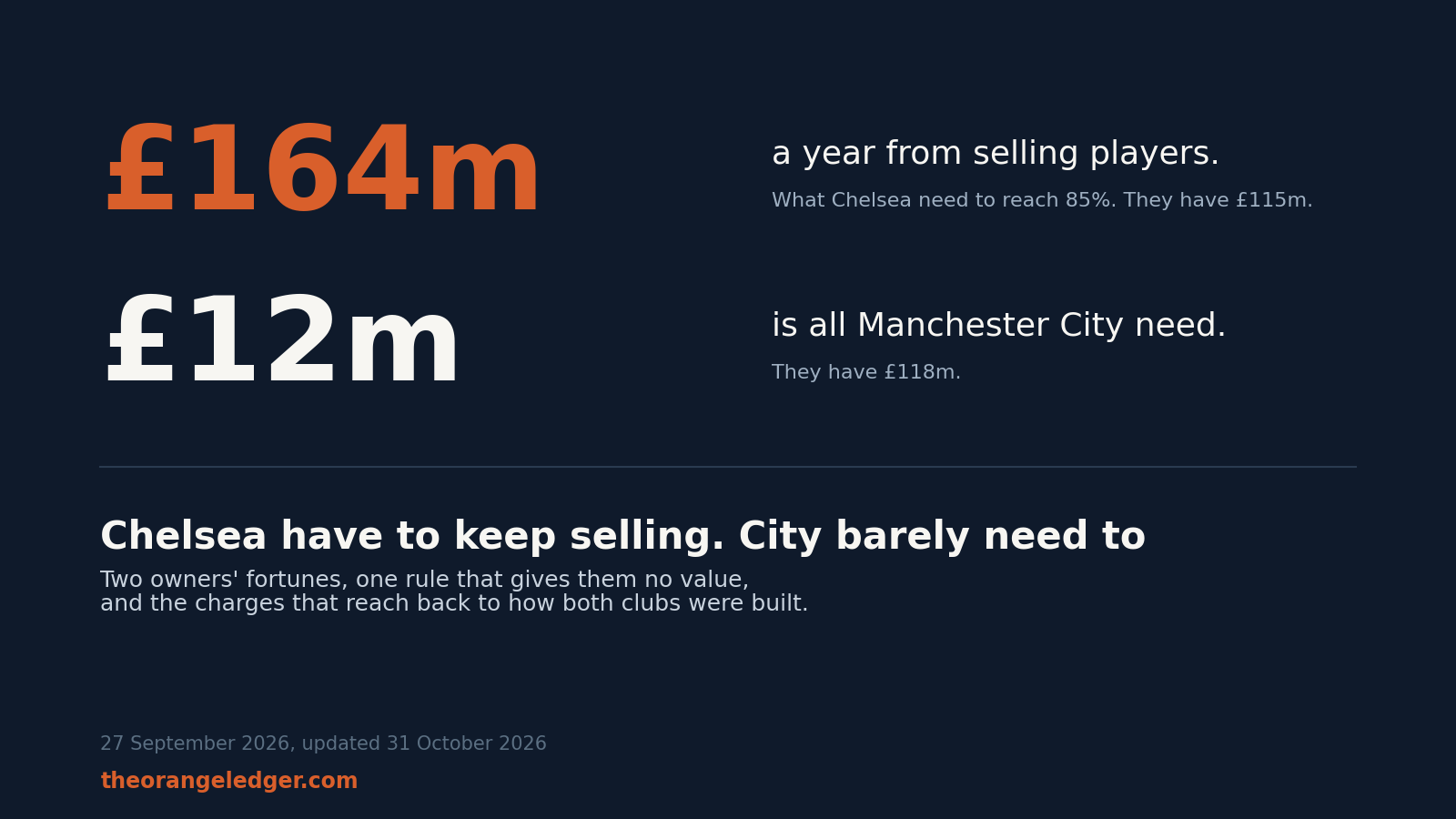 Chelsea have to keep selling players. Manchester City barely need toManchester City have been found guilty of the Premier League's financial charges and have appealed. Chelsea reported their former owner's undisclosed payments themselves, admitted them and paid. Both clubs were built on an owner's fortune, and both now play under a Premier League spending rule that gives the money those owners put in no value at all. What counts is what a club earns and what it makes selling players. Both clubs sold heavily this summer. On our central figure Manchester City are on the limit before any of those sales are counted, 1.4 percentage points over it, a margin too small to tell reliably which side they are on. Chelsea need all of theirs, and more.Read the piece →
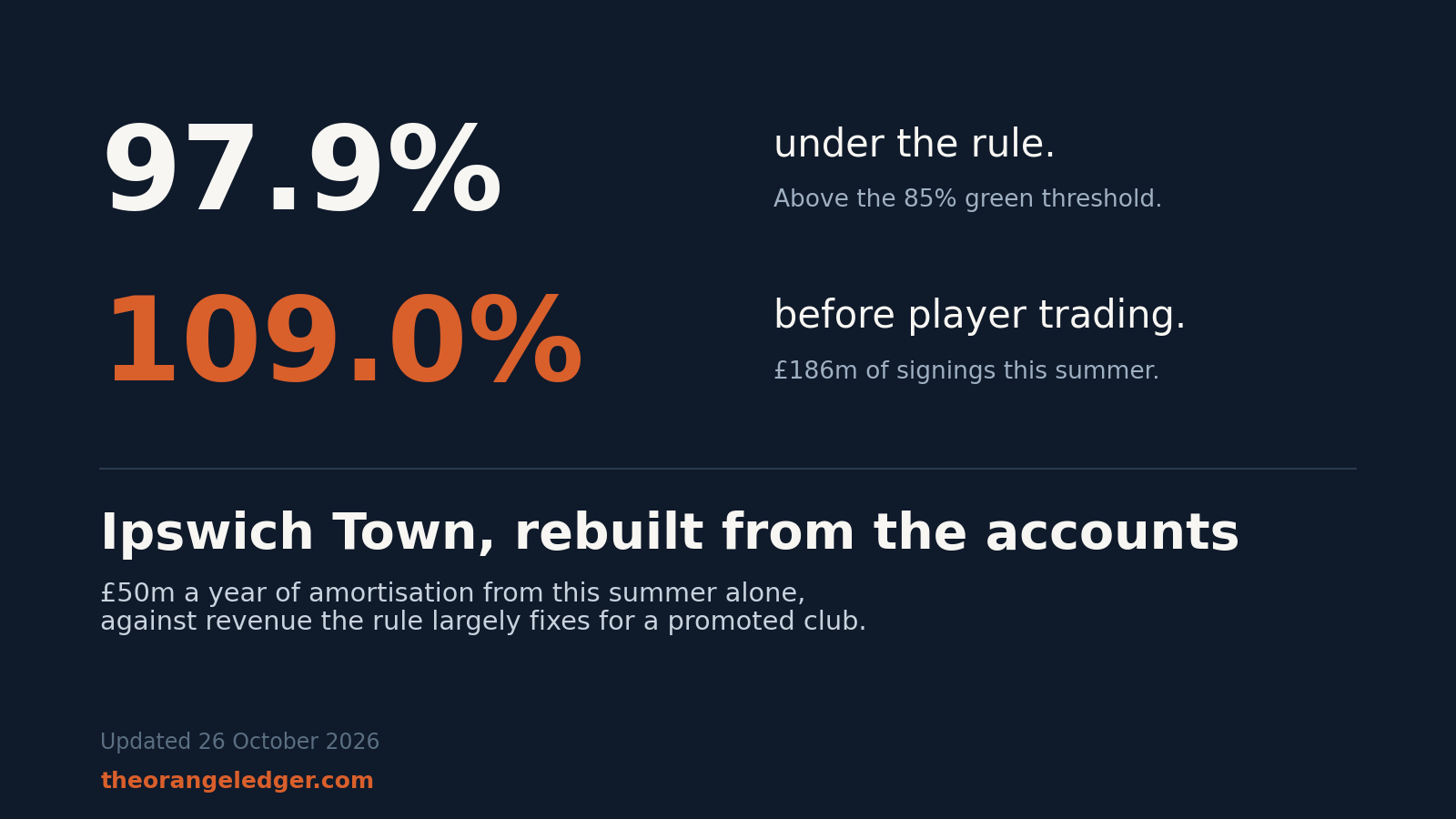 Ipswich Town's squad cost ratio: £186m of signings and the first three-year commercial averageIpswich Town's squad cost ratio for the 1 March 2027 test comes out at 97.9%, above the 85% green threshold by roughly £23.3m. Measured before profit on player sales it is 109.0%. Ipswich are an Appendix 2 Promoted Club with a Premier League season inside the last three years, so the rule credits their commercial income at the three-year average rather than last season's figure. Reconstructed from Ipswich Town Football Club Company Ltd's accounts and Appendix 2 of the Premier League Handbook.Read the piece →
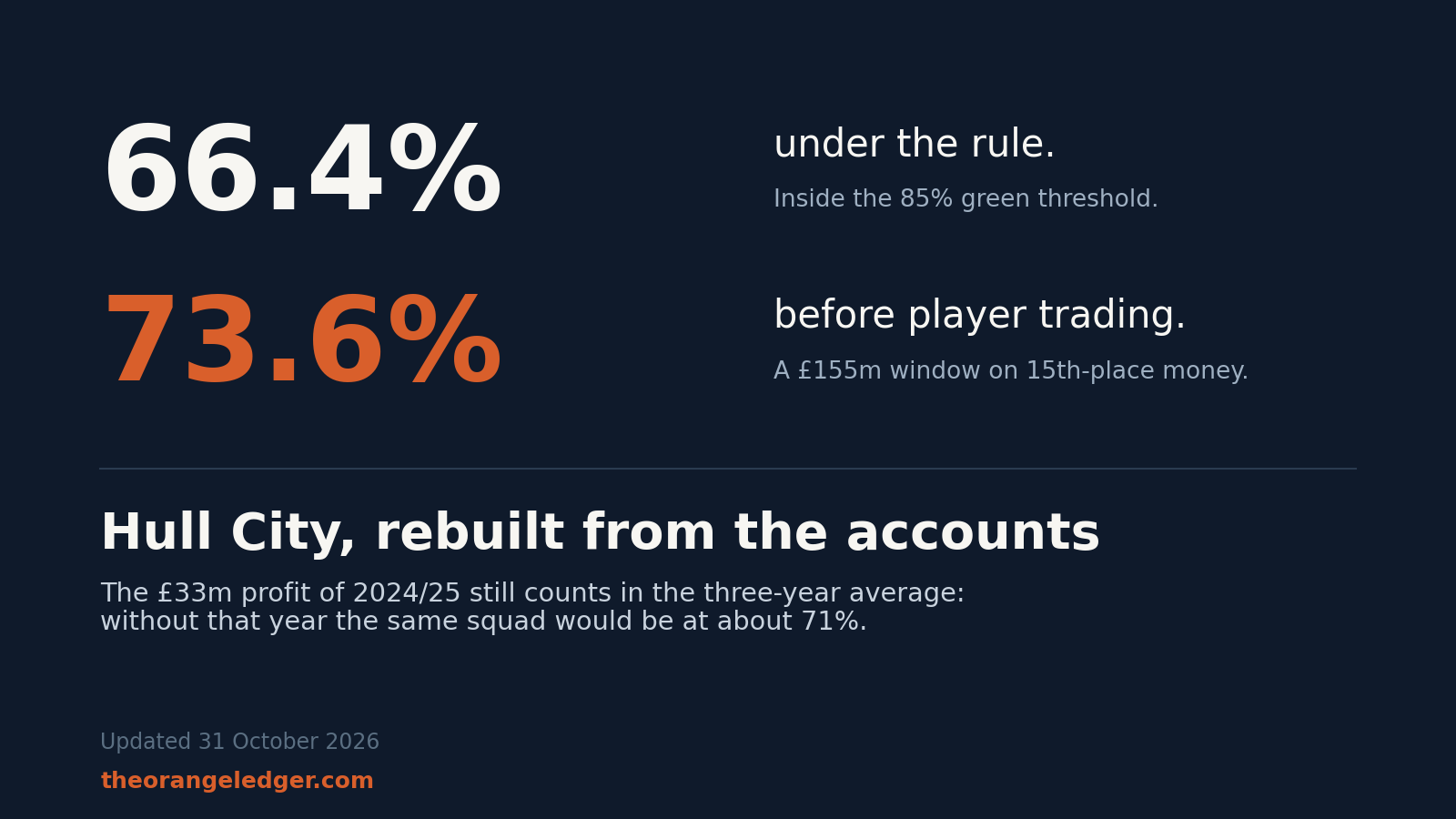 Hull City's squad cost ratio: £155m of signings on 15th-place moneyHull City's squad cost ratio for the 1 March 2027 test comes out at about 66.4%, inside the 85% green threshold with roughly £32m of annual headroom. Measured before profit on player sales it is 73.6%. Hull are a promoted club under the rule, so the rule counts their central money at 15th place, puts a £15m floor under commercial income and lifts last season's Championship gate by a quarter. Reconstructed from Hull City Tigers Ltd's accounts and Appendix 2 of the Premier League Handbook.Read the piece →
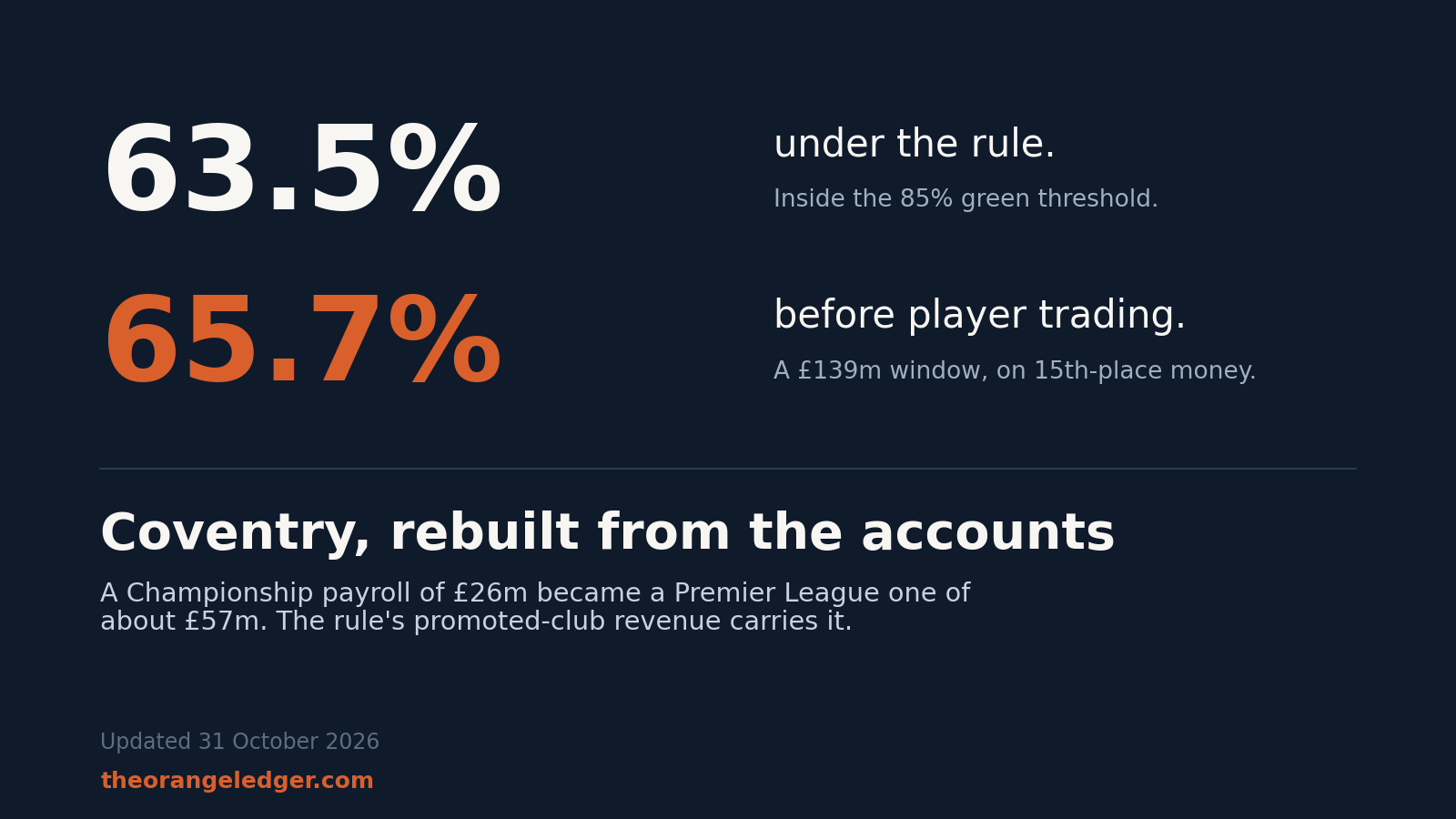 Coventry's squad cost ratio: a summer of buying on 15th-place moneyCoventry City's squad cost ratio for the 1 March 2027 test comes out at 63.5%, inside the 85% green threshold with roughly £37m of annual headroom. Measured before profit on player sales it is 65.7%. Coventry are the first Promoted Club in this series: the rule counts their central money at 15th place, puts a £15m floor under commercial income and lifts last season's Championship gate by a quarter. Reconstructed from Coventry City Football Club Ltd's accounts and Appendix 2 of the Premier League Handbook.Read the piece →
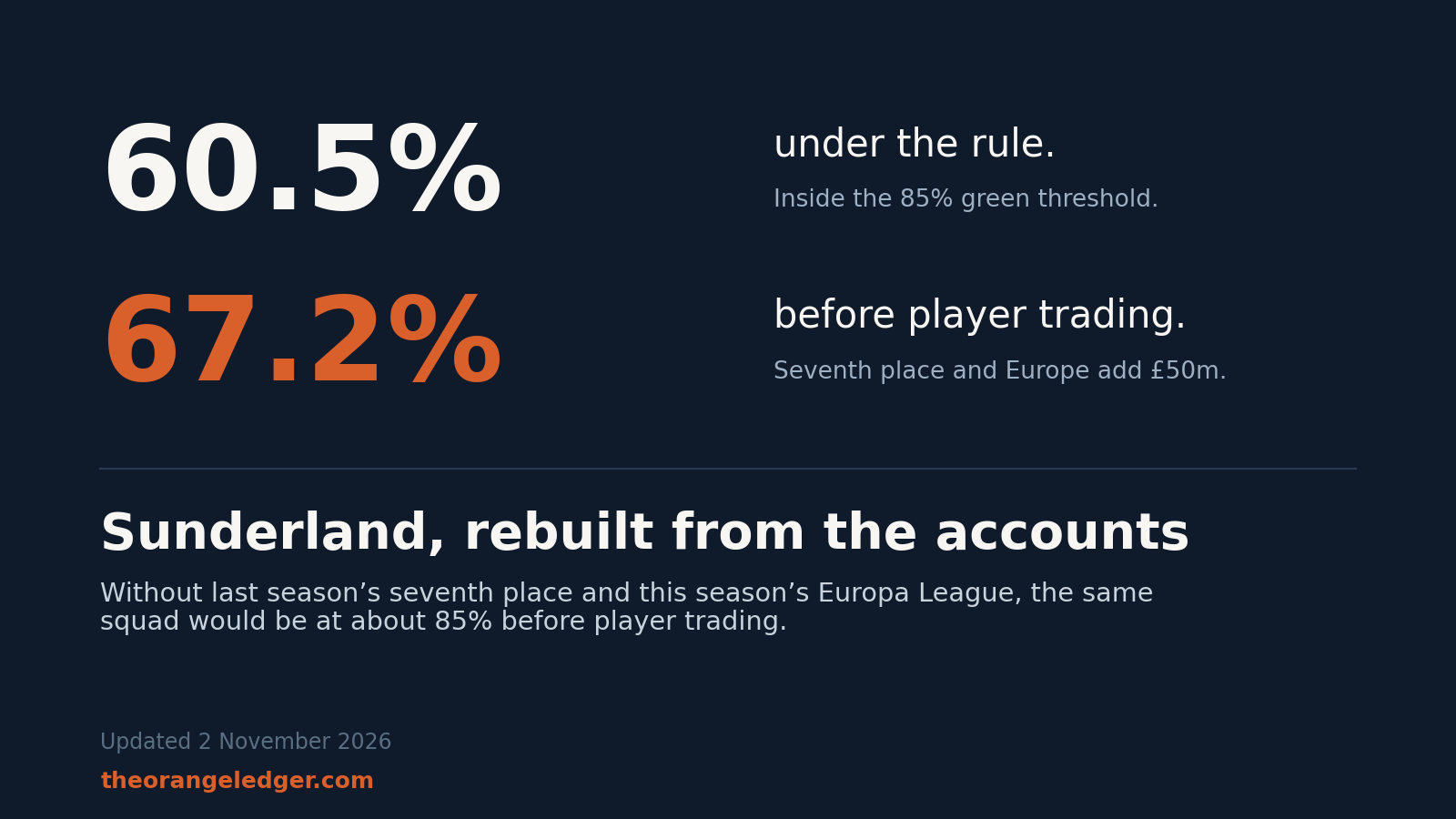 Sunderland's squad cost ratio: seventh place does the heavy liftingSunderland's squad cost ratio for the 1 March 2027 test comes out at 60.5%, inside the 85% green threshold with roughly £65m of annual headroom. Measured before profit on player sales it is 67.2%. The last filed accounts are from a Championship season, so the wage bill is estimated player by player, and £50m of the revenue counted is merit earned by last season's seventh place and the amounts the rule sets for this season's Europa League. Reconstructed from The Sunderland Association Football Club Ltd's accounts and Appendix 2 of the Premier League Handbook.Read the piece →
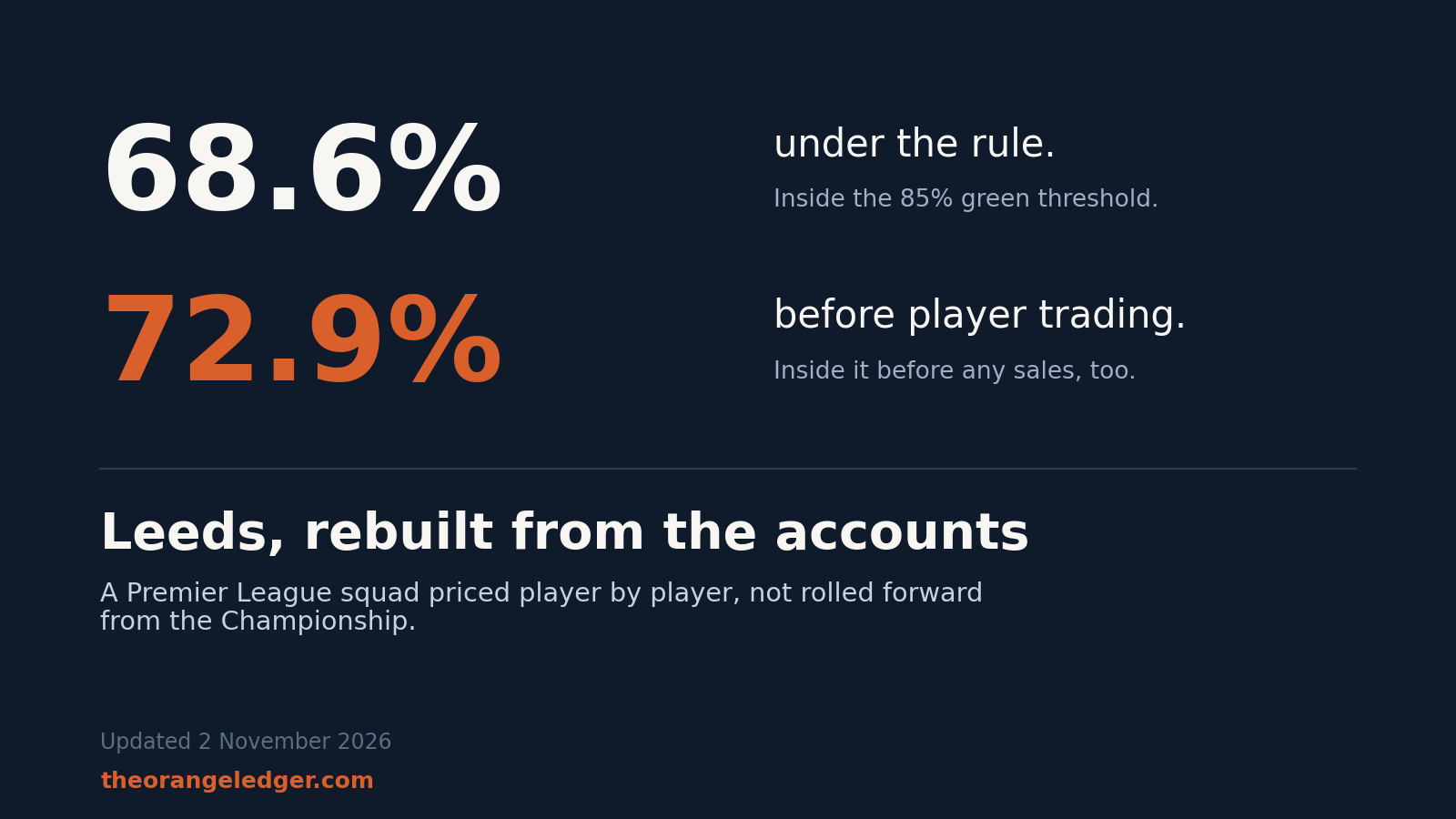 Leeds' squad cost ratio: a Premier League squad priced player by player, not rolled forward from the ChampionshipLeeds' squad cost ratio for the 1 March 2027 test comes out at 68.6%, well inside the 85% green threshold with roughly £42m of annual headroom. Measured before profit on player sales it is 72.9%. The last filed accounts are from a Championship season, so the wage bill is estimated player by player for the 2026/27 squad rather than rolled forward from a second-tier payroll. Reconstructed from Leeds United Football Club Ltd's accounts and Appendix 2 of the Premier League Handbook.Read the piece →
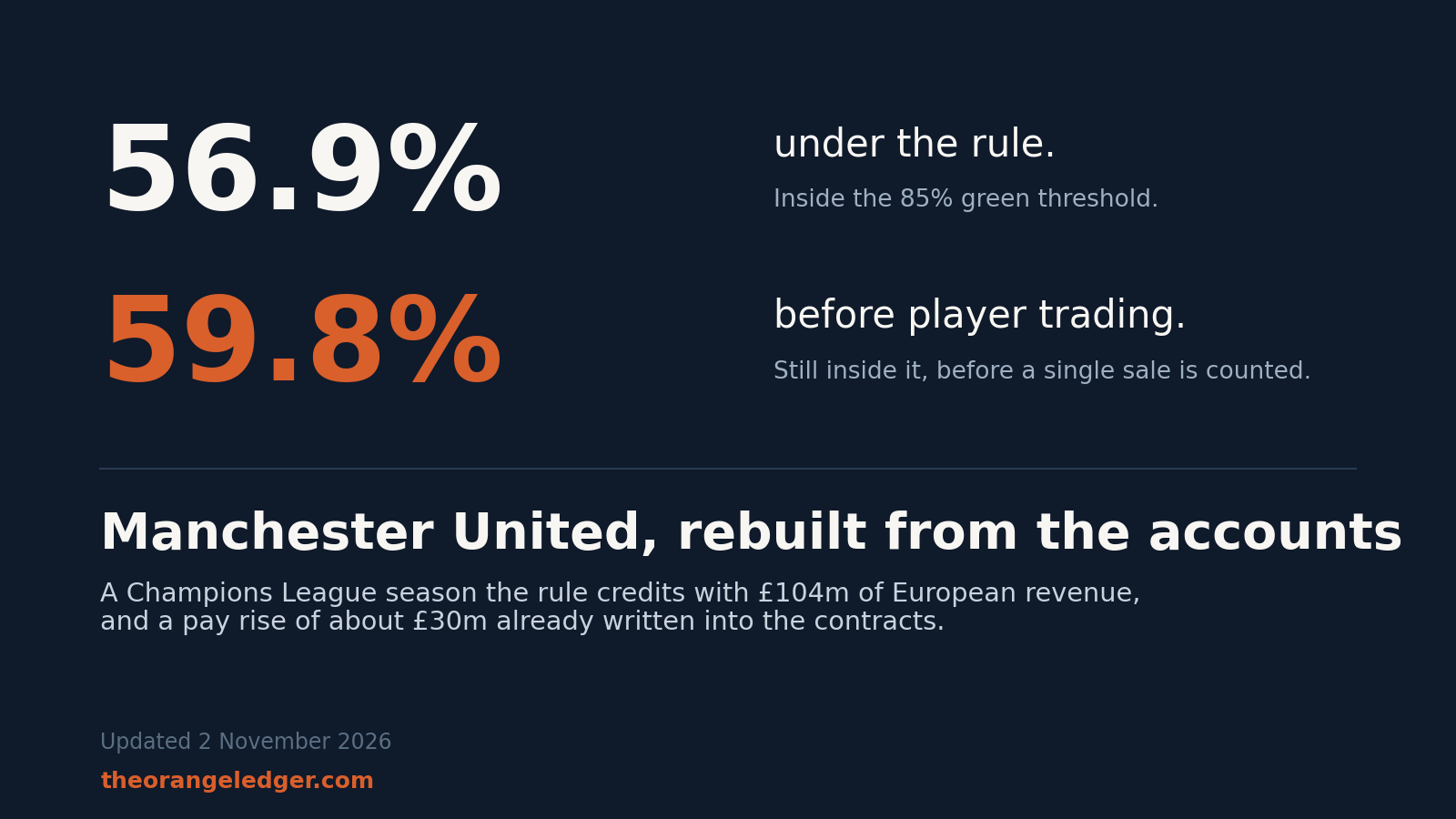 Manchester United's squad cost ratio: well inside the line, with a Champions League pay rise already written into the squadManchester United's squad cost ratio for the 1 March 2027 test comes out at 56.9%, well inside the 85% green threshold with roughly £218m of annual spending headroom. Measured before profit on player sales it is 59.8%, so United, unlike several of their peers, do not depend on selling to stay inside the line. The ratio is low because the rule credits a Champions League club with European revenue it has not yet earned, and because the payroll in the last filed accounts was set in two seasons without the Champions League. Reconstructed from the accounts of Red Football Limited, the group that holds the club and its football companies, and Appendix 2 of the Premier League Handbook.Read the piece →
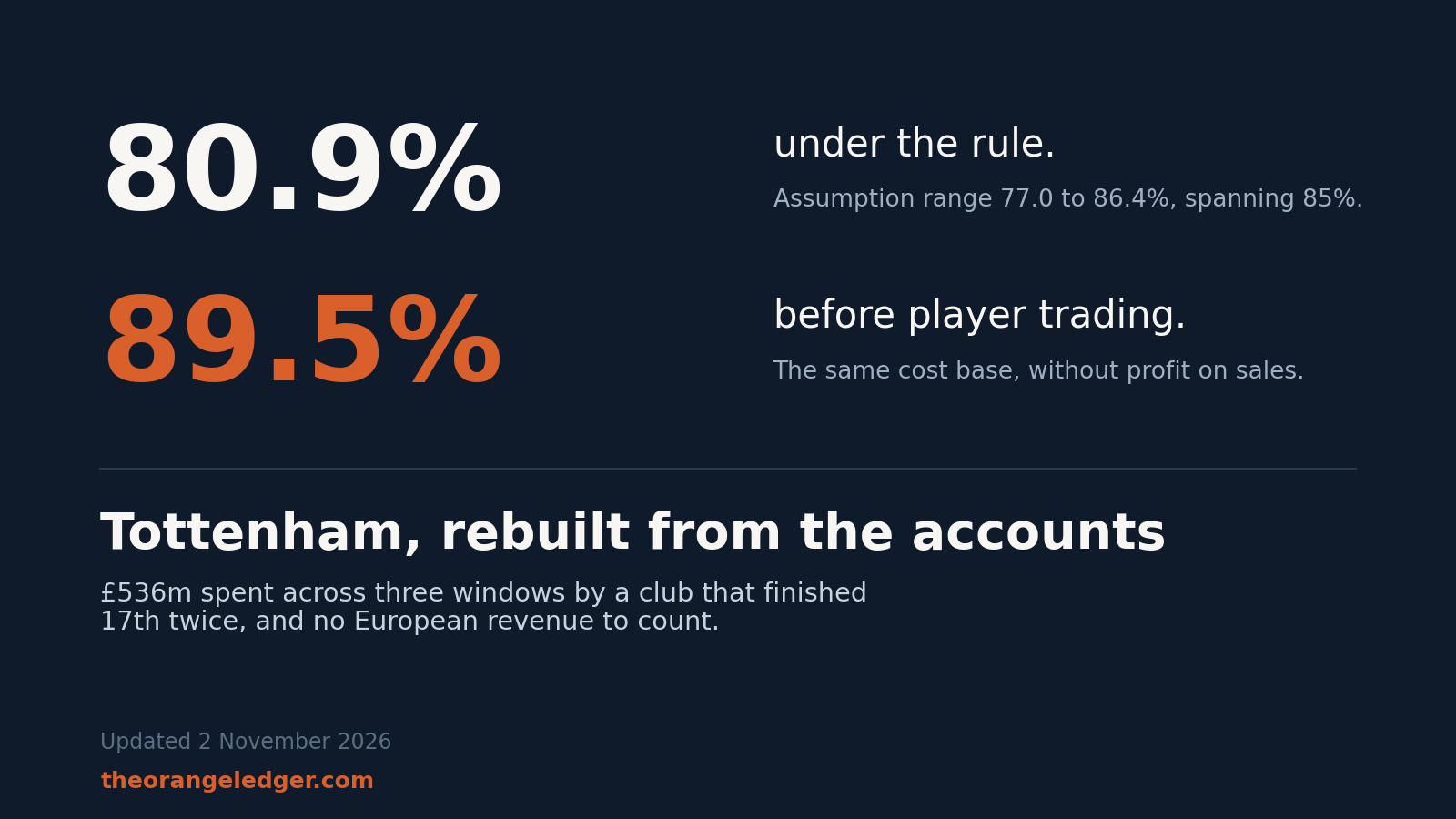 Tottenham's squad cost ratio: £536m spent, and no European revenue to countTottenham Hotspur's squad cost ratio for the 1 March 2027 test comes out at 80.9%, in an assumption range of 77.0% to 86.4% that spans the 85% green threshold: the estimate does not reliably tell which side of the line Tottenham are on. On the central figure there is roughly £25m of annual spending headroom. Measured before profit on player sales it is 89.5%, because the club spent £536m on registrations across three windows while the rule's revenue calculation gave back almost nothing: eighteen months after winning the Europa League, Tottenham's European revenue for this test is nil. The position does not last: the trading profit holding the ratio down expires, the merit payment falls to the rule's floor unless Tottenham finish 14th or higher this season, and on our assumed timing an £11.2m annual charge for Omar Marmoush begins in 2027/28. Reconstructed from Tottenham Hotspur Limited's consolidated accounts and Appendix 2 of the Premier League Handbook.Read the piece →
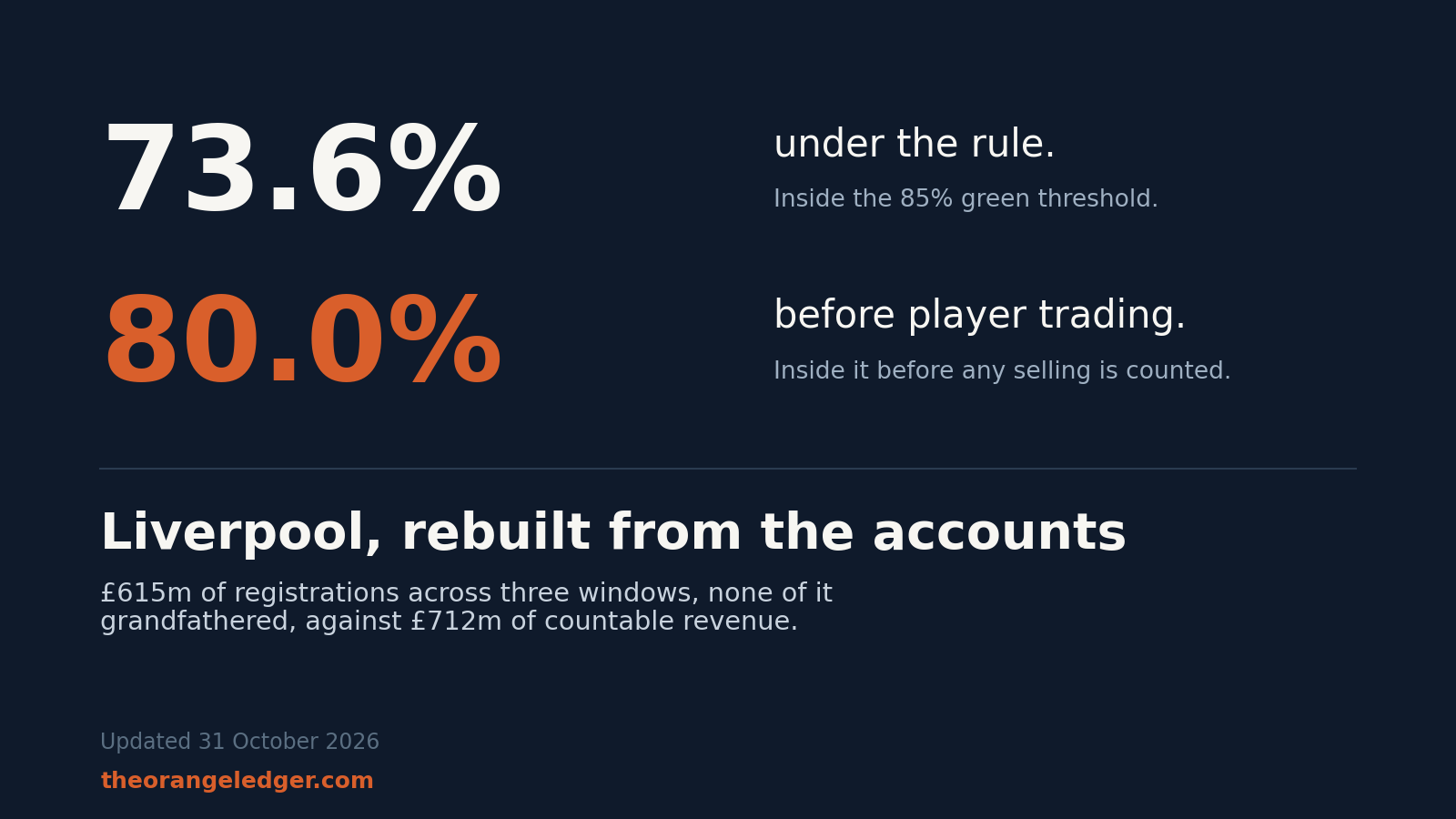 Liverpool's squad cost ratio: £615m of signings, and not one of them grandfatheredLiverpool's squad cost ratio for the 1 March 2027 test comes out at 73.6%, inside the 85% green threshold with roughly £88m of annual spending headroom. Measured before profit on player sales it is 80.0%, so the club sits inside the line before any selling is counted. £615m of registrations were bought across three windows and every one was signed after 12 December 2023, so none is grandfathered and all are capped at five years. Player trading supplies only 6.4 points, and three of the largest salaries at the club left on free transfers in a single summer. Reconstructed from UKSV Holdings' consolidated accounts and Appendix 2 of the Premier League Handbook.Read the piece →
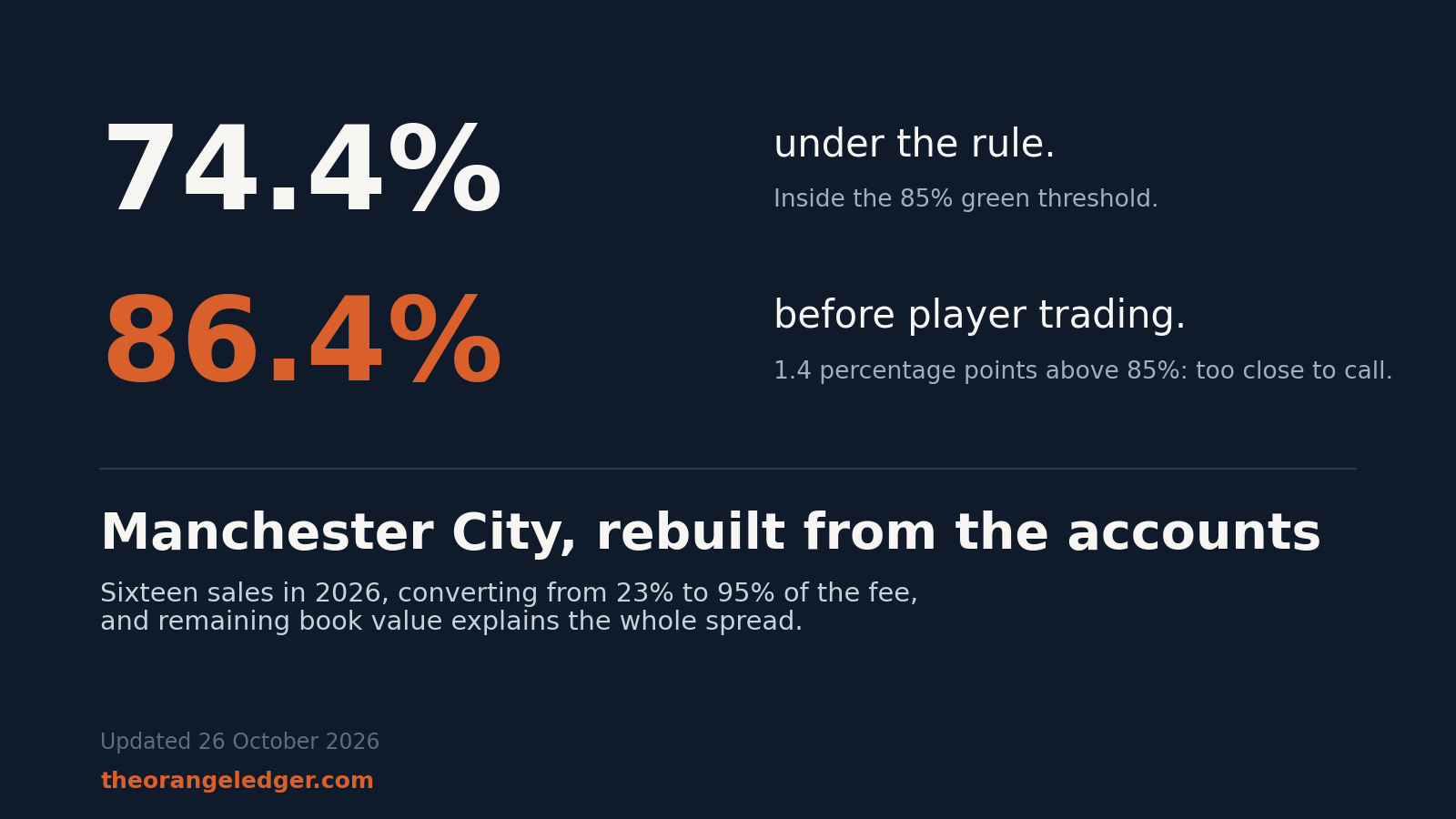 Manchester City's squad cost ratio: a large cost base, on the line before a single saleManchester City's squad cost ratio for the 1 March 2027 test comes out at about 74%, inside the 85% green threshold with roughly £91m of annual spending headroom. Measured before profit on player sales it is 86.4%, which is 1.4 percentage points above 85%, a margin smaller than the uncertainty in our estimate of last season's commercial revenue and too small to tell reliably which side of the line City are on before a sale is counted. On the central figure City need about £12m a year of disposal profit to reach 85%, and the £118.4m three-year average City actually have takes them well below. Where that profit comes from is the other half of the story: across the twelve largest disposals of the past two seasons, the share of each fee that became profit ran from 23% to 95%, and the spread came from how much of each registration was left on the books. Reconstructed from Manchester City Football Club Limited's accounts and Appendix 2 of the Premier League Handbook.Read the piece →
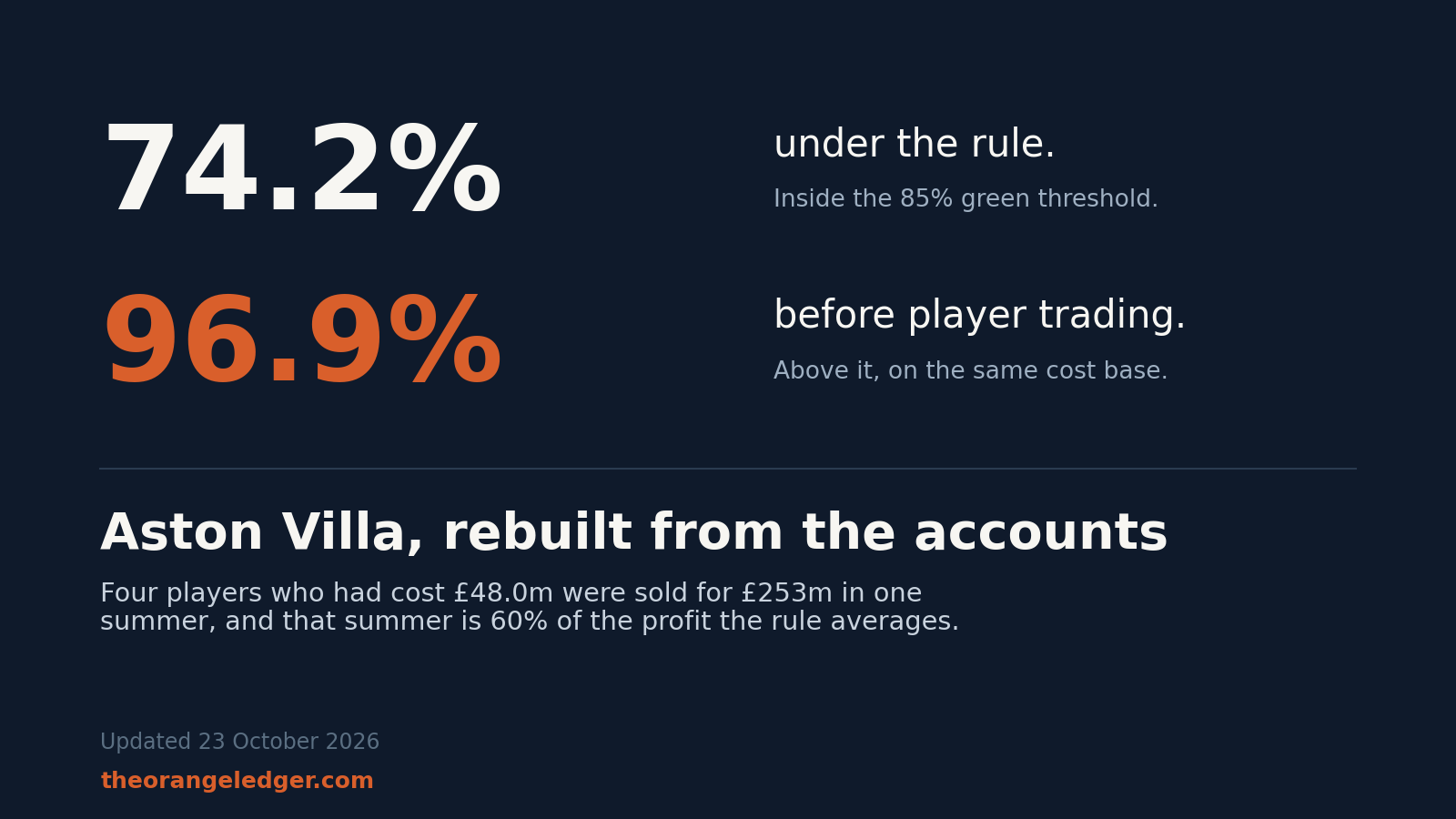 Aston Villa's squad cost ratio: one summer of selling that carries the averageAston Villa's squad cost ratio for the 1 March 2027 test comes out at about 74%, inside the 85% green threshold with roughly £57m of annual spending headroom. Measured before profit on player sales it is 96.9%, above the threshold even with £120m of merit above the fifteenth-place floor and European amounts in the revenue. £122.7m a year of averaged player-sale profit closes the gap, and three fifths of it comes from a single summer. Four players who had cost Villa £48.0m were sold for £253m in 2026 and produced £211m of profit. Reconstructed from NSWE UK Ltd's consolidated accounts and Appendix 2 of the Premier League Handbook.Read the piece →
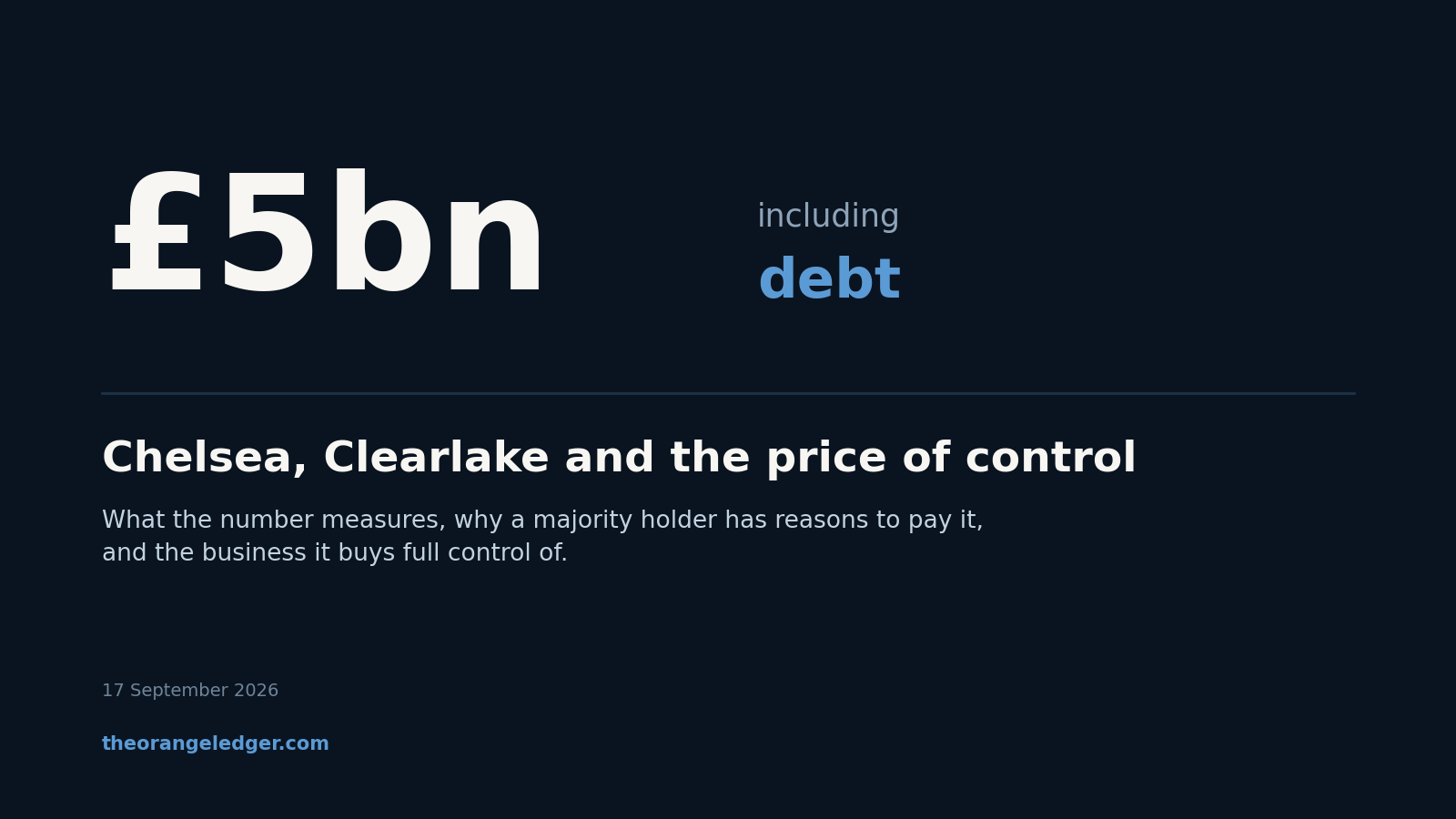 Chelsea at £5bn: what the price tells you, and what it doesn'tTodd Boehly and Mark Walter have agreed to sell their Chelsea stakes to Clearlake, which will take full control on completion. The Financial Times reports £950m for the two holdings and a club valuation of £5bn including debt; Bloomberg describes an enterprise value of about the same. Neither figure is an equity value. About £1.4bn of external debt sits above the football club in the ownership chain. The consideration implies equity of roughly £3.7bn, against Paul Quinn's independently derived central estimate of about £1bn. This piece sets out what was announced, why a buyer already holding 61.5% has reasons to pay a price a third party might not, and what the accounts say about the business Clearlake has taken control of: a squad costing £530m against £459m of the revenue the squad cost rule counts, an 92% regulatory ratio held there by £115m of averaged player-trading profit, and a £794m senior facility maturing in July 2027.Read the piece →
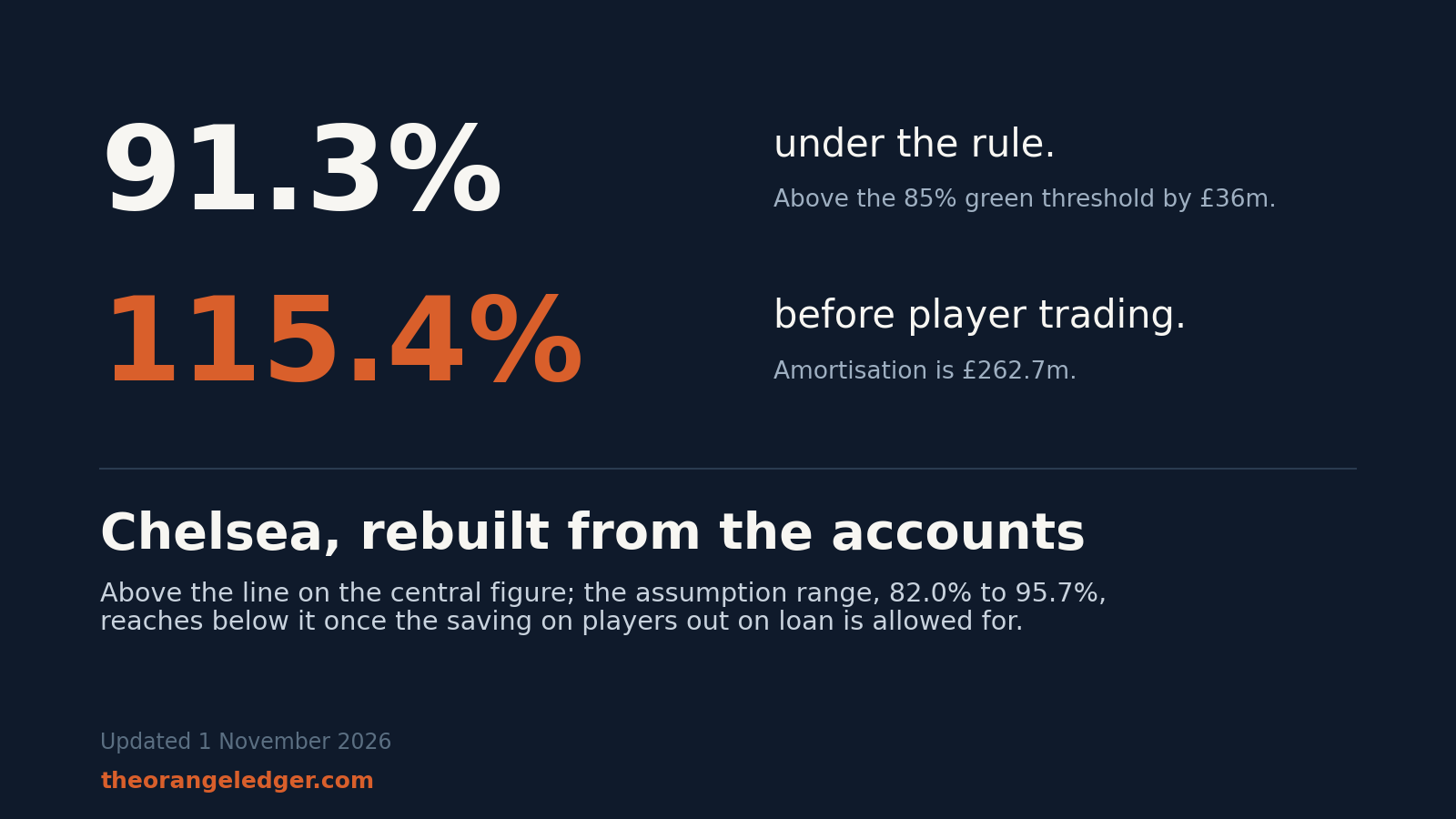 Chelsea's squad cost ratio: heavy amortisation, and a grandfathered set that keeps shrinkingChelsea's squad cost ratio for the 1 March 2027 test comes out at about 91%, above the 85% green threshold by roughly £36m of annual squad cost, with an assumption range of 82.0% to 95.7% that reaches below the line. Measured before profit on player sales it is 115.4%, 0.4 percentage points above 115%, a margin too small for the estimate to tell reliably which side of that figure it is on; the red line is tested on the ratio after player trading, which is well below it. Amortisation is £262.7m, 57% of the football revenue the rule counts. The five-year cap was not backdated, so eight registrations carrying £312m of fees still sit outside it. But Chelsea renegotiate contracts routinely, and every post-cut-off extension pulls another registration inside the cap: Palmer and Caicedo have left the grandfathered set that way, and new contracts for João Pedro and Neto, signed after the cut-off, restarted their five years. And £1.39bn of external debt sits above the club, which the ratio does not see. Reconstructed from Chelsea's accounts and Appendix 2 of the Premier League Handbook.Read the piece →
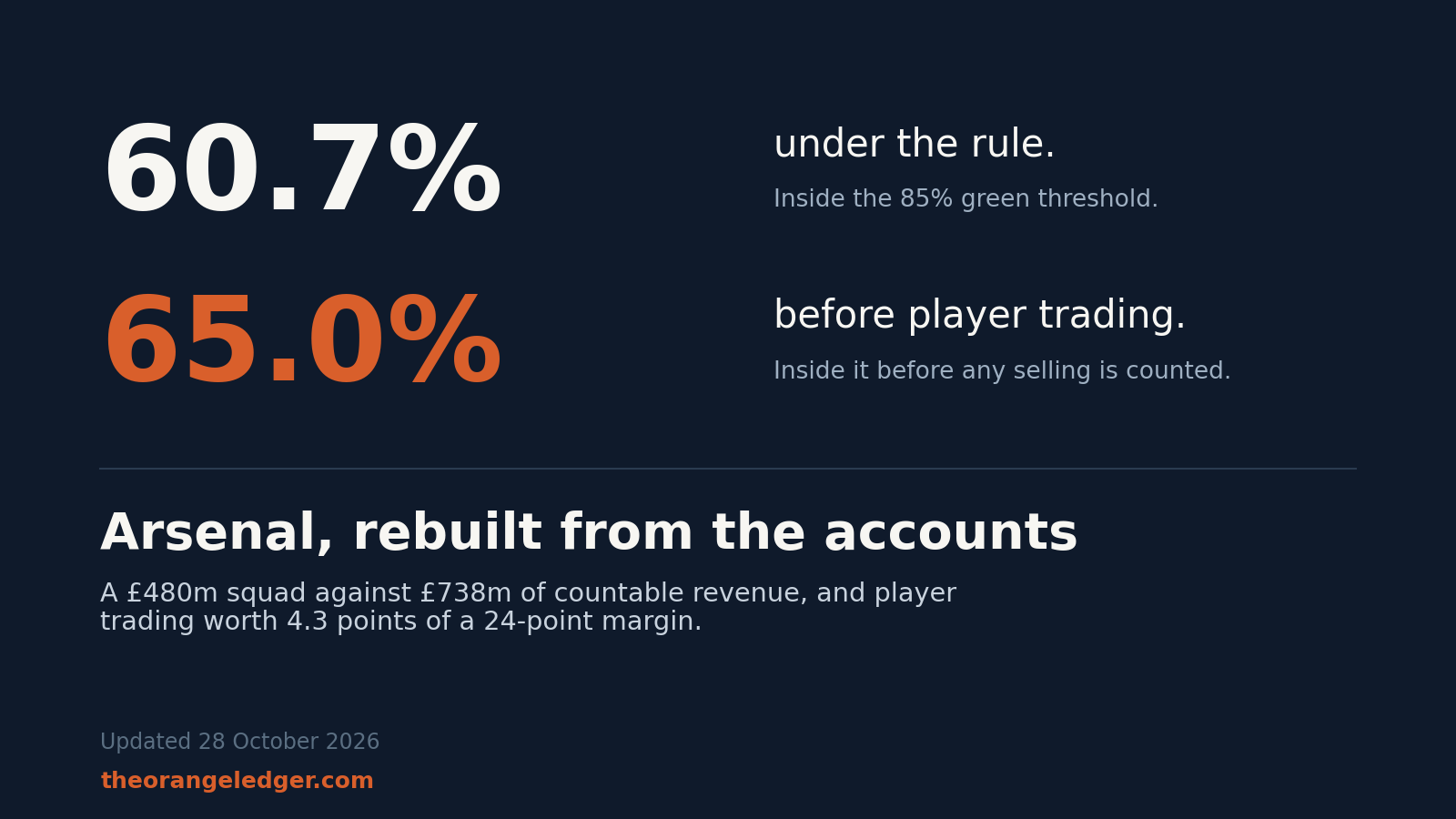 Arsenal's squad cost ratio: a large squad cost against much larger countable revenueArsenal's squad cost ratio for the 1 March 2027 test comes out at 60.7%, inside the 85% green threshold with roughly £192m of annual spending headroom. Measured before profit on player sales it is 65.0%, so the club sits comfortably inside the line before any selling is counted. Player trading is worth only 4.3 percentage points, and one of the three years in the three-year average of sale profit produced just £5.7m of profit, against £81.2m and £70.9m in the other two, without it mattering. The squad costs 85% more than Nottingham Forest's and the ratio is about three fifths of Forest's, which is what it means to say the rule measures a relationship rather than an amount. Reconstructed from Arsenal Holdings Ltd's consolidated accounts and Appendix 2 of the Premier League Handbook.Read the piece →
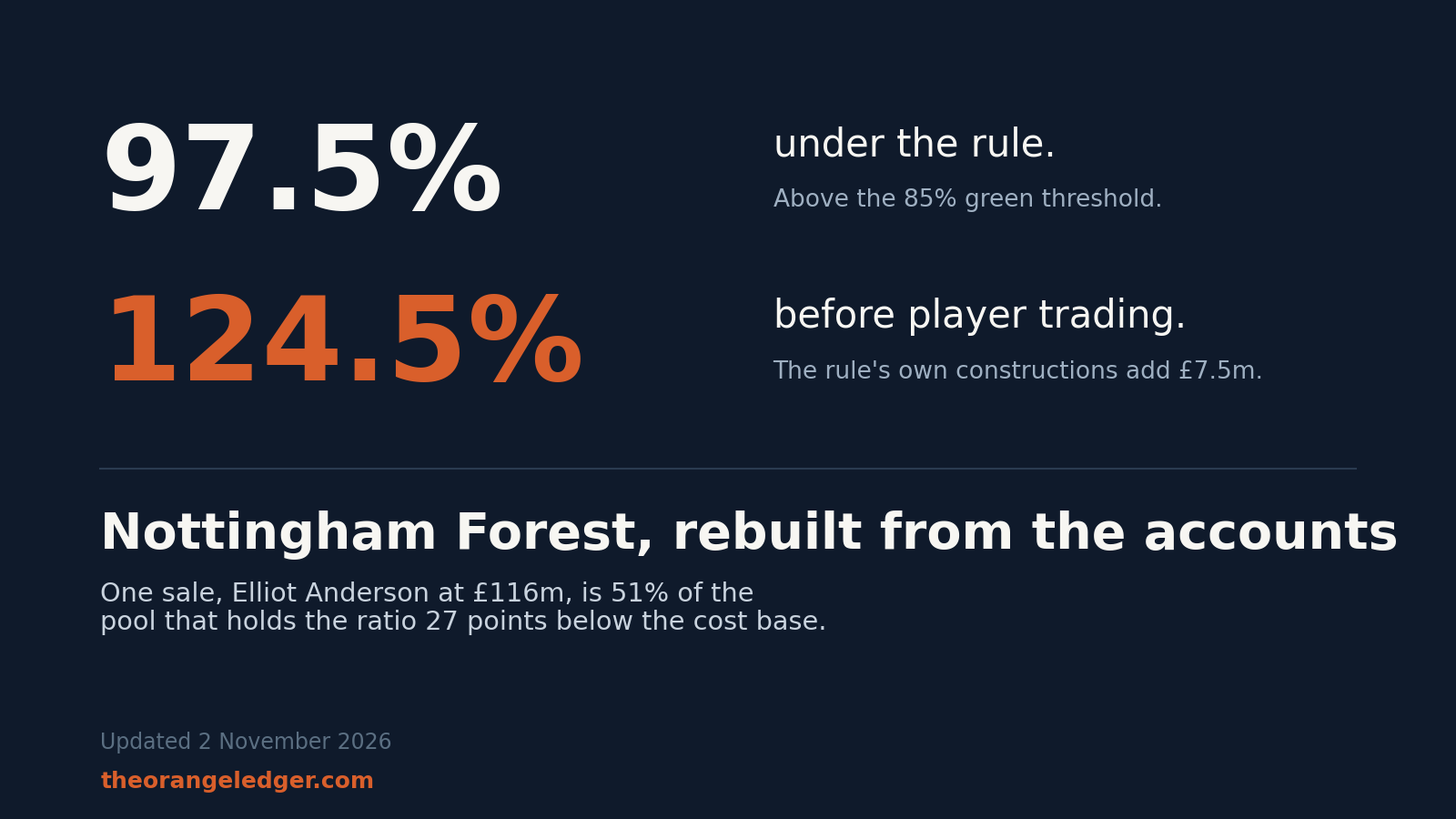 Nottingham Forest's squad cost ratio: far above the line before player trading, and almost nothing from the ruleNottingham Forest's squad cost ratio for the 1 March 2027 test comes out at 97.5%, above the 85% green threshold by roughly £33m of annual squad cost. Measured before profit on player sales it is 124.5%, so the squad costs about 24% more than the football revenue the rule counts. The rule's own constructions are worth only 4.6 points here, because a sixteenth-place finish pays merit near the floor and there is no European money at all. Player trading supplies 27.1 points, and about half of that is one sale: Elliot Anderson at £116m, about 51% of the pool. Reconstructed from Nottingham Forest Football Club Limited's accounts and Appendix 2 of the Premier League Handbook.Read the piece →
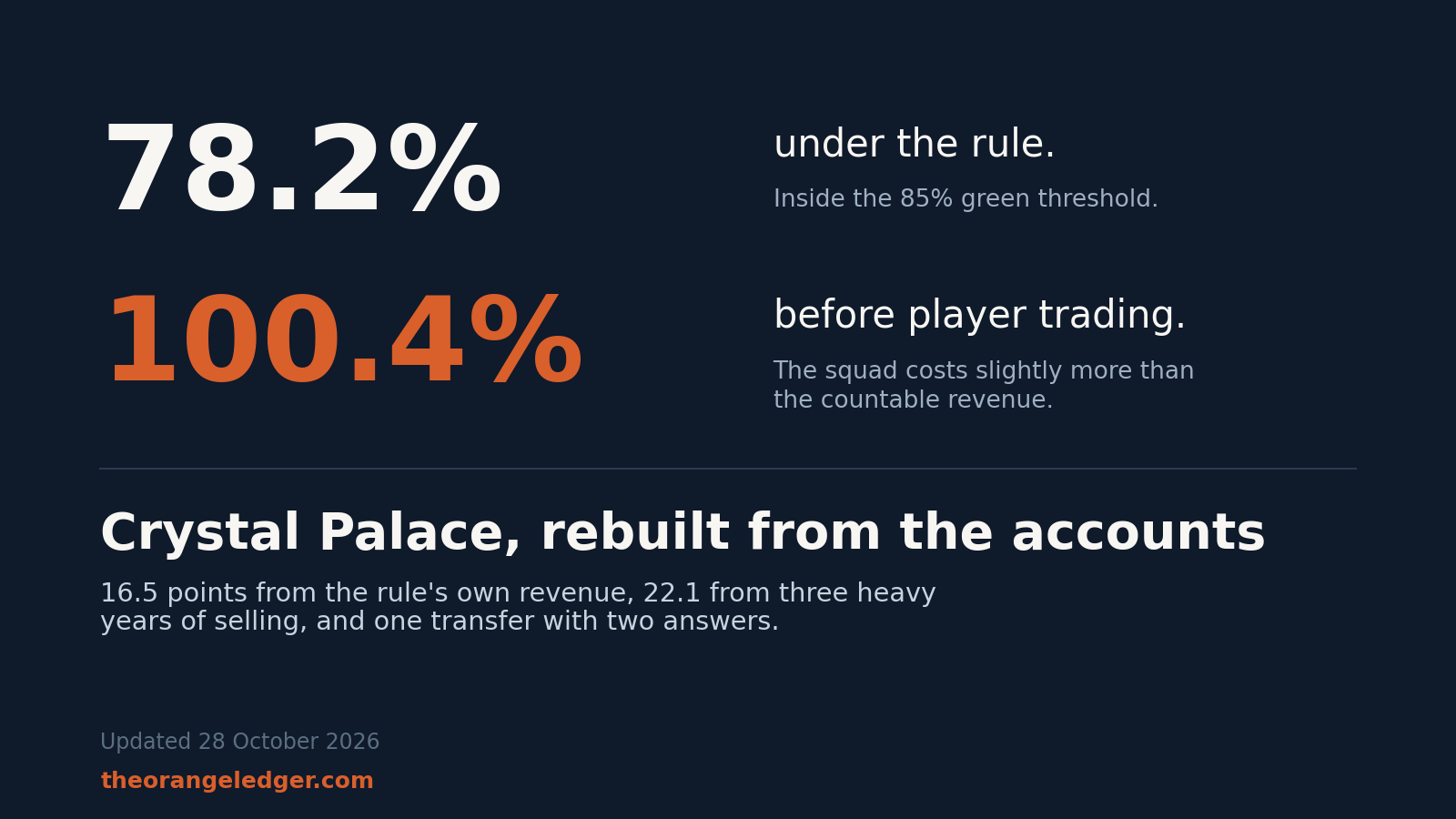 Crystal Palace's squad cost ratio: a squad costing about as much as its countable revenue, and two answers to one transferCrystal Palace's squad cost ratio for the 1 March 2027 test comes out at about 78%, inside the 85% green threshold with roughly £19m of annual spending headroom. Measured before profit on player sales it is 100.4%: the squad costs slightly more than the football revenue the rule counts. What sits in between is 16.5 points from merit above the floor and European amounts and 22.1 points from three heavy years of selling. One arrival has two defensible accounting answers that the public record cannot choose between, so the club is published as a branch rather than a point. Reconstructed from Crystal Palace's accounts and Appendix 2 of the Premier League Handbook.Read the piece →
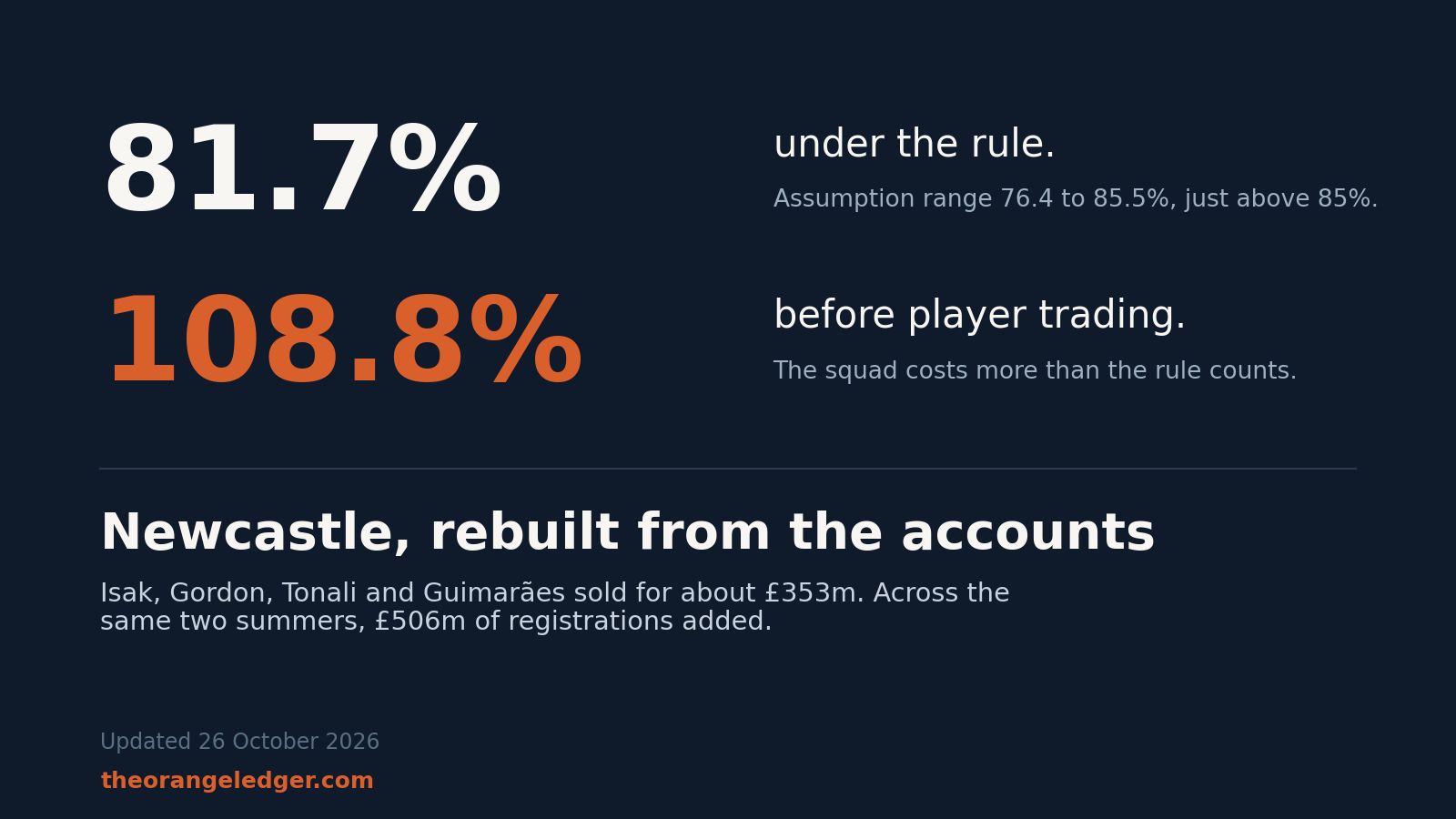 Newcastle's squad cost ratio: the squad costs more than the rule counts, and selling closes the gapNewcastle's squad cost ratio for the 1 March 2027 test comes out at 81.7%, 3.3 percentage points below the 85% green threshold, in an assumption range of 76.4% to 85.5% whose top end is just above the line. Squad cost is £14.4m less than 85% of the revenue the rule counts. Measured before profit on player sales it is 108.8%, so the squad costs more than the football revenue the rule counts. A three-year average of £109.9m of sale profit closes the gap, dominated by four sales across two years, Isak, Gordon, Tonali and Guimarães for about £353m, with Anderson's and Minteh's sales of June 2024 and £19.9m of filed profit from 2024/25. The same two summers bought £506m of replacements, so the cost base did not fall. Reconstructed from Newcastle United Football Company Ltd and the filed group and subsidiary accounts used for the reporting perimeter, and Appendix 2 of the Premier League Handbook.Read the piece →
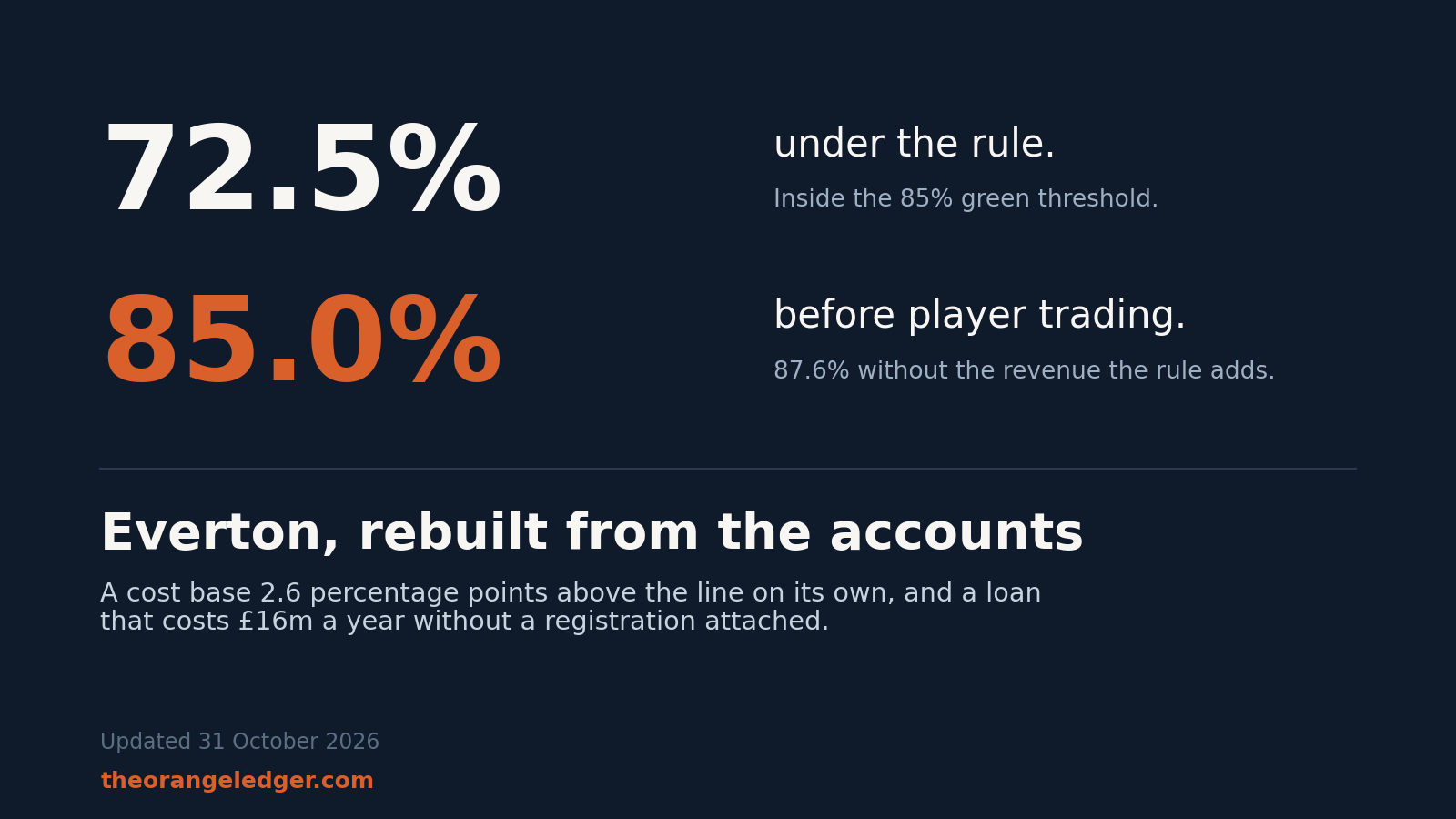 Everton's squad cost ratio: a cost base close to the line, and one loan that costs £16m a yearEverton's squad cost ratio for the 1 March 2027 test comes out at about 72%, inside the 85% green threshold with £36.7m of annual spending headroom. Measured before profit on player sales it is 85.0%, and measured at the fifteenth-place merit floor it is 87.6%, which is 2.6 percentage points above the threshold, less than the uncertainty in the wage estimate. Jack Grealish's loan adds about £16m of annual squad cost for a registration Everton do not own and do not amortise. And a new stadium has roughly doubled the matchday line in the year the rule measures, while the £813m it cost sits outside the calculation. Reconstructed from Everton's accounts and Appendix 2 of the Premier League Handbook.Read the piece →
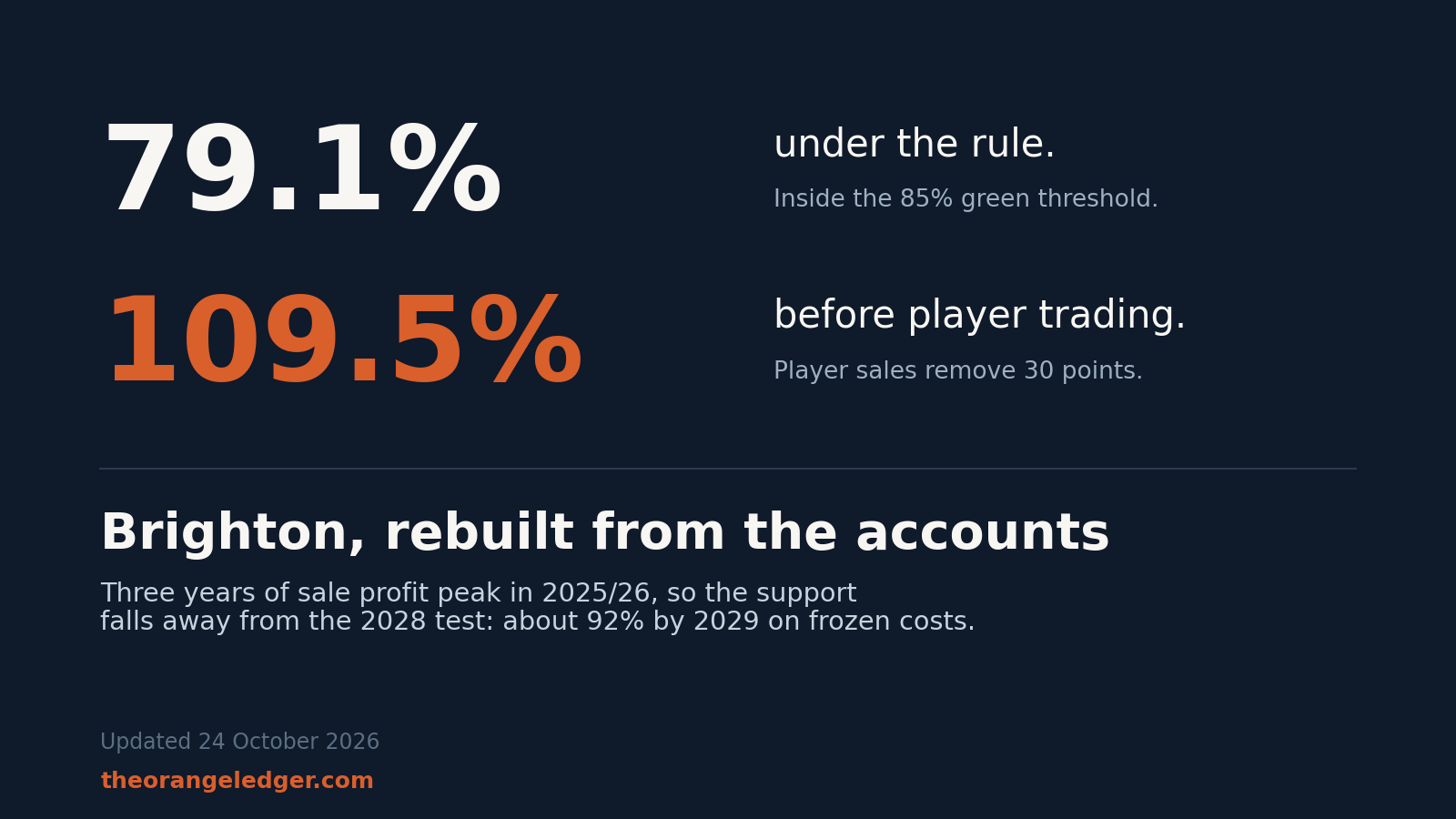 Brighton's squad cost ratio: a squad that costs more than its countable revenue, sold back inside the lineBrighton's squad cost ratio for the 1 March 2027 test comes out at 79.1%, inside the 85% green threshold with roughly £19m of annual spending headroom. Measured before profit on player sales it is 109.5%, so the squad costs materially more than the football revenue the rule counts. Player trading removes 30.4 points of that on three years of disposal profit, £56.9m, £134.5m and £78.0m. Behind it, amortisation has gone from £39.3m to £108.6m in two years after £332m of buying, the transfer book has swung £208m from net creditor to net debtor, and £406.5m is owed to the chairman interest-free. Reconstructed from Brighton and Hove Albion's accounts and Appendix 2 of the Premier League Handbook.Read the piece →
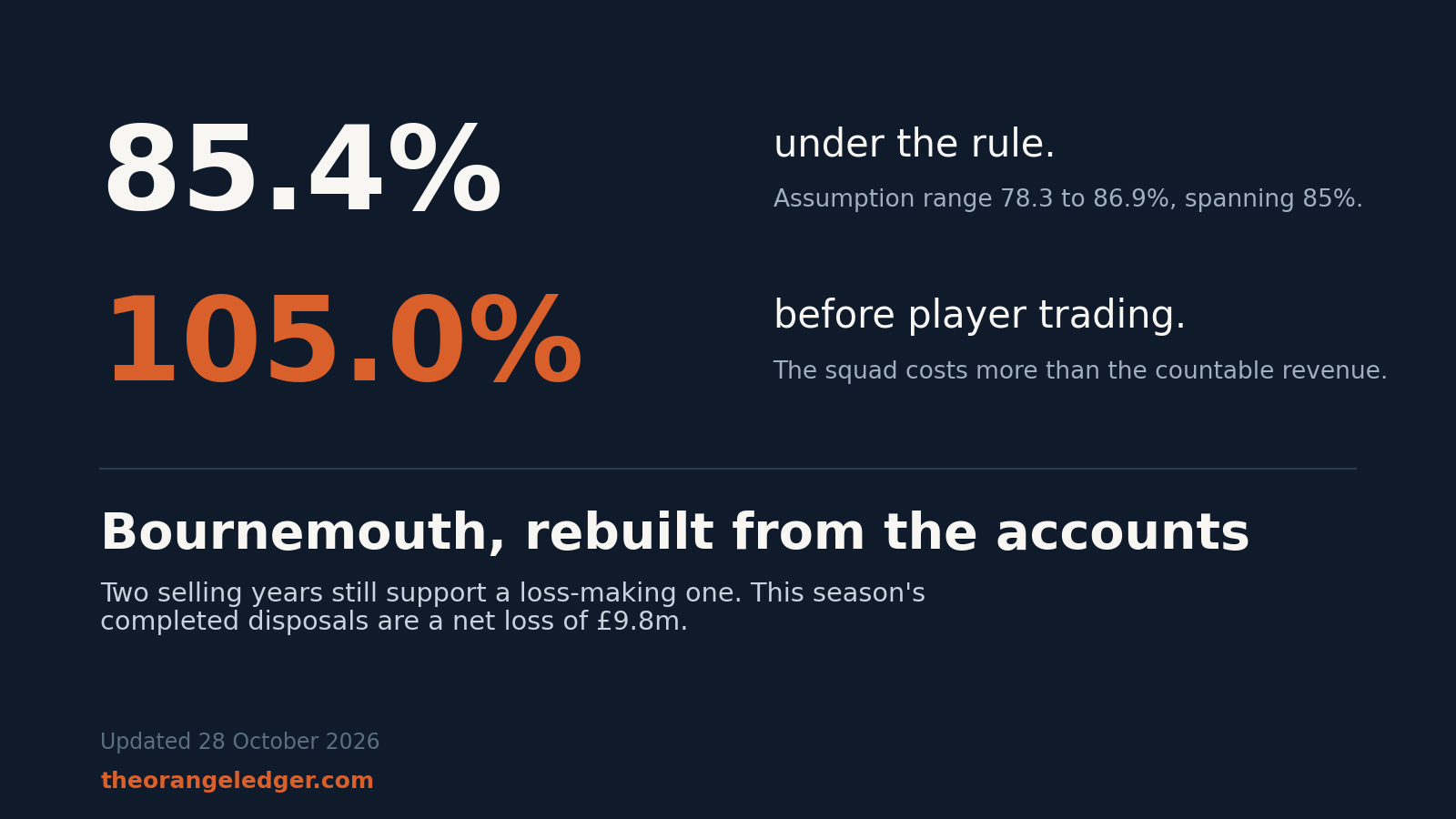 Bournemouth's squad cost ratio: the profitable selling has stopped, and the rule has not noticed yetBournemouth's squad cost ratio for the 1 March 2027 test is an estimated 85.4%, in an assumption range of 78.3% to 86.9% that spans the 85% green threshold, and 105.0% before profit on player sales. Two large selling years hold it near the line while this season's completed disposals are a net loss of £9.8m. Reconstructed from AFC Bournemouth Limited's accounts and Appendix 2 of the Premier League Handbook.Read the piece →
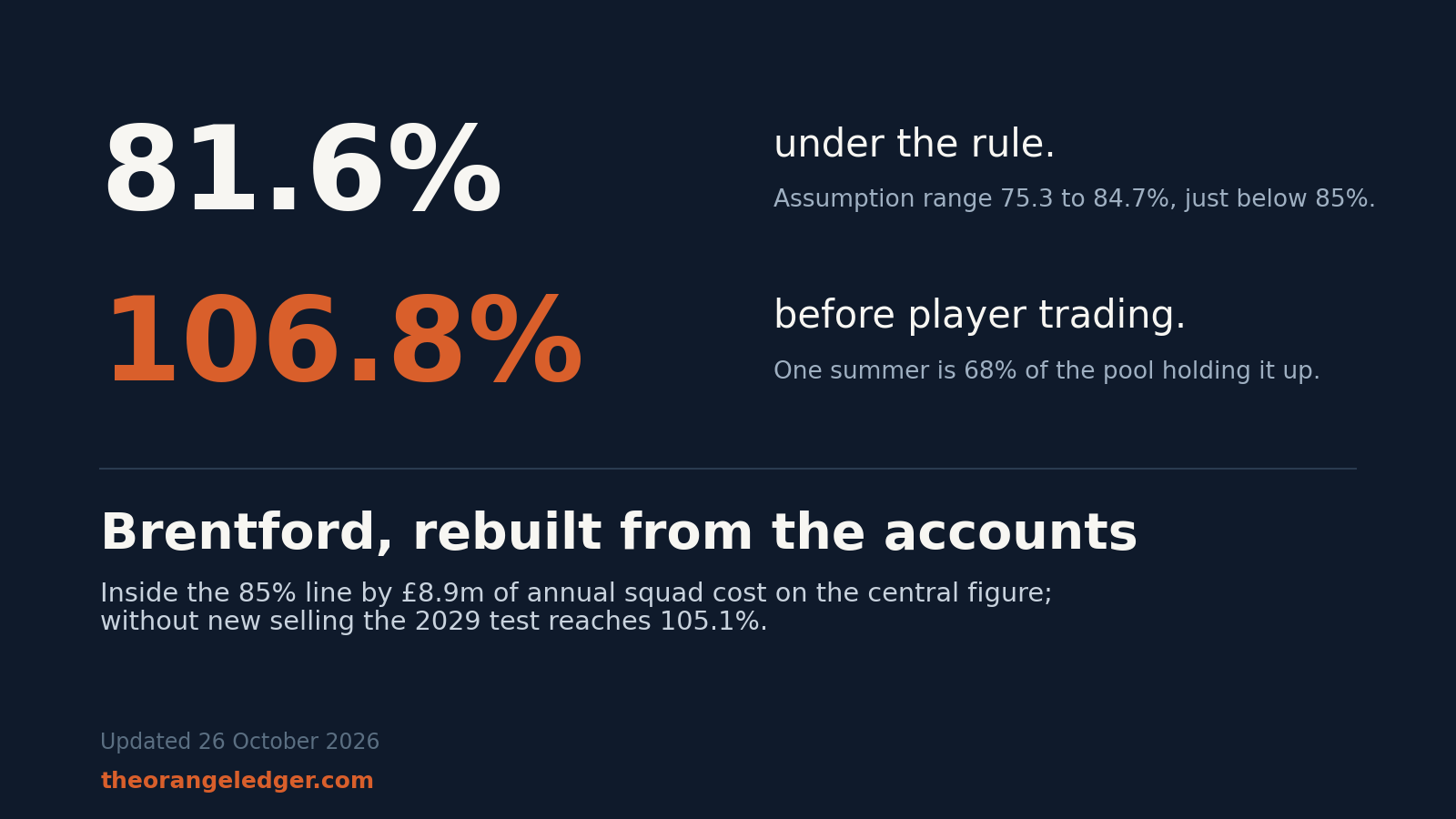 Brentford's squad cost ratio: a squad that costs more than its countable revenue, and one summer holding it upBrentford's squad cost ratio for the 1 March 2027 test is an estimated 81.6%, in an assumption range of 75.3% to 84.7%, just below the 85% green threshold, and 106.8% before profit on player sales. Player sales and coaching compensation remove 25.3 percentage points, and 68% of the sale profit behind that comes from a single summer. Reconstructed from Brentford's accounts and Appendix 2 of the Premier League Handbook.Read the piece →
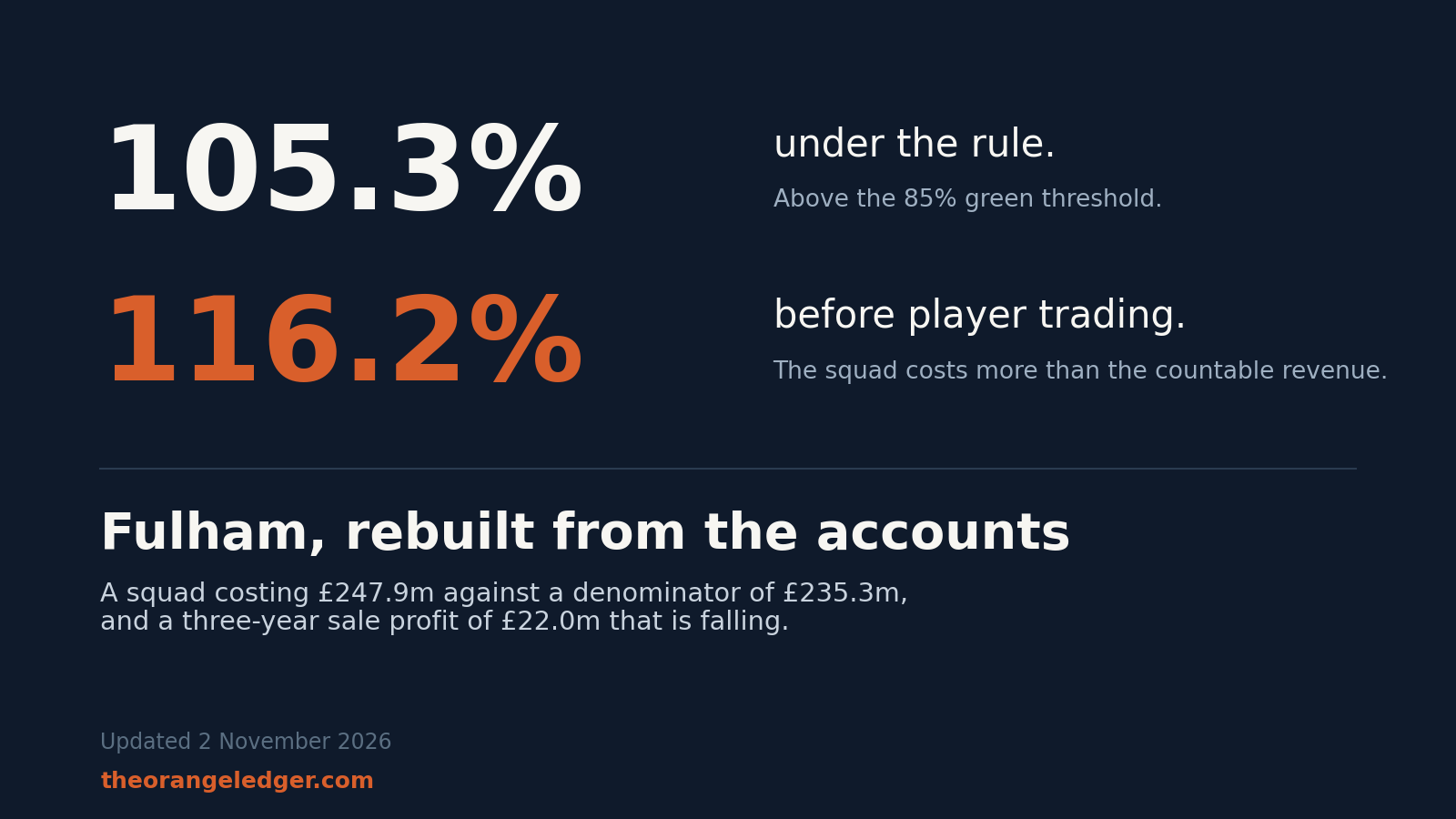 Fulham's squad cost ratio: a squad that costs more than everything the rule countsFulham's squad cost ratio for the 1 March 2027 test comes out at about 105%, above the 85% green threshold by roughly £48m of annual squad cost. Measured before profit on player sales it is 116.2%. The squad costs £247.9m against a denominator of £235.3m, so the cost base exceeds the rule's football revenue and its averaged trading profit combined. Hugo Larsson is treated as bought; the range, 96.8% to 109.8%, also covers the loan the clubs describe. What separates Fulham from Brighton is that Fulham's three-year sale profit is £22.0m and falling, against Brighton's £89.8m. On the central estimate the club would receive a Breach Notification and an Accounts Confirmation Test at the test of 1 March 2027. Reconstructed from Fulham Football Club Limited's accounts and Appendix 2 of the Premier League Handbook.Read the piece →
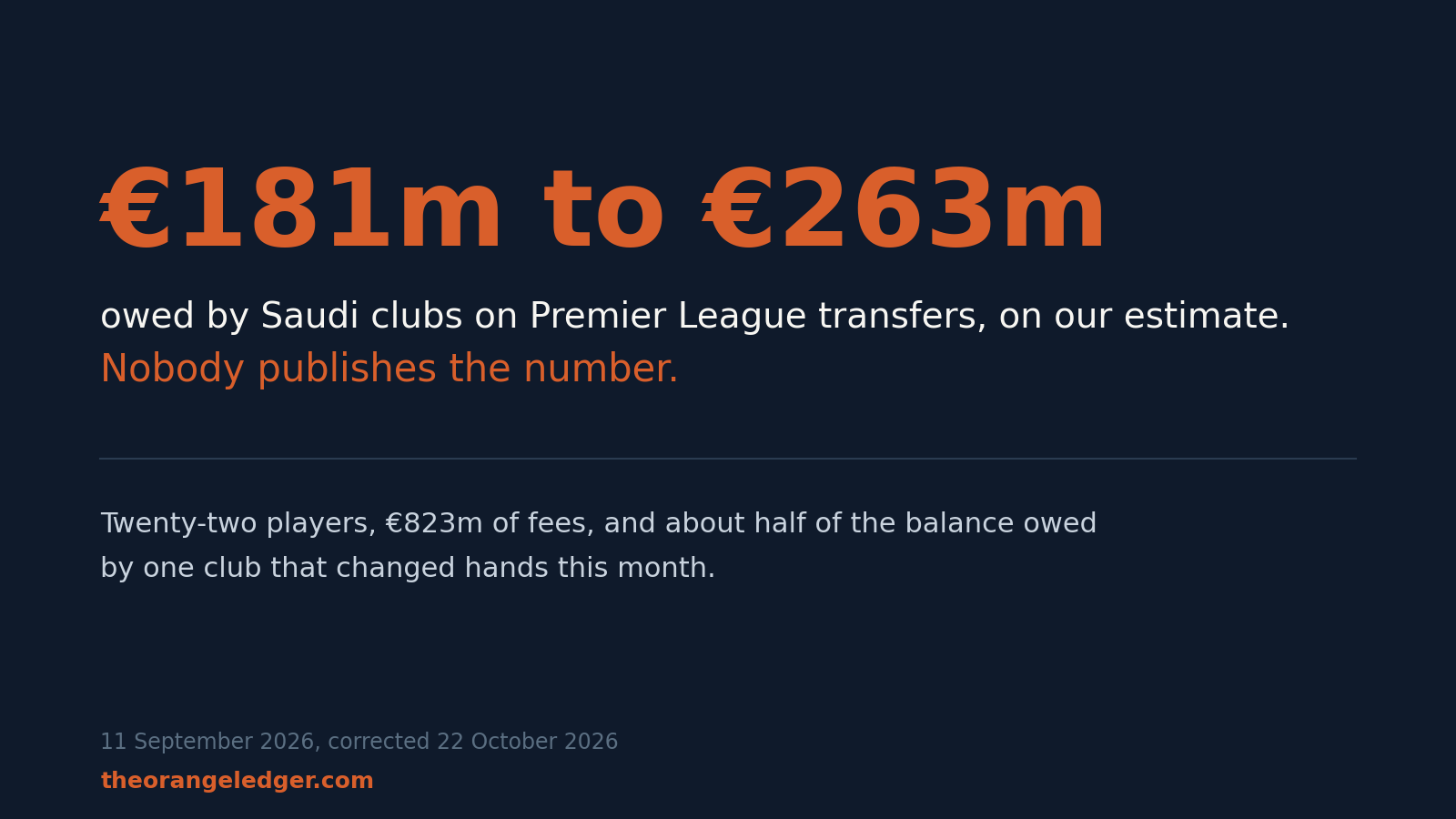 Saudi clubs owe an estimated €180m to €260m on Premier League transfers. Nobody publishes the number.Twenty-two players, €823m of fees, and a receivables book concentrated on one club that changed hands in September. What LIV Golf, the Chinese Super League and NEOM say about the risk, and why no one in England can read the debtor's accounts.Read the piece →
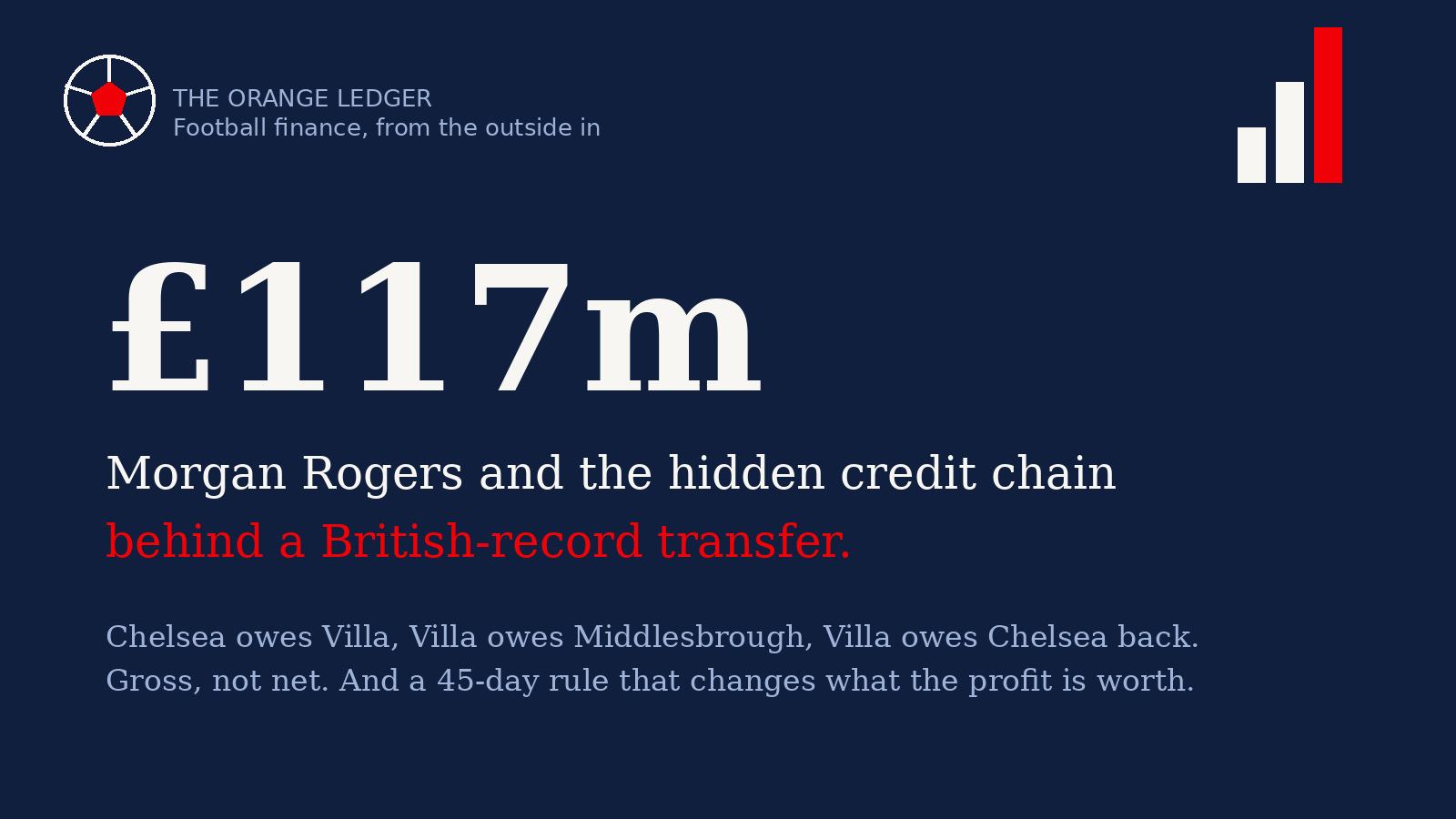 Morgan Rogers and the hidden credit chain behind a £117m transferA British-record fee, paid in instalments, that triggered a second obligation to Middlesbrough and ran alongside three other deals between the same two clubs, two of them the other way. A worked example of why transfer debt is measured gross, not net, and why UEFA's 45-day rule changes what Villa's profit is worth.Read the piece →
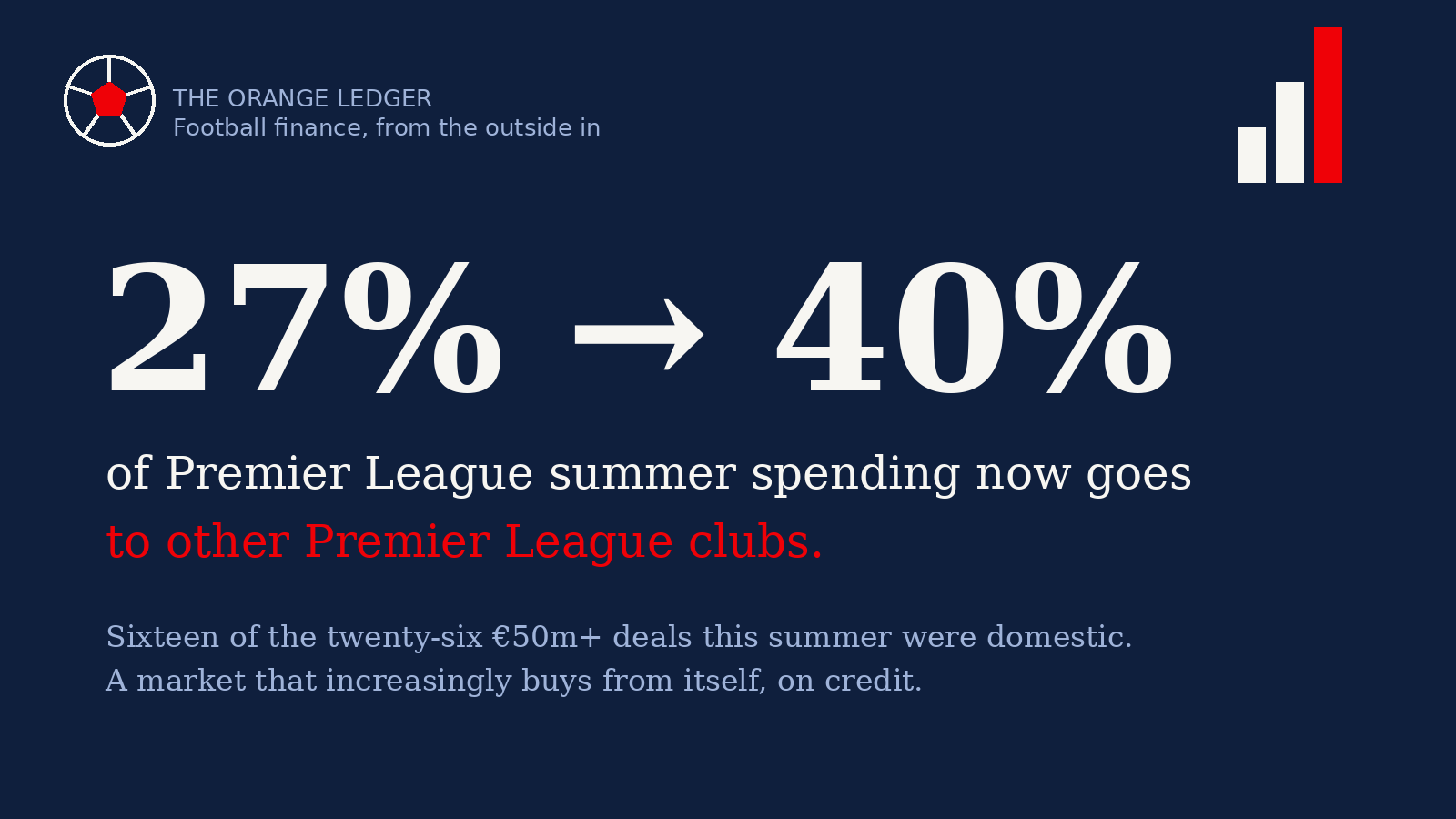 The window that bought itselfPremier League clubs spent a record £3.46bn this summer, and forty per cent of it went to other Premier League clubs. Six summers of transfer data on where the money goes, whether English clubs pay each other a premium, and what a market that increasingly trades with itself on deferred terms looks like from the outside.Read the piece →
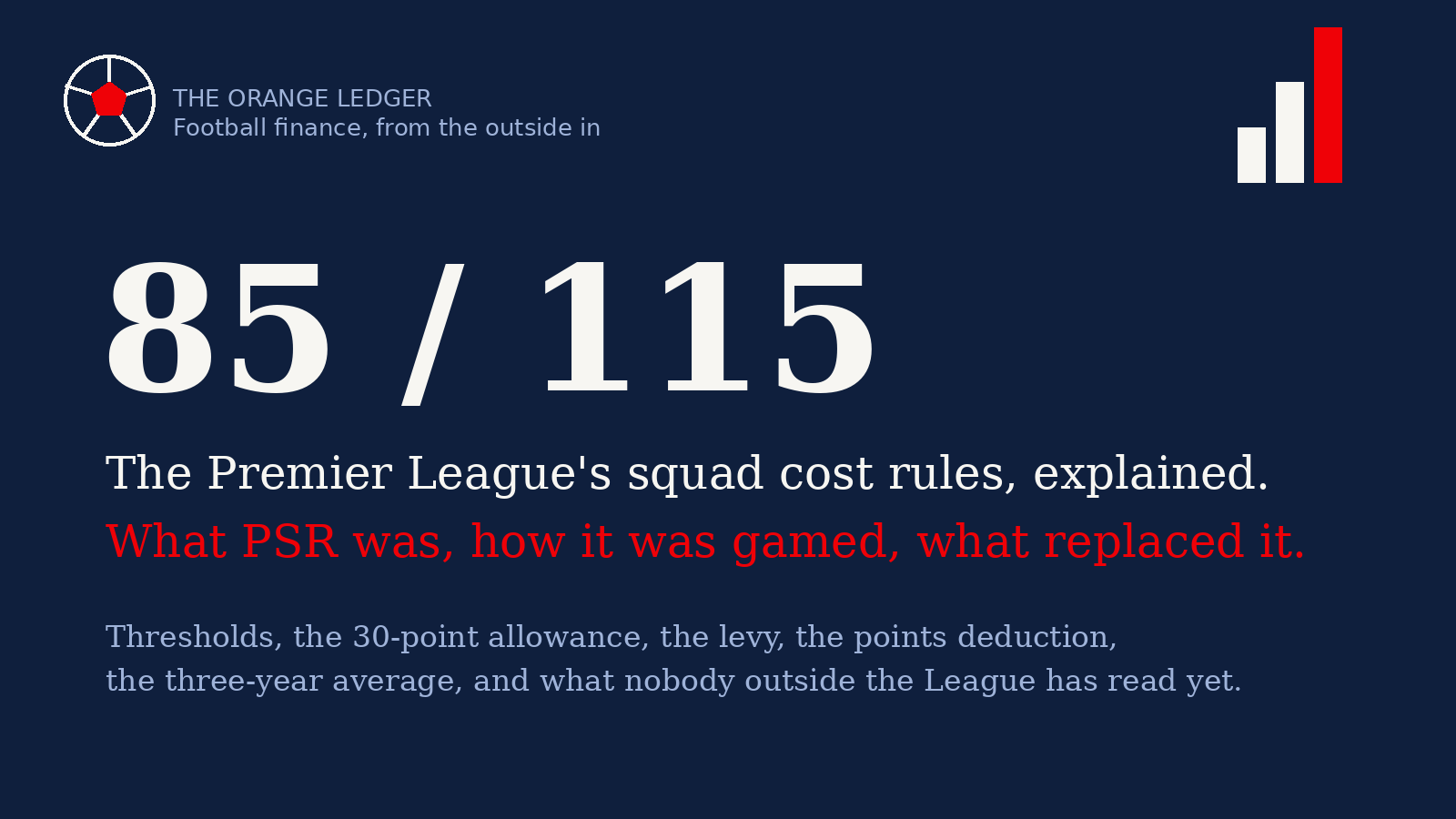 The Premier League's squad cost rules, explainedWhat PSR was, how clubs learned to game it, and what replaced it in 2026: the 85% line, the allowance of 30 percentage points that ratchets up and down, the levy that doesn't bite until 2027/28, the points deduction, the new liquidity tests, and the parts of the calculation that remain difficult to reconstruct from outside a club.Read the piece →
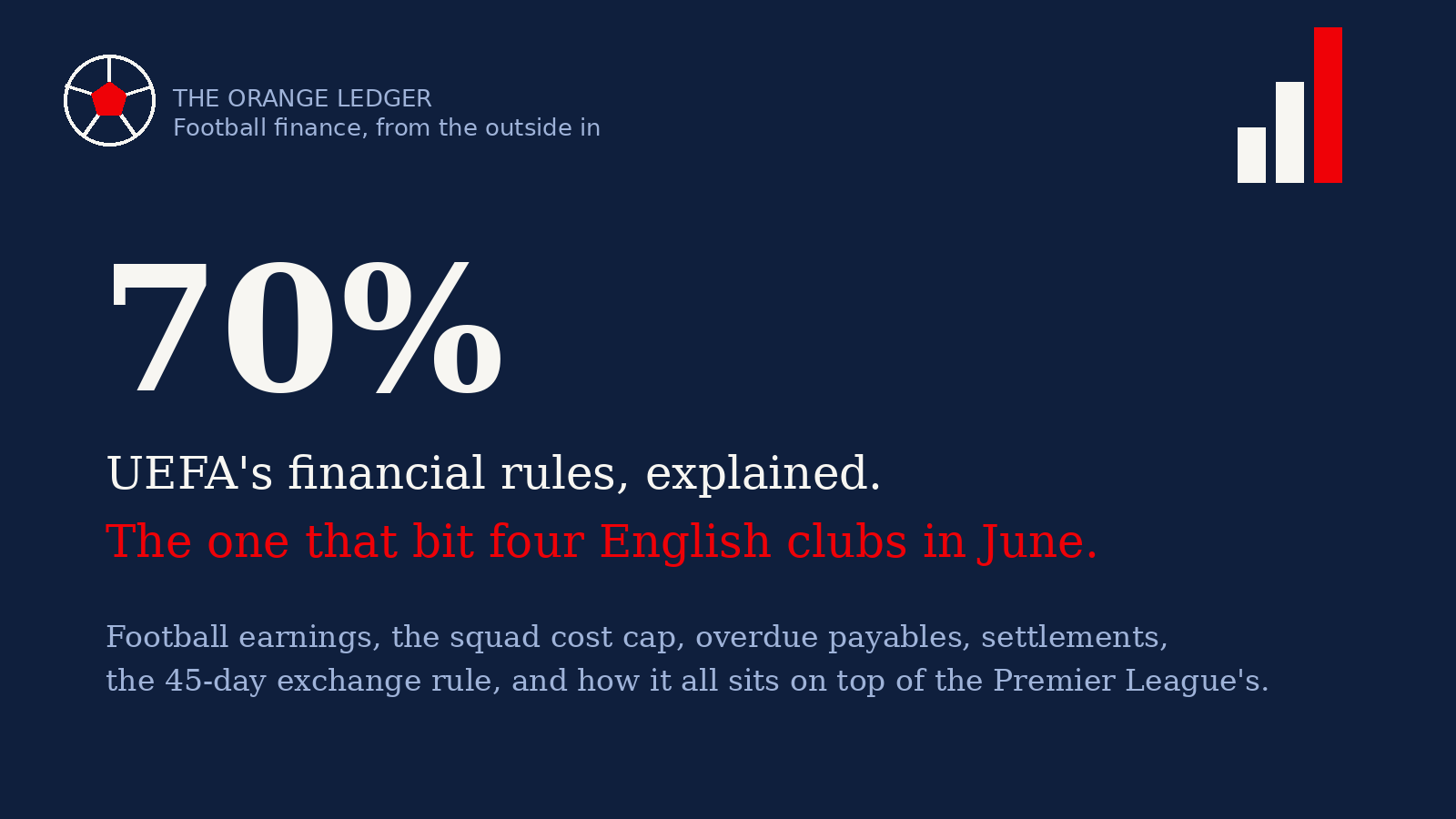 UEFA's financial rules, explainedFour English clubs were fined by UEFA in June for a rule most fans have never had described to them. This is what the Club Licensing and Financial Sustainability Regulations actually test: the football earnings rule, the 70% squad cost cap, overdue payables, settlement agreements, the exchange-transaction rule, and how all of it sits alongside the Premier League's own regime.Read the piece →