
Analysis
City's sponsors paid £119m. Their owner paid £831m
The independent commission has found every charge against Manchester City proven except one. Its findings cover nine seasons of misstated accounts from 2009/10 to 2017/18, breaches of UEFA and Premier League financial rules, and later failures to cooperate with the League's investigation. At the centre is what it calls a Disguised Funding Scheme: sponsorship deals with Abu Dhabi companies, recorded well above their value, with the club's owner secretly paying most of the fee. This is what the 40-page decision says, why the scheme worked under football's rules, and what happens next. City dispute the findings and have appealed.
Latest note, 25 October 2026: new evidence. The correction note is at the end.
Over nine seasons, Manchester City recorded £949.9m of sponsorship income from companies in Abu Dhabi. According to the independent commission that ruled on the Premier League’s case against the club, the sponsors paid £119.3m of it. The other £830.7m came from the club’s owner, Abu Dhabi United Group (ADUG), dressed up as sponsorship so that it would count under football’s financial rules. City dispute every finding and have appealed.
On 29 September 2026 the Premier League published a redacted version of the independent commission’s core decision in its case against Manchester City. It runs to 40 pages, and the detailed reasoning sits in appendices that have not yet been released. But the core decision is enough to see what the commission found, and why it matters for every financial rule the Orange Ledger has written about.
What was decided
- Every charge was found proven except one. The Premier League brought four groups of charges. The commission upheld all of them apart from Charge 4(B), one of the four charges of failing to cooperate.
- City’s challenges failed. The club argued that the League had no power to bring the case, and criticised how it investigated and prosecuted it. The commission rejected both.
- No sanction has been set. That will be decided at a separate, private hearing. The League’s rules allow fines, points deductions and other sporting sanctions.
- City have appealed. They lodged the appeal on 2 October. The club said it was disappointed and surprised, that it is innocent, and that the decision contains material errors of law, principle and fact.
The League’s chief executive, Richard Masters, called it the most significant decision in Premier League history.
I should say where I stand, as I did yesterday: I support Arsenal, who finished second to City twice in their title run. That is exactly why this piece sticks to what the commission found, in its own terms, and to how the rules worked. Nothing below should be read as the last word on a case that is not over.
Why owner money had to look like sponsorship
The scheme only makes sense once you know one rule, and it is the rule that runs through every piece of football’s financial regulation.
When a club’s owner puts money in by buying new shares, that money does not count as income. It pays the bills, but it cannot make a loss smaller. UEFA’s break-even rule and the Premier League’s Profitability and Sustainability Rules both worked this way, and so does today’s squad cost ratio, as the Orange Ledger’s explainer on the SCR sets out.
Sponsorship is different. Money from a sponsor is commercial revenue. It counts in full.
So an owner who wants to fund a club without breaking the rules has an obvious temptation: route the money through a sponsor. That is what the commission found City did.
How the scheme worked
According to the commission, by late 2009 City were expecting very large losses and could only fund their plans with ever larger payments from their owner, ADUG, which had put in more than £190m of equity in its first season and a further £295m in 2009/10. UEFA was preparing a break-even rule under which that money would not count. In early 2010, the commission found, the club devised a plan, which it calls the Disguised Funding Scheme:
- The club signed sponsorship deals with Abu Dhabi companies at fees well above what the rights were worth on the open market.
- The sponsor paid only part of the fee, which the commission calls the Base Sum.
- ADUG paid the rest, the Tagged Sum, in secret.
- The club recorded the whole fee as sponsorship income, and concealed that most of it was really its owner’s money.
The commission’s own figures show the scale. Across the nine seasons, City recorded £949.9m of sponsorship income from Abu Dhabi companies. Only £119.3m of it was paid by the sponsors; £830.7m came from ADUG. The share paid by the owner grew almost every year:
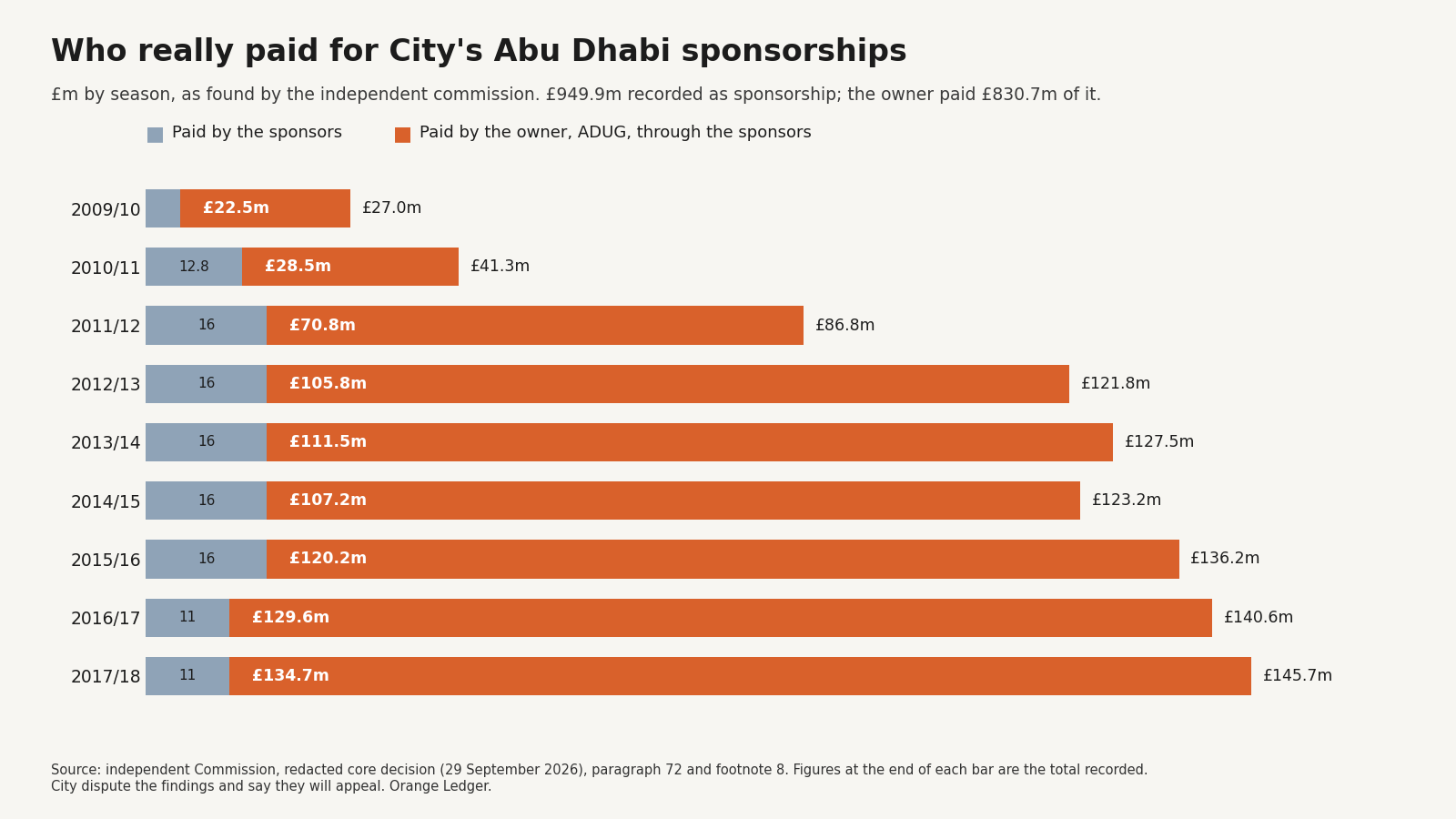
| Season | Sponsorship recorded | Paid by the sponsors | Paid by ADUG |
|---|---|---|---|
| 2009/10 | £27.0m | £4.5m | £22.5m |
| 2010/11 | £41.3m | £12.8m | £28.5m |
| 2011/12 | £86.8m | £16.0m | £70.8m |
| 2012/13 | £121.8m | £16.0m | £105.8m |
| 2013/14 | £127.5m | £16.0m | £111.5m |
| 2014/15 | £123.2m | £16.0m | £107.2m |
| 2015/16 | £136.2m | £16.0m | £120.2m |
| 2016/17 | £140.6m | £11.0m | £129.6m |
| 2017/18 | £145.7m | £11.0m | £134.7m |
| Total | £949.9m | £119.3m | £830.7m |
By 2017/18, the sponsors were paying £11m of £145.7m. Under the rules, every pound in the last column made the club’s income look bigger and its losses smaller than they were.
The commission found that documents were produced to reassure the sponsors that they would never have to pay more than the Base Sum, and to hide the arrangement from regulators and auditors if questions were asked. The club’s auditors and football’s regulators, it found, remained unaware of the scheme for many years.
Not every deal was part of it. The League accepted that two of the early Abu Dhabi sponsorships were negotiated at arm’s length and at a fair price.
City’s explanation, rejected. City denied that any such scheme existed. The club’s case was that the sponsors had paid every fee themselves, sometimes with financial help from the Abu Dhabi government, and that this help happened to match the sums the League said came from ADUG. The commission rejected that account as untrue, concluding that it had been put together well after the event to obscure what had happened.
One finding in the club’s favour on who knew. The commission found no direct evidence that one senior figure, whose name is redacted in the published decision, was aware of or authorised the scheme, and concluded that it was operated without that person’s knowledge.
The scheme in action: May 2013
The decision gives one example of how quickly the scheme could be used. Days before the end of the 2012/13 financial year, an unexpected liability of around £20m left City about £9.9m short of complying with UEFA’s rules for that season. Within days, and without the sponsors even being approached, the commission found, amended sponsorship agreements were produced: higher fees, bonuses for events that had already happened, and payment for a tour of the United States. The shortfall was covered.
A record City did not want to break
One detail explains the timing. In 2009/10, City were close to the record for the biggest loss in a single Premier League season: Chelsea’s £140m in 2006. The commission found that the club was adamant it should not break that record. Using the scheme at the very end of the 2009/10 financial year, including sponsorship payments backdated to earlier in the season, City avoided it.
The money
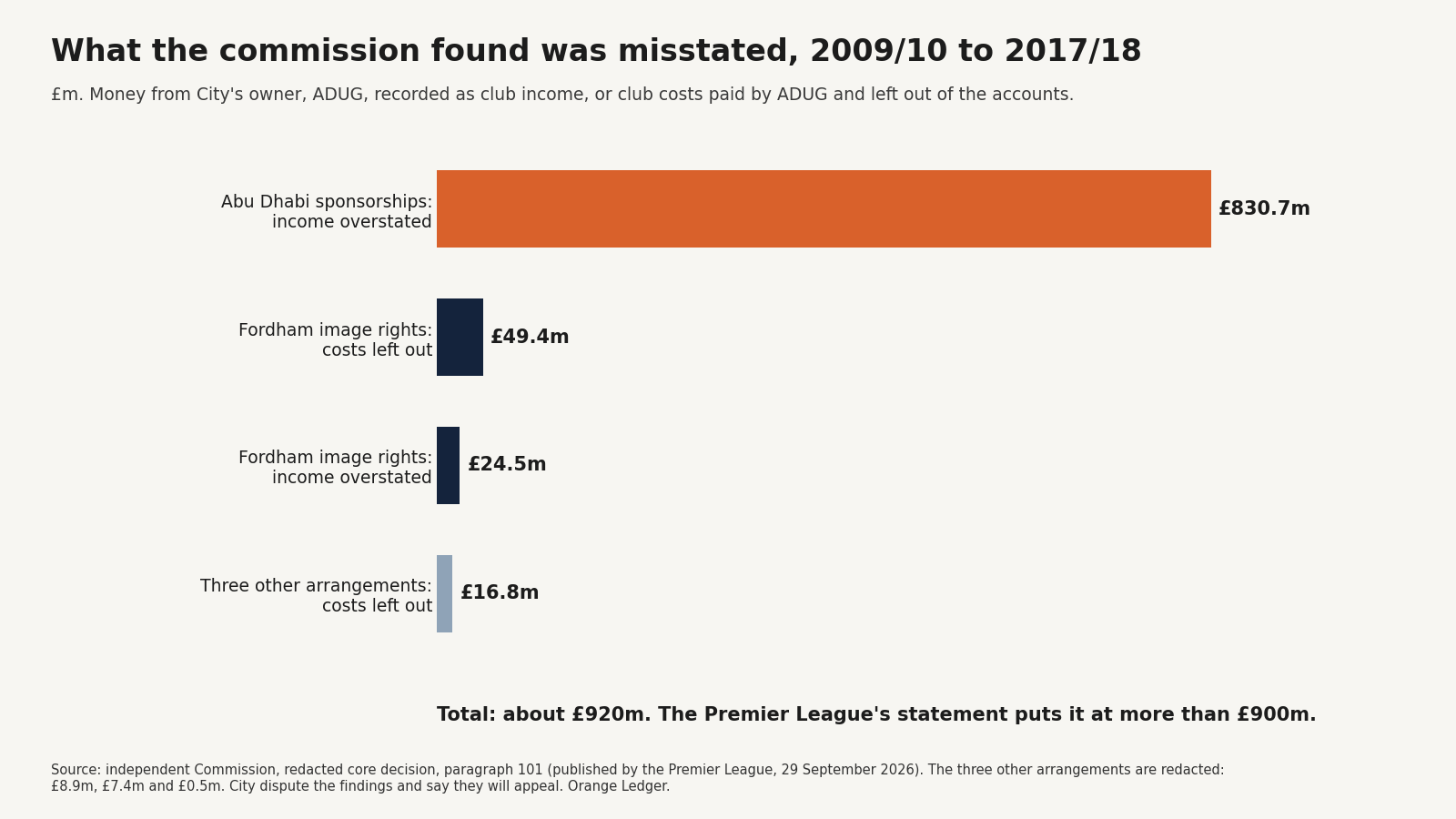
The commission found that City’s accounts for all nine seasons from 2009/10 to 2017/18 did not give a true and fair view of the club’s finances:
| What was misstated | Amount |
|---|---|
| Abu Dhabi sponsorships: income overstated | £830.7m |
| Fordham image rights: costs left out | £49.4m |
| Fordham image rights: income overstated | £24.5m |
| Three other arrangements: costs left out | £16.8m |
| Total | about £920m |
Fordham was a company that bought the image rights of City’s players. The commission found that the arrangement was also funded by ADUG: the money Fordham paid the club was really an injection from the owner, and the image-rights payments to players that Fordham then made were really the club’s costs. The arrangement was one strand of Project Longbow, a wider plan to raise revenue and cut losses; the commission accepted that the other strands were genuine.
The three other arrangements are redacted in the published decision. The commission found that in each, ADUG paid money that was really owed by the club, in payments of £8.9m, £7.4m and £0.5m, so that the costs never appeared in City’s accounts or in the contracts registered with the League.
The commission found that the conduct was intentional. In its words, the club “clearly intended to circumvent the PL Rules”.
What it meant for the rules
Once the accounts are restated, with the owner’s money taken out of income and the hidden costs put back in, the commission found:
- UEFA’s rules: City failed UEFA’s break-even requirement in every season from 2013/14 to 2017/18, by a very large margin, even under the terms of the settlement City reached with UEFA in May 2014.
- The Premier League’s rules: City failed the League’s limit of £105m of losses over three seasons in every season it applied to them, 2015/16 to 2017/18, again by a very large margin.
The precise figures are in appendices not yet published.
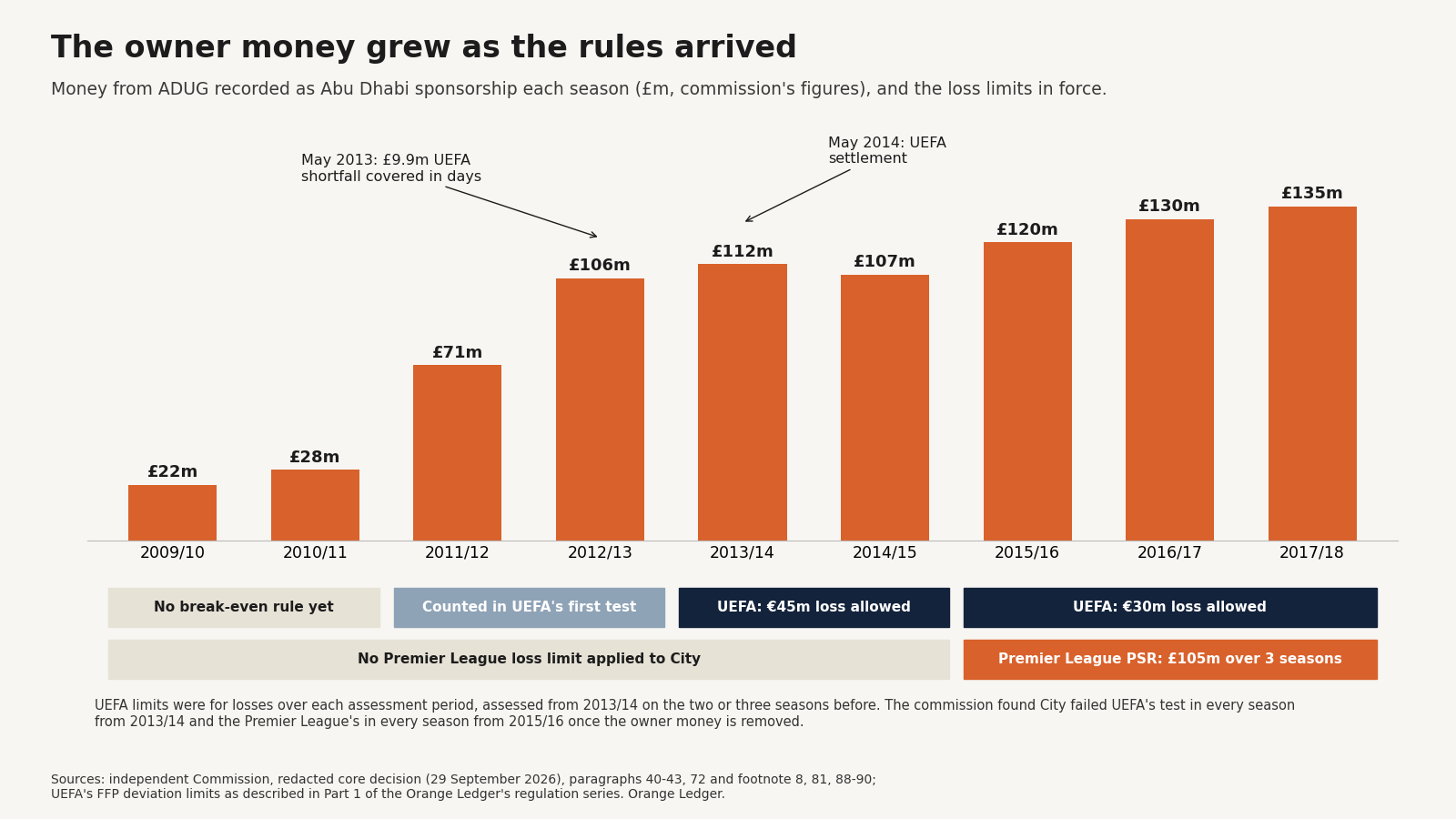
Set against the rules, the pattern is clear. The owner money ran at £22m to £28m a year before any break-even rule existed. It jumped to £71m and then £106m in the two seasons that fed into UEFA’s first break-even assessment, and kept rising once UEFA’s limits and then the Premier League’s took effect.
The commission also reached an alternative conclusion. Even if it was wrong that the sponsorship deals were shams paid for by ADUG, the deals were with companies related to the club’s owner, and their fair market value was very substantially below what City recorded. Valued at a fair price, as the rules require for such deals, City would still have failed both UEFA’s break-even test and the Premier League’s loss limit in every season concerned. The case does not rest on one disputed theory.
And a separate accounting failure. The commission found that the Abu Dhabi sponsorships were related-party transactions, deals with companies connected to the club’s owner, and should have been disclosed as such in City’s accounts so that readers could understand their effect. They were not.
That is a very different conclusion from 2020. Then, the Court of Arbitration for Sport overturned UEFA’s two-year ban, finding most of UEFA’s allegations either not established or too old to pursue, and that City had not disguised owner funding as sponsorship. This case was not a rerun on the same record. After millions of documents had been searched, the commission heard 42 days of evidence from 27 factual witnesses and a range of experts, producing around 7,000 pages of transcripts, and reached the opposite view.
Non-cooperation, and the witnesses
The League opened its investigation in December 2018, after Der Spiegel published documents taken in a hack of City’s servers. It issued the charges in February 2023. The hearing ran for 42 days from September to December 2024, and the decision was published almost two years after it ended, a delay the commission itself called regrettable.
The commission found that City had made concerted efforts to stop and frustrate the investigation, upholding three of the four charges of failing to cooperate. It also found that most witnesses were honest, but that the evidence of a number of important witnesses for the club was false in key respects, and that some of them knowingly gave untrue evidence.
What happens next
- The appeal. City lodged it on 2 October. An appeal board of three, chaired by someone who has held judicial office, can dismiss an appeal, allow it or change the commission’s decision.
- The sanction. A separate, private hearing will decide it. The Orange Ledger’s scenarios for what a points deduction would do to City’s finances show how a sanction would echo through the squad cost ratio for years. They are scenarios, not predictions.
- The appendices. The League says it will publish the full decision when it can. The appendices hold the figures for each season.
City’s current finances are a separate matter. The Orange Ledger’s reconstruction of City’s squad cost ratio uses the club’s accounts for 2024/25, outside the period of the charges, and the decision does not affect it.
Why this matters beyond City
Every financial rule in football that ties spending to income has the same weak point: it trusts the income. If a club’s owner can dress up his own money as sponsorship, the limit on spending becomes a limit on nothing. The commission’s findings show that one club did exactly that for nine seasons, past its auditors and past two regulators.
That is why the Premier League now tests deals with companies linked to a club’s owner against their market value, and why the Orange Ledger’s comparison of Chelsea and City matters: under today’s rule, owner equity does not enlarge the revenue side of the squad cost ratio, while genuine commercial sponsorship does. That means regulators still have to decide whether revenue from companies linked to an owner is genuine and fairly valued. The incentive the commission describes has not gone away. The Orange Ledger’s six-part series on the history of football’s financial rules, starting with Part 1, looks at how the rules got here and how they could close that gap.
More on the Manchester City caseThe ruling, what it could cost City, and what it cost the others
Sources and caveats.
The decision. Independent Commission, redacted Core Decision in The Football Association Premier League Limited v Manchester City Football Club Limited, published by the Premier League on 29 September 2026: outcome (paragraphs 6-7), the Club's challenges (36, 108), ADUG's equity funding (53), the Club's financial position and the loss record (64-66, 79), the Disguised Funding Scheme (63-81), the sponsorship totals and the season-by-season table (72 and footnote 8), the redacted individual's knowledge (70), the Club's explanation (76-77), the May 2013 example (88-90), Project Longbow and Fordham (83-87), the three redacted arrangements (91-97), the misstated sums (101), the findings on each charge including the alternative fair-value findings (110-159), the witnesses (27-29) and the length of the proceedings (8, 15-16, 18). Several pages of the published decision are scanned images; their text was read by the Orange Ledger from the page images. The commission's detailed reasons are in appendices not yet published; names, dates and some amounts are redacted. Season figures in the table are rounded to one decimal place.
Statements. The Premier League's statement of 29 September 2026, including Richard Masters's comments, the appeal deadline, the sanction process and the appeal board. Manchester City's statement of 29 September 2026 as published by the club and reported by The Independent.
The 2020 case. The CAS award of 13 July 2020 as reported at the time.
Position. Manchester City deny the findings and appealed on 2 October 2026. No sanction has been set. This article reports the commission's findings and takes no view on the sanction.
Corrections and updates (1)
25 October 2026 · New evidence · no figure changed
Correction, 25 October 2026. No figure changed. The piece said City had until 2 October to appeal. They appealed on that day: the Premier League’s statement of 2 October 2026 says the club lodged an appeal with the chair of the Judicial Panel, and that an independent Appeal Board of three will hear it in private. No sanction has been set. The description, the opening and the sources now record the appeal as well.