
Analysis
The Premier League's squad cost rules, explained
What PSR was, how clubs learned to game it, and what replaced it in 2026: the 85% line, the allowance of 30 percentage points that ratchets up and down, the levy that doesn't bite until 2027/28, the points deduction, the new liquidity tests, and the parts of the calculation that remain difficult to reconstruct from outside a club.
Figures as of 9 October 2026, Orange Engine release V2BV · Latest figures · What the engine does not capture
Latest note, 25 October 2026 (second): editorial, no figure changed. All 10 correction notes are at the end.
In the last days of June 2024, Premier League clubs under pressure sold young players to one another in deals whose accounting logic was plain: each sale booked a profit in the year the seller needed one. For a decade the League had policed its clubs’ finances with one number, losses, and a well-timed sale could move it.
From the 2026/27 season the League polices a different number, the squad cost ratio: what a club spends on its squad as a share of what it earns from football. A club at or below 85% complies. Above 85%, the club is notified and its final figures for the season are checked, and from 2027/28 it pays a levy if those confirm it is still over the line. Above a second line, which starts at 115%, it loses league points. The first test is on 1 March 2027.
The change is larger than it sounds. Under PSR a £30m profit on a sale counted in full in the year it was booked; under the squad cost ratio the same profit is divided by three and counted in three tests, £10m in each. And the line is drawn against what a squad costs, not against losses; which clubs are above 85% on our estimates is in the series table. This is a guide to both, written for people who have to read club finances rather than write them, and it ends with how to read the ratios this site publishes for every Premier League club.
What PSR was
The Profitability and Sustainability Rules applied from 2013 to the end of the 2025/26 season, and the League keeps its power to pursue breaches from those years. A club’s losses over a rolling three-year period could not exceed £105m, or £15m if the owner wasn’t funding them with equity. Not every cost counted: spending on youth development, the women’s team, infrastructure and community work was deducted before the test, so the number being tested was a club’s “adjusted” loss, and the adjustments were substantial.
The rule had a logic. It let a wealthy owner lose £35m a year for as long as they liked, which kept Chelsea, City and Newcastle’s owners inside it, while stopping a club from betting the house. It also had three flaws that took ten years to fully surface.
How it was gamed
The year-end deadline. Because PSR was tested on each club’s accounts, a club that was over the limit could fix it in the last weeks of its financial year by selling a player whose book value was low. For a club whose year ends on 30 June that meant June; Arsenal’s year ends on 31 May and Sunderland’s on 31 July. Academy players were the perfect instrument: they had no purchase cost, so a £30m fee was close to £30m of profit, less the costs of the sale and any share owed to someone else, booked in the year that needed it. The deals of late June 2024 described above were of this kind, and included academy players moving in opposite directions between clubs under pressure, each side booking a profit on a player the other side then amortised over five years.
Selling things to yourself. Profit on the sale of an asset counted toward PSR, and the rule didn’t require the buyer to be independent. Chelsea sold two hotels to a sister company for £70.5m and their women’s team to another group entity for £198.7m; Aston Villa sold their women’s team and a property company for £113.7m. The gains counted in full for PSR, while UEFA, which had a fair-value test the League didn’t, required adjustments when it assessed both clubs (see the UEFA explainer).
The lag. PSR judged the past. Everton were deducted points in 2023/24 for accounts covering 2021/22; Nottingham Forest likewise. By the time a breach was punished, the squad that caused it had often been sold, and the club being punished was sometimes better run than the one that had overspent. The sanctions were also unpredictable: Everton’s ten league points became six on appeal, then a further two for a second breach, with different commissions reaching different numbers for similar overspends.
Underneath all three was the deeper problem: the rule capped losses, not costs. A club could spend any amount on wages as long as revenue or asset sales covered it, and revenue in the Premier League kept rising. So the rule that was meant to restrain spending sat comfortably alongside the largest wage inflation in the sport’s history.
The vote
On 21 November 2025 the twenty clubs voted 14 to 6 to replace PSR with two new regimes from 2026/27. Fourteen is the minimum for a rule change. The League did not publish how each club voted; the six reported at the time as voting against were Bournemouth, Brentford, Brighton, Crystal Palace, Fulham and Leeds. Several have relied materially on player trading, although the clubs’ individual reasons for opposing the package were not publicly disclosed.
The ratio had already been run in the background alongside PSR since the middle of the 2024/25 season. The 2025/26 season was then a transition year: ratios were calculated and each club was told what would have followed, but no sanction, levy or change to a club’s allowance applied (Appendix 2, Rule H.1).
What SCR is
The squad cost ratio (SCR) divides what a club spends on its squad by what it earns from football.
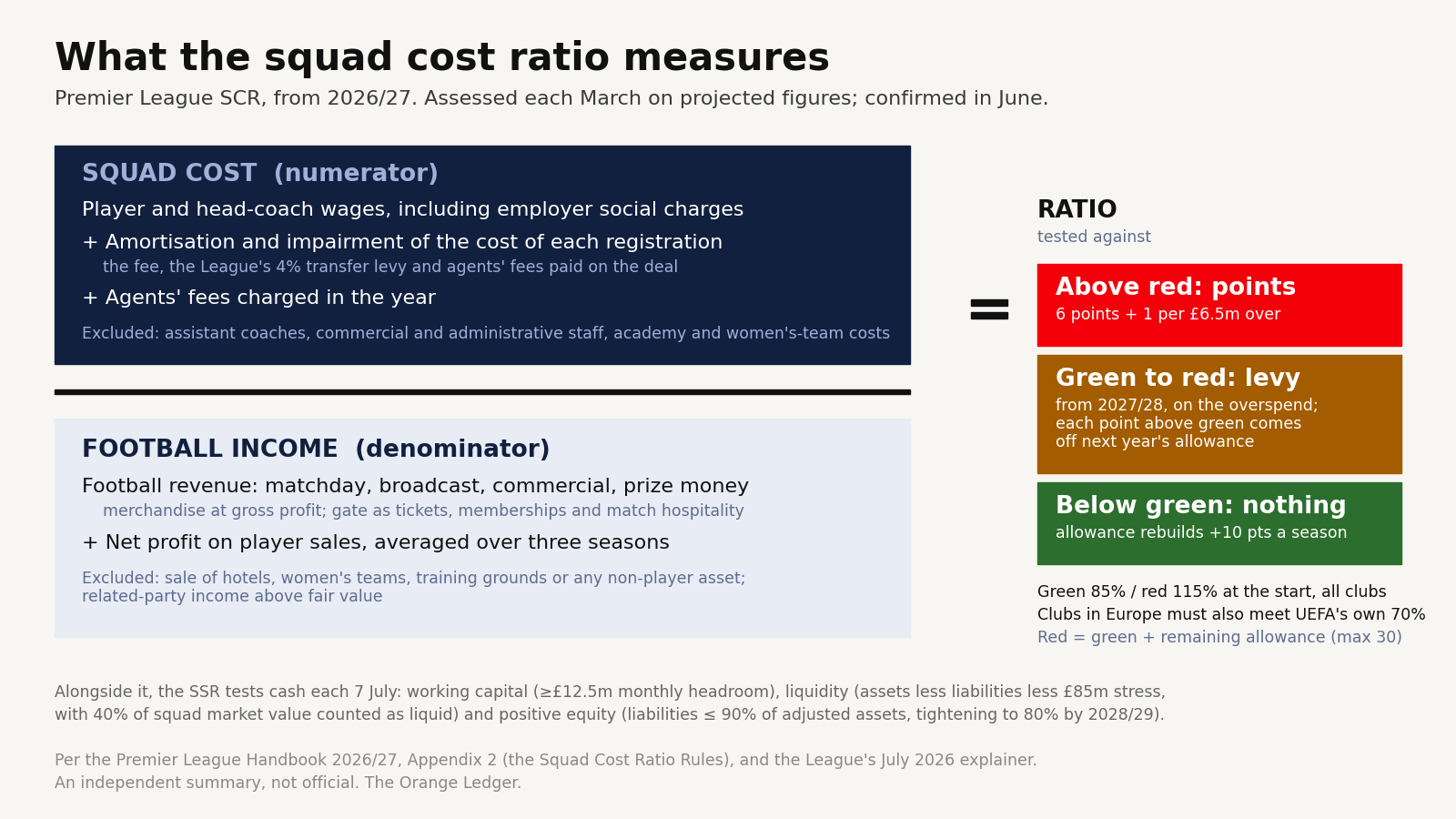
Squad cost, the top of the ratio, has four parts (Rule A.1.22):
- The pay of contract players and the manager, including employer national insurance, pensions, signing-on and loyalty payments, image rights and termination payments. Bonuses are counted as a set percentage of that pay rather than as paid. Assistant coaches and commercial and administrative staff are excluded, and so are the club’s Academy Players. These are players aged under 9 to under 21 registered with its academy. A player stops being one, and starts to count, only when the League accepts that he has outgrown the academy and he has signed a professional contract; for a player aged 17 or over that needs the League’s approval of an application by the club (Youth Development Rules, Rule 1.13). On Kieran Maguire’s figures, players and the manager are roughly three-quarters of the wage bill a club publishes.
- The cost of each signing, spread over the player’s contract. The cost is everything payable in connection with the transfer, including the fee, the League’s 4% transfer levy and agents’ fees on the deal (Rule A.1.43). Spreading it is called amortisation: a player whose registration cost £60m in all, on a five-year contract, counts as £12m a year. A reported £60m fee costs more than that once the levy and agents’ fees are added, so its yearly charge is higher too. For contracts signed or extended on or after 12 December 2023 the spreading is capped at five years, so a six-year contract is charged as though it ran for five; longer contracts signed before that date may still be spread over their full term. If a player’s value is written down below what remains of his cost (an impairment), the write-down counts as well.
- What a club pays to borrow players on loan (Rule A.1.22(e)).
- Agents’ fees charged in the year.
The rule tests a club together with what it calls its reporting perimeter, which reaches any company or person that employs players or incurs football costs for the club, whether or not it sits in the club’s group (Rule A.1.55). A squad employed by a sister company still counts.
Revenue, the bottom of the ratio, is football revenue, and the rule builds most of it from defined bases rather than taking it straight from the accounts (Rule A.1.29):
- League money, with the merit payment taken at the best of last season’s finish, the three-year average finish and fifteenth place, plus facility fees for televised matches;
- commercial revenue from last season, at least £15m, with merchandise counted at gross profit, sales less the cost of the goods (Rule A.1.19);
- gate receipts, meaning tickets, memberships and match hospitality, taken at last season’s average per home match and multiplied by the home matches the rule counts (Rule A.1.30);
- European prize money for a club that has qualified and goes past the competition’s qualifying stage, at the highest of three amounts (Rule A.1.29(e), set out in the UEFA explainer), and a three-year average of domestic cup money;
- profit on selling players, averaged over three seasons.
Not included: the sale of a hotel, a women’s team, a training ground or anything else that isn’t a player. That was the door PSR left open, and the new rule closes it.
Profit on selling players enters as an average. Profit on a sale is the fee less what remains of the player’s cost on the books: a £50m sale of a player with £20m still on the books makes £30m before the costs of the sale. That is why an academy player with no purchase cost produces profit close to the whole fee, less the costs of the sale and any sell-on share owed to another club. The rule adds up the profit or loss a club has made on player sales over the last six transfer windows, which is three seasons, and divides the total by three. The two windows of summer 2025, the early window of 1 to 10 June opened for the Club World Cup and the main window, count as one. The result is added to revenue (Rules A.1.13, A.1.53 and A.1.29(g)), and the guidance adds contingent sums and any loan fee received above the loaned player’s costs.
The average has three consequences:
- A club that sells every year sees the effect smoothed.
- A club that makes one large sale and then stops keeps a third of that profit in its revenue for three successive tests, and then loses it in one step when the sale leaves the period.
- A sale counts from the first test whose period includes it, at a third of its profit each time. A sale in June 2026 falls before the January 2027 window, the last window the 2026/27 tests count, so it counts in the March 2027 test and the next two. A sale in June 2027 comes after that window, so it first counts in the 2027/28 test.
To see the arithmetic, take a club whose squad costs £300m, with £330m of football revenue and £30m a year of average profit on player sales. Its ratio is £300m divided by £360m, or 83.3%. Without the sale profit, the same club would be at 90.9%, above the line. The figures are illustrative, not any club’s.
UEFA’s separate squad cost rule averages over the same three years by different arithmetic, taking a 36-month period and prorating it to twelve (Article 93.04).
The thresholds
There are three bands, and the middle one is where most of the interesting cases sit.
At or below 85%. A club at or below 85% at the March test is compliant with the green threshold. It receives a Positive Feedback Notice, and its allowance for the following season rebuilds by ten percentage points, up to the maximum of 30 (Rules C.3 and A.1.44).
Above 85% and at or below the red line. The club has breached the green threshold. That triggers a Breach Notification and an Accounts Confirmation Test, in which the League tests the season’s outturn using the club’s provisional accounts rather than the March estimate (Rules C.4 and D.1).
If the confirmed ratio is still above 85%, the club’s allowance for the next season is cut; if it has come back to 85% or below, the allowance rebuilds by ten percentage points instead (Rule D.2).
No levy is charged for 2026/27; levies begin with breaches in 2027/28. From then, a club whose confirmed ratio is above 85% pays a levy equal to its overspend multiplied by the number of percentage points it is over: a club £25m and five percentage points over the line pays 5% of £25m. The overspend is the lower of the March and the confirmed figure, and a club that stayed at or below 85% in the two previous seasons can reduce its levy. For 2027/28, the first season with a levy, a club can show that discipline for 2025/26 through PSR compliance or the transition-year ratio, and a promoted club through its record in the EFL (Rules A.1.35, A.1.37, E.7 and E.8; Part 3 of the regulation series works through the levy in detail).
This band starts 30 percentage points wide. The League describes it as allowing clubs to “invest ahead of revenues.” Maguire’s description is that clubs have treated it as a target rather than a constraint, and the summer of 2026, a record £3.46bn, is the evidence.
Above the red line. The club still goes through the Accounts Confirmation Test, and from 2027/28 pays a levy if the confirmed ratio is above 85% (Rules C.4.1 and D.2.2). It also loses league points: six, plus one more for every £6.5m, or part of £6.5m, spent over the line (Rule F.4). A club over the red line in consecutive seasons has the deduction multiplied by 1.3 in the second season and 1.6 in the third (Rule F.5). The deduction is set on the March figure, and a lower confirmed ratio reduces the levy but does not undo the deduction.
Clubs in European competition face a second test on top. UEFA’s own squad cost rule caps them at 70%, assessed on the calendar year under UEFA’s regulations, with UEFA’s sanctions and no allowance. The League’s explainer says clubs outside Europe “only have to comply with the League’s SCR, which has a higher threshold of 85%”, which reads as two concurrent regimes rather than one. Some analysts have read the detailed rules as moving the League’s own thresholds to 70% and 100% for European clubs; Appendix 2 sets out no separate European threshold, so the two regimes run side by side and a club in Europe complies with both.
The allowance, and why it ratchets
The 30 percentage points between green and red are not a fixed band. They are an allowance that each club starts with, called the Club Error Margin (Rule A.1.17), and it moves with the club’s behaviour.
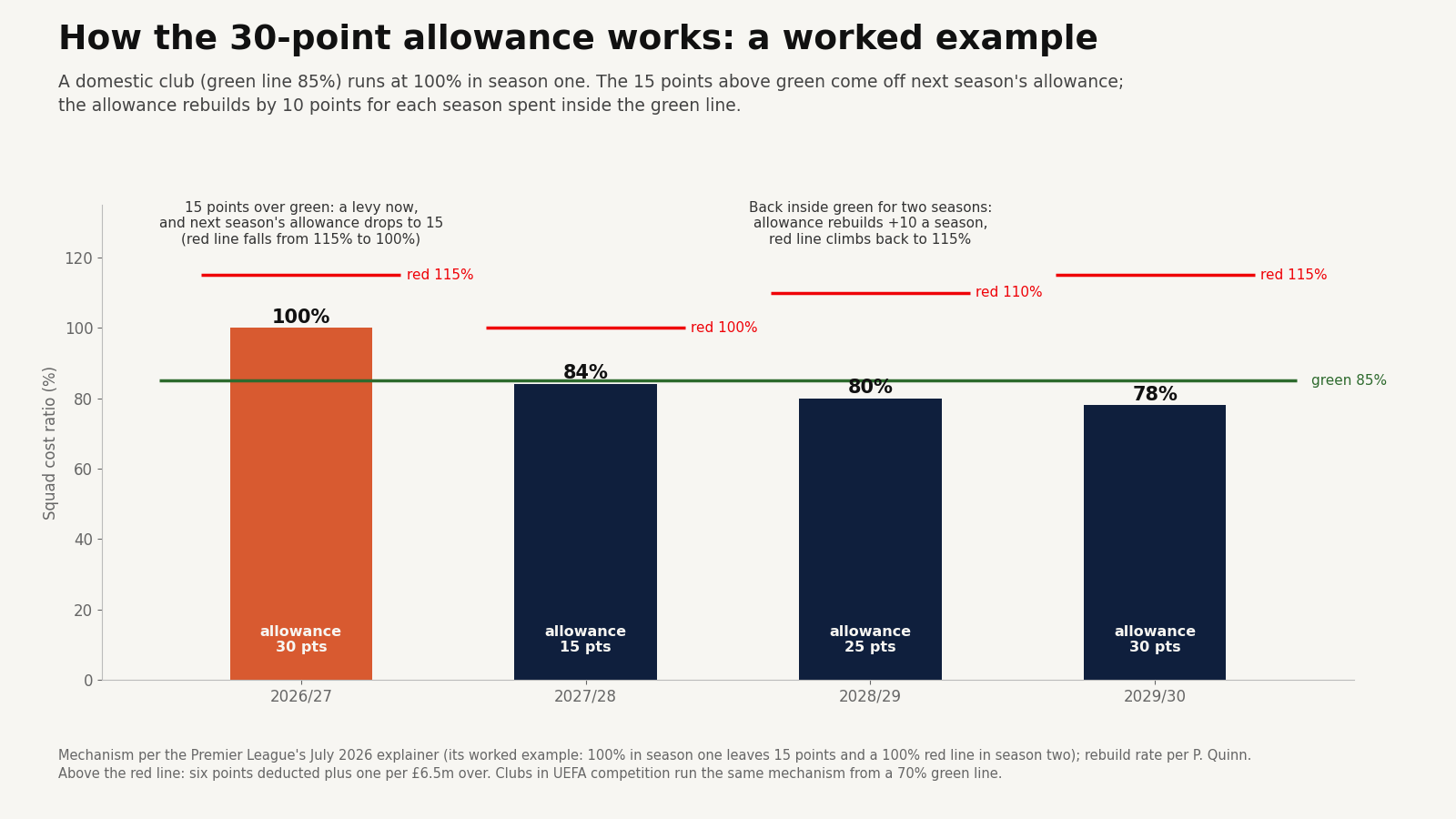
Where a club remains above 85% at the Accounts Confirmation Test, the excess reduces the following season’s allowance. The League’s own example: a club that finishes at 100% against an 85% green line has used 15 percentage points, so next season it has 15 left and its red line is 100%, not 115%. Finish at 100% again and the allowance is gone; the red line is now the green line, and the next overspend is a points deduction.
The cut is not simply the number of percentage points above 85%. Rule A.1.39 takes the lower of two figures, each rounded to the nearest whole percentage point: the overspend at the March test divided by the season’s actual football revenue, and the season’s actual ratio less 85%. Because the rule takes the lower, revenue above forecast reduces the first figure, and squad cost below the March estimate reduces the second. To take an illustrative club with £200m of football revenue and £200m of squad cost at the March test: its ratio is 100%, and its overspend is £30m above the £170m that 85% would allow. If its revenue for the season comes in at £220m and its costs do not change, the first figure is £30m divided by £220m, 13.6 percentage points. The second is 90.9% less 85%, 5.9 percentage points. The allowance is cut by the lower, rounded to 6 percentage points, rather than the 15 the March figure alone would suggest. No cut can be stated from a March estimate alone, which is why our club articles describe what would follow above the line rather than give a figure for it.
In the other direction, the allowance rebuilds by ten percentage points, up to the cap of thirty, for a club at or below 85% at the March test, and also for a club that breached in March but whose confirmed ratio for the season comes in at or below 85% (Rules C.3 and D.2.1). Only the first receives the Positive Feedback Notice, but both rebuild.
This is the mechanism the chart above walks through, and it is the part of the rule that changes club behaviour most. A club can spend above its means for a season with, this year, no levy at all. Doing it for two seasons uses up the allowance quickly when the overspend is large: two seasons at 100% exhaust it, while two at 90% use only ten of the 30 percentage points. For a club whose squad cost exceeds its revenue before player sales, the allowance is a countdown. Selling players, raising recurring revenue or cutting squad cost can bring the club back to 85% or below, and from then the allowance rebuilds by ten percentage points for each qualifying season, not all at once. For the clubs in Europe, UEFA’s 70% cap sits underneath it with no countdown at all.
When it’s tested
The ratio is tested once a year, on 1 March, after the January window, on each club’s projected figures for the season; football revenue inputs are agreed with the League before the season using formulas and historical figures, and those club-specific figures are not public. Clubs above 85% then face the Accounts Confirmation Test, on the season’s outturn as shown in provisional accounts that a club normally submits by 1 June, a date the Handbook moves to 26 June for the 2026/27 season (Rules B.2 and H.3), and, where required, an Accounts Confirmation Test True-Up in October. The point is speed: a club knows in March where it stands, not eighteen months later.
That date has a consequence the club pieces keep returning to. At both the March test and the June confirmation, January is the most recently completed transfer window, because the following summer’s window has not closed, so January is the last window whose player-trading profit can enter the season’s average on either test. The old profitability rule ran on the accounting year, so the year end was the deadline. For player trading under the new rule, the deadline has moved.
SSR: the other half
Alongside SCR the League introduced the Sustainability and Systemic Resilience (SSR) rules, which set three tests.
This section is a step less certain than the rest. The test dates below are from Appendix 3 of the Handbook, which holds the SSR rules. The other details rest on the League’s published explainer and contemporaneous reporting, and have not all been checked against the rule text.
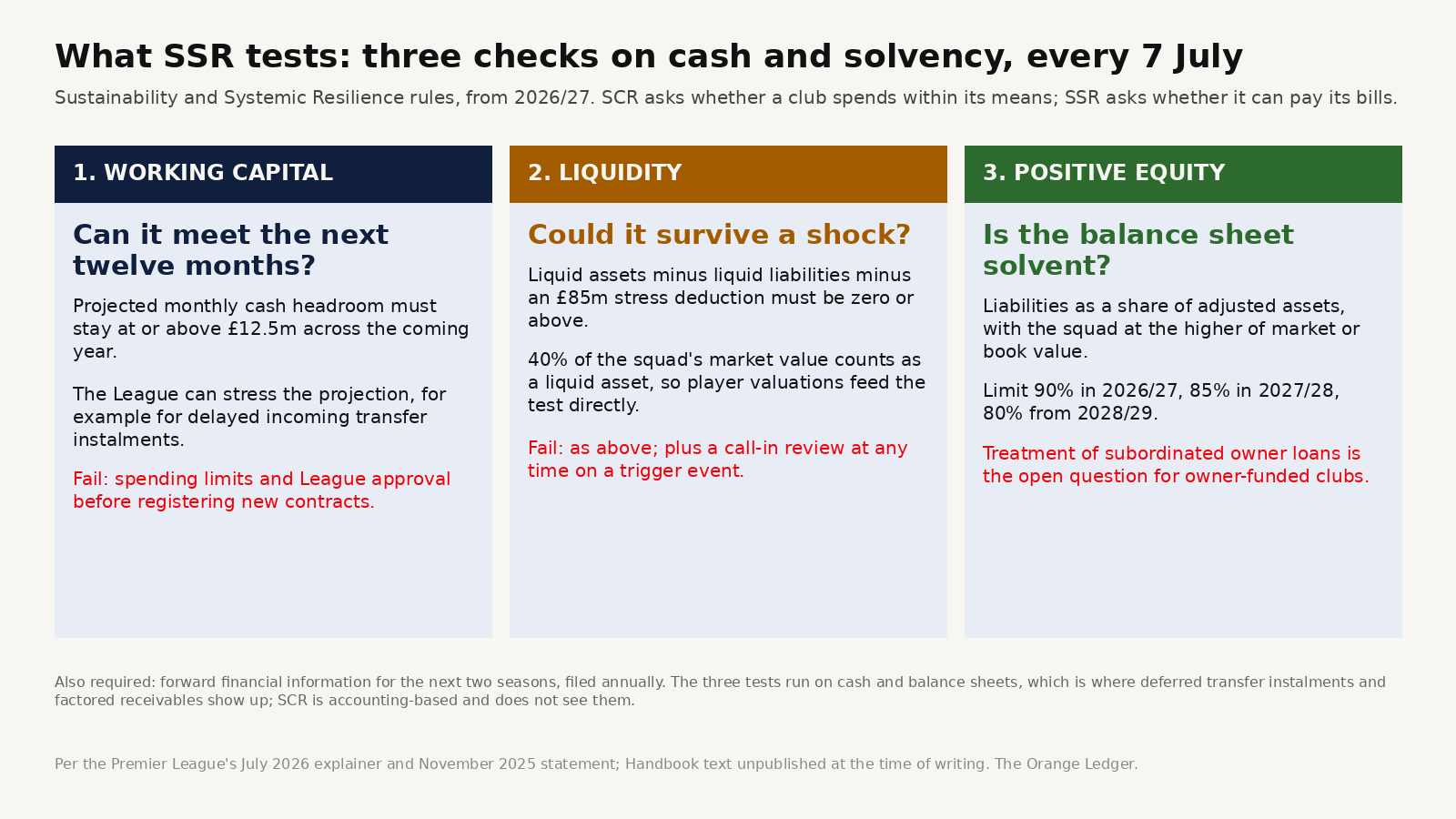
- Working capital: a club must show at least £12.5m of projected monthly resources over the coming year.
- Liquidity: liquid assets less liquid liabilities, less an £85m stress deduction, must be zero or above, with 40% of the squad’s market value counting as a liquid asset.
- Positive equity: liabilities, which include shareholder loans as well as external debt, as a share of adjusted assets must be no more than 90% this season, 85% next, and 80% from 2028/29, and the squad enters adjusted assets at its full market value, or net book value if higher.
The working capital test is on 7 July. The liquidity and positive equity tests are on 7 July too, except for a newly promoted club, which is tested on 31 October, and the League can call in any club for a test on another date (Appendix 3, “SSR Test Date”). Clubs also file forward financial information for the following two seasons. Failure can bring spending limits and a requirement for League approval before registering new contracts.
SSR is the part of the package aimed at the problem PSR never touched, which is cash. A club can be compliant with SCR and short of liquidity, because SCR runs on accounting and the transfer market runs on instalments. And player valuations matter twice: 40% of squad market value enters the Liquidity Test, while the Positive Equity Test includes the full squad market value, or net book value if higher, in adjusted assets. A fall in player valuations therefore moves a club toward failing the Liquidity Test and shrinks the asset base in the equity test without the club spending a pound, and in a market where those valuations are marked to the clubs’ own trades with each other, that is a quirk worth watching.
How to read the ratios published on this site
Every club rebuild on this site opens with a table. Its lines mean the following.
-
Squad cost ratio, 1 March 2027 test: our estimate of where the club stands against the rule, with the three-year average of sale profit in the revenue.
-
SCR before player trading: the same ratio without the sale-profit average, which shows whether the squad costs more than the football revenue the rule counts.
-
Revenue added by the rule: how many percentage points higher the ratio would be without three parts of the revenue that the rule supplies rather than the club earning them in the season: the merit payment above the fifteenth-place floor, European prize money, and the extra home gate European matches bring.
-
Effect of player-sale profits: how many percentage points the sale-profit average takes off the ratio.
-
Green headroom: how much more the squad could cost before the ratio reached 85%. A negative figure is the amount by which it is already above.
-
Assumption range: where the ratio lands if each uncertain input is set at the low or high end of what is plausible. It is not a probability.
-
Stress case (costs only): every uncertain cost set against the club at once, with revenue held at the central estimate. A club whose range sits below the line can still cross it under stress.
-
Completed disposals this season: the profit or loss on the sales the club has completed so far in 2026/27, which is already in the average.
-
Figures for later tests: where a rebuild gives them, each test averages the sales of the six transfer windows before it, with squad cost and revenue held at this season’s level and no further selling.
The club articles call the 85% threshold the green line and the 115% starting point the red line.
The ratios are our reconstructions, not the League’s calculation. The League computes each club’s ratio on revenue inputs agreed privately with the club before the season. We rebuild the revenue on the rule’s own basis from filed accounts and the League’s published figures, and count players signed since a club’s last accounts at the reported fee plus 12%, for the levy and agents’ fees (Three definitions in the squad cost rule, and what they change). Every club article shows its arithmetic, so a reader can substitute their own assumptions, and The Orange Engine sets out how the estimates are built and checked.
Each article keeps the figures of the release it printed and says which release that was. Club pages and the Premier League SCR table always show the latest figures.
Projections that depend on how the rule’s allowance will move, such as next season’s red line, are a step less certain than the ratios themselves and are labelled as provisional wherever they appear.
Regulatory room is not financial strength, and financial strength is not regulatory room. A club can be comfortably inside 85% and finance against next season’s League distributions in August; a club can be above 85% with an owner paying in equity and the cheapest bank debt in the division. The club pieces report both.
What it changes, and what it doesn’t
It changes the incentives. Under PSR a club managed its losses; under SCR it manages its ratio. For clubs already carrying high squad costs, profitable player trading is one of the fastest ways to improve the ratio, but player sales create temporary capacity, while recurring revenue and lower wages create structural capacity. A sale can create an immediate accounting gain for the seller while the buyer recognises its acquisition cost through amortisation, and when both clubs operate under the same SCR system that asymmetry can make intra-league trading particularly useful. It changes the timing: March, not eighteen months later. It changes what a club can sell to comply: players, not hotels.
It doesn’t change the wage bill, which is where the money goes. A rule that permits squad cost of 115% of revenue for a season, and 85% indefinitely, is not a rule that reduces wages; it’s a rule that ties them to revenue with a generous lag. And SCR controls the accounting cost of the squad; it does not regulate the bilateral credit created when transfer fees are deferred. That sits as a liquidity and counterparty-risk problem, partly visible to SSR and mostly visible to no one, which is why SCR and SSR should never be analysed in isolation.
Three different questions
SCR asks whether the squad cost fits the club’s regulatory capacity: wages, amortisation and agents’ fees against football revenue and player trading. SSR asks whether the club’s balance sheet and liquidity can survive a shock: cash, working capital, liabilities, equity and player values. Neither tells you when the transfer cash actually arrives, who owes it, or how dependent one club has become on another club paying. That third question is about the market’s structure, not its regulation, and it’s the one the rules don’t fully reveal.
In the modern Premier League, understanding a club requires answering all three.
Sources and caveats.
The Premier League's rules. Premier League Handbook 2026/27 (published 31 July 2026; the rules cited are unchanged in the edition of 21 October 2026). Appendix 2, the Squad Cost Ratio Rules, in particular the Application paragraph and Rules A.1.13, A.1.17, A.1.19, A.1.22, A.1.29, A.1.30, A.1.35, A.1.37, A.1.39, A.1.43, A.1.44, A.1.53 and A.1.55, B.2, C.3, C.4, D.1, D.2, E.7, E.8, F.4, F.5 and H.1 to H.3. Appendix 3, the SSR Rules, for the test dates. The Premier League's statement of 21 November 2025 and "New Premier League financial system explained" (21 July 2026) for the SSR thresholds and the League's own descriptions.
The vote and its background. The League did not publish a club-by-club vote; the six clubs against are as reported at the time (for example by Gulf News and SuperSport, 21 and 22 November 2025). The background trial is from Sky Sports, 21 November 2025. PSR history is from published commission decisions and contemporaneous reporting.
Analysis and reporting. Kieran Maguire on The Price of Football (August and September 2026); Chris Weatherspoon, The Athletic, 14 August 2026; Paul Quinn, theesk.org. UEFA Club Licensing and Financial Sustainability Regulations 2026 for the parallel regime.
Scope. The reading of Appendix 2 covers the definitions, revenue provisions and consequences relevant to the ratio, not every operative provision. Appendix 3 has been read for the SSR test dates only. The worked examples are illustrative and describe no club.
Not advice.
Corrections and updates (10)
11 September 2026 · Regulatory interpretation · several figures: see the note
Correction, 11 September 2026. The first version presented two points as settled that the League’s own public material does not settle: separate 70/100 thresholds for clubs in Europe, and three-year averaging of player-sale profit. Both are now described as what they are, interpretations pending the detailed rule text, and the levy’s 2027/28 start date has been added. The corrections are in the body rather than hidden.
13 September 2026 · Editorial · several figures: see the note
Update, 13 September 2026. A section on how to read the ratios published in the club rebuilds, and what “green line” means on this site, added ahead of the section on what is confirmed.
15 September 2026 · Regulatory interpretation · several figures: see the note
Update, 15 September 2026. Appendix 2 of the 2026/27 Handbook, the operative SCR Rules, has now been read. It confirms three-year averaging of player-sale profit (Rule A.1.13) and the wage perimeter, and it sets out how the League builds its revenue denominator (Rule A.1.29). The sections below are updated to cite it; the earlier hedges are left visible where they were, so that the record of what was known when is intact.
4 October 2026 · Methodology change · several figures: see the note
Update, 4 October 2026. Three descriptions of what the rule counts are made more exact: the cost of a registration is everything payable in connection with the transfer (Rule A.1.43), merchandise counts at gross profit (Rule A.1.19), and gate receipts are tickets, memberships and match hospitality (Rule A.1.30). The diagram of what the ratio measures is redrawn to match; it no longer shows separate thresholds for clubs in Europe, a reading this article withdrew on 11 September. No figure in this article changes (Three definitions in the squad cost rule, and what they change).
9 October 2026 · Methodology change · several figures: see the note
Update, 9 October 2026. The description of the stress case under “How to read the ratios published on this site” now says what it is: the worst case on costs alone, with every uncertain cost input set against the club at once and revenue held at the central estimate. It is not an upper bound of the modelled outcomes: now that last season’s commercial revenue is drawn across a wider range (how we estimate last season’s commercial revenue), a few modelled outcomes at some clubs are above the stress case.
15 October 2026 · Editorial · several figures: see the note
Clarification, 15 October 2026. Wording only; no figure changed. Ranges are described as assumption ranges, the spread of the model’s inputs between assumed bounds, not calibrated or confidence intervals, and the section on how to read the ratios no longer describes a share of modelled outcomes above a threshold.
22 October 2026 · Regulatory interpretation · no figure changed
Correction, 22 October 2026. Several statements about the rules were wrong or incomplete when checked against Appendices 2 and 3 of the 2026/27 Premier League Handbook and the reporting of the vote.
- A recovering club’s allowance. The article said a club that breached at the March test but came in at or below 85% at the Accounts Confirmation Test “receives neither the notice nor a deduction”. Under Rule D.2.1 its allowance rebuilds by ten percentage points; it does not receive the Positive Feedback Notice, which Rule C.3 gives only to a club compliant at the March test.
- A single sale. The article said a club that sells once and stops “sees its ratio rise for three years afterwards”. A third of the profit stays in the club’s revenue for three successive tests and then leaves in one step.
- The vote. The article named West Ham among the six clubs against. The six reported at the time were Bournemouth, Brentford, Brighton, Crystal Palace, Fulham and Leeds; the League did not publish a club-by-club vote. The article also gave 2025/26 as the only shadow season; the ratio had been trialled alongside PSR since the middle of 2024/25, and 2025/26 was a transition year under Rule H.1.
- When PSR ended. The article said PSR ran from 2013 to 2025. It applied to seasons up to and including 2025/26, and the League keeps its power to pursue breaches from those years.
- The two-season wall. The article said a club cannot spend above its means for two seasons “without arriving at a wall”. That holds only for a large overspend: two seasons at 100% exhaust the 30-point allowance, two at 90% use ten.
- Resetting the allowance. The article said only selling resets the countdown. Higher recurring revenue or lower squad cost also bring a club back below 85%, and the allowance then rebuilds by ten percentage points a qualifying season rather than resetting at once.
- UEFA and the asset sales. The article said the Chelsea and Aston Villa asset-sale gains “were never accepted by UEFA”. UEFA required adjustments when assessing both clubs; the article now says so, in line with the UEFA explainer.
- The June 2024 deals. The article said they “made no footballing sense”. Their accounting effect is documented; whether every deal lacked a sporting purpose is not, and the article no longer says so.
- The PSR deadline. The article treated 30 June as every club’s year end. Year ends differ: Arsenal’s is 31 May and Sunderland’s 31 July.
- SSR test dates. The article said all three SSR tests are held each 7 July. Promoted clubs take the liquidity and positive equity tests on 31 October, and the League can call in a club on another date.
- When a June sale counts. The article said a sale in June changes “the current season” by a third of its value. Which season depends on the year: a sale in June 2026 falls inside the period for the March 2027 test, while a sale in June 2027 comes after the last window the 2026/27 tests count and first counts in 2027/28 (Rules A.1.53 and A.1.69).
- What squad cost includes. The article did not mention amounts paid to borrow players on loan (Rule A.1.22(e)), that bonuses count as a set percentage of pay (Rule A.1.22(b)), the five-year amortisation cap for contracts signed or extended from 12 December 2023, or that Academy Players are outside squad cost until the League accepts that they have outgrown the academy (Youth Development Rules, Rule 1.13).
- Levy and sanction detail. The article now gives the transitional route to levy relief for 2027/28 (Rule E.7), and states that a club above the red line also goes through the Accounts Confirmation Test and, from 2027/28, the levy (Rules C.4.1 and D.2.2).
- Profit on an academy sale. The article said it equals the fee. It is the fee less the costs of the sale and any share owed to another club.
- How to read this site’s ratios. That section explained labels the club tables do not print and said articles are updated together after each release, which the policy of 22 October 2026 replaced. It now explains the labels the tables use and the current policy.
No figure changed. The article’s account of how the ratio works is unchanged apart from these points. The errors were our reading of the rules and of the reporting of the vote.
22 October 2026 (second) · Editorial · no figure changed
Editorial, 22 October 2026. Wording only; no figure changed.
- The opening describes the June 2024 sales before naming the rules, and gives the 85% and 115% lines and the first test date.
- What the ratio counts is set out as lists. Amortisation, sale profit and the three-year average are explained with worked examples, labelled as illustrative.
- The levy and points-deduction formulas are given, and a worked example of the allowance cut is added.
- The three SSR tests are listed separately.
- The section “What’s confirmed, and what still isn’t”, and sentences describing what this article said on earlier dates, are removed; that record is in the notes above.
- “Points” for the allowance now reads “percentage points”.
- Em dashes, most bold and “limb” are removed from the body.
- The sources note is divided into headed paragraphs.
25 October 2026 · Regulatory interpretation · no figure changed
Correction, 25 October 2026. No figure changed. The list of the revenue the rule counts gave European prize money at the highest of three amounts without the condition the UEFA explainer gives: it counts only for a club that goes past the competition’s qualifying stage (Rule A.1.29(e) and its guidance). The condition is now stated. The sentence on the six transfer windows now says which two summer 2025 windows count as one (Rule A.1.53).
25 October 2026 (second) · Editorial · no figure changed
Correction, 25 October 2026 (second). No figure changed. The opening said the new number is “harder to move but easier to hit”, a judgement the article did not explain. It now states the mechanism and its figures: a sale’s profit counts in full in one year under PSR, and a third of it in each of three tests under the squad cost ratio (Rules A.1.13 and A.1.53); and that the line is drawn against what a squad costs, with a link to the series table for which clubs are above it.