
Analysis
UEFA's financial rules, explained
Four English clubs were fined by UEFA in June for a rule most fans have never had described to them. This is what the Club Licensing and Financial Sustainability Regulations actually test: the football earnings rule, the 70% squad cost cap, overdue payables, settlement agreements, the exchange-transaction rule, and how all of it sits alongside the Premier League's own regime.
Figures as of 9 October 2026, Orange Engine release V2BV · Latest figures · What the engine does not capture
Latest note, 25 October 2026: regulatory interpretation, no figure changed. All 6 correction notes are at the end.
On 30 June UEFA fined four English clubs, Aston Villa, Chelsea, Newcastle and Nottingham Forest, for spending too much on their squads, and fined Strasbourg, Chelsea’s sister club under the same owners, more than any of them. Villa’s breach was classed as “significant”, and it came with a limit on how many players they can register for Europe this season. Most of the reporting stopped at the size of the fines.
The fines were for breaching UEFA’s squad cost rule, which limits what a club in European competition may spend on its players and head coach, including the cost of its signings, to 70% of the football income UEFA counts. It was the first time the 70% limit had been enforced at full strength. The rule is one part of the Club Licensing and Financial Sustainability Regulations, the successor to Financial Fair Play, which UEFA retired in 2022: they are longer, stricter in some ways and looser in others. For the nine English clubs in Europe they now run alongside the Premier League’s own squad cost rule, and the two measure the same thing differently. This guide explains UEFA’s rules first and then sets them against the League’s, using UEFA’s 2026 regulations and Appendix 2 of the 2026/27 Premier League Handbook.
Three pillars
The Club Licensing and Financial Sustainability Regulations, the CLFSR, have three financial pillars. Solvency asks whether a club pays its bills when they fall due. Stability asks whether it loses more than a set amount over three years. Cost control asks whether its squad costs more than 70% of its football income. UEFA’s monitoring applies them to clubs in its competitions, although smaller clubs can be exempt from the stability and cost-control requirements, and each pillar is measured over a different period.
Solvency: no overdue payables
Solvency is the simplest of the three and the one that catches clubs first. Every club must declare, on 15 July and again on 15 October, that it has no overdue payables to other clubs, to employees, to tax and social-security authorities or to UEFA itself in respect of amounts that fell due by 30 June, or by 30 September. An amount still unpaid on the declaration date counts as overdue unless the club can show that it has been offset against what the creditor owes, that the creditor has agreed in writing to a later deadline, or that it is the subject of a genuine dispute, among the exceptions UEFA allows (Annex H).
A club that had overdue or deferred payables at either of those dates, or that UEFA’s Club Financial Control Body (CFCB) asks, must make the same declaration on 15 January for amounts that fell due by 31 December (Articles 81 to 84). Payables more than ninety days overdue at a payment deadline are an aggravating factor (Article 97). Transfer instalments count. This pillar is the reason a club cannot simply stop paying another club: it risks UEFA disciplinary action and ultimately its eligibility to compete. It does nothing, though, if the club is insolvent rather than slow, and it doesn’t look at how much a club has committed to pay in future.
Stability: the football earnings rule
The stability pillar replaces the old break-even rule. Over a three-year monitoring period a club’s aggregate “football earnings” deficit must not exceed €5m, or €60m if the excess is covered by equity contributions from the owner. A club in good financial health can raise that equity-funded limit further, by up to €10m for each year of the period in which it passes UEFA’s tests of equity, liquidity and debt, is not under a settlement agreement and has no breach of UEFA’s monitoring requirements, provided its owner’s funding covers the extra amount too. That is up to €30m more in all, so the largest permitted three-year deficit is €90m (Article 88). Football earnings are the club’s result with qualifying long-term investments deducted (youth development, women’s football, community work, infrastructure costs) and with income transactions adjusted where necessary to fair value, including relevant related-party transactions.
That last adjustment is what separates UEFA from the old Premier League rules. When Chelsea sold hotels and their women’s team to sister companies, and Villa did the same with their women’s team and a property company, those transactions could produce domestic accounting benefits that were not fully available under UEFA’s football-earnings calculation. UEFA subsequently required adjustments when assessing Chelsea and Villa, and both entered multi-year settlements in July 2025 (Chelsea for four years and up to €80m; Villa for three years and up to €20m) in the same summer they were compliant at home.
Cost control: the 70% squad cost ratio
The cost-control pillar produced June’s fines. A club’s squad cost may not exceed 70% of its relevant income, the football income UEFA counts, which is defined below (Article 94). UEFA phased the limit in by licence season, the season a club’s UEFA licence covers: 90% for 2023/24, 80% for 2024/25, and 70% from 2025/26 onwards. Each licence season is tested on the twelve months to the 31 December that falls within it, so the 2025/26 test covered calendar 2025, which is the year decided in June (Article 93.04).
Squad cost has four parts under the 2026 regulations, in force since 1 June 2026 (Article 93.01):
- the wages of players and the head coach, including bonuses, image rights, termination payments and employer social charges;
- the amortisation of their transfer fees;
- the net result on loans, what a club pays to borrow players less what it receives for lending them;
- the fees paid to agents and intermediaries.
Amortisation is the cost of a signing spread over the years of the player’s contract, so a fee enters squad cost a slice at a time rather than all at once. UEFA spreads it over five years at most, however long the contract; if a contract is extended, the remaining cost may be spread over the new term, again for no more than five years from the extension (Annex G.3.4). The players counted are the club’s registered male professionals, so a young player on a professional contract counts like any other (Annex K.1.2). The wider academy’s running costs, the women’s team, assistant coaches and commercial and administrative staff are outside it.
UEFA also allows for differences in employment taxes. It compares what a club’s players and coach cost in total with what they take home, and sets a reference relationship between the two, currently 2.16 and valid until UEFA announces another figure. A club whose taxes and social charges push its own figure above that reference can reduce its squad cost by the difference (Annex K.1.6). This matters more in France than in England.
Relevant income is adjusted operating revenue plus three transfer items: the profit or loss on selling players, any impairment of players’ registration costs (a write-down when a player’s value falls below what is left of his cost on the books), and other transfer income and expenses (Article 93.01). An impairment is a charge against profit, so, like a loss on a sale, it reduces this total and, other things being equal, raises the ratio. The 2025 edition of the regulations counted impairment in squad cost alongside amortisation; the 2026 edition moves it into this group.
The two sides are measured over different periods. Wages, amortisation, loans, agents’ fees and operating revenue are measured over the twelve months to 31 December. The three transfer items are smoothed: UEFA takes them over the 36 months to 31 December and prorates the result to twelve months, so a large sale counts at a third of its value in each of three successive tests (Article 93.04). The Premier League reaches a similar three-year average by counting transfer windows rather than calendar months: it adds up the profit or loss across the last six completed windows and divides by three (Rule A.1.13). The two regimes therefore average over the same span without producing the same number.
A club whose total employee costs were below €30m both in the financial year ending in the calendar year its UEFA competition begins and in the year before is exempt from the cost-control requirements. The rest are measured on the calendar year and decided the following summer: calendar 2025 was decided on 30 June 2026, and calendar 2026 will be decided in mid-2027.
What a breach costs
The sanction for exceeding 70% is a fine calculated as a percentage of the “excess”, the amount by which the club’s squad cost exceeds what a 70% ratio would allow. It is withheld from the solidarity and prize money the club earns in UEFA competitions, and if that money is not enough the club pays the rest by a deadline the CFCB sets (Annex L.1). The percentage depends on how far over the limit the club is and how many times it has breached in the current and previous three seasons: 10% to 25% of the excess for a first breach of up to ten percentage points over 70%, rising through the grid to 75% to 100% for a large or repeated breach (Annex L).
To take an illustrative club with €400m of relevant income and €320m of squad cost: its ratio is 80%, ten percentage points over the limit. A 70% ratio would allow €280m of squad cost, so the excess is €40m, and a first breach of that size costs between €4m and €10m.
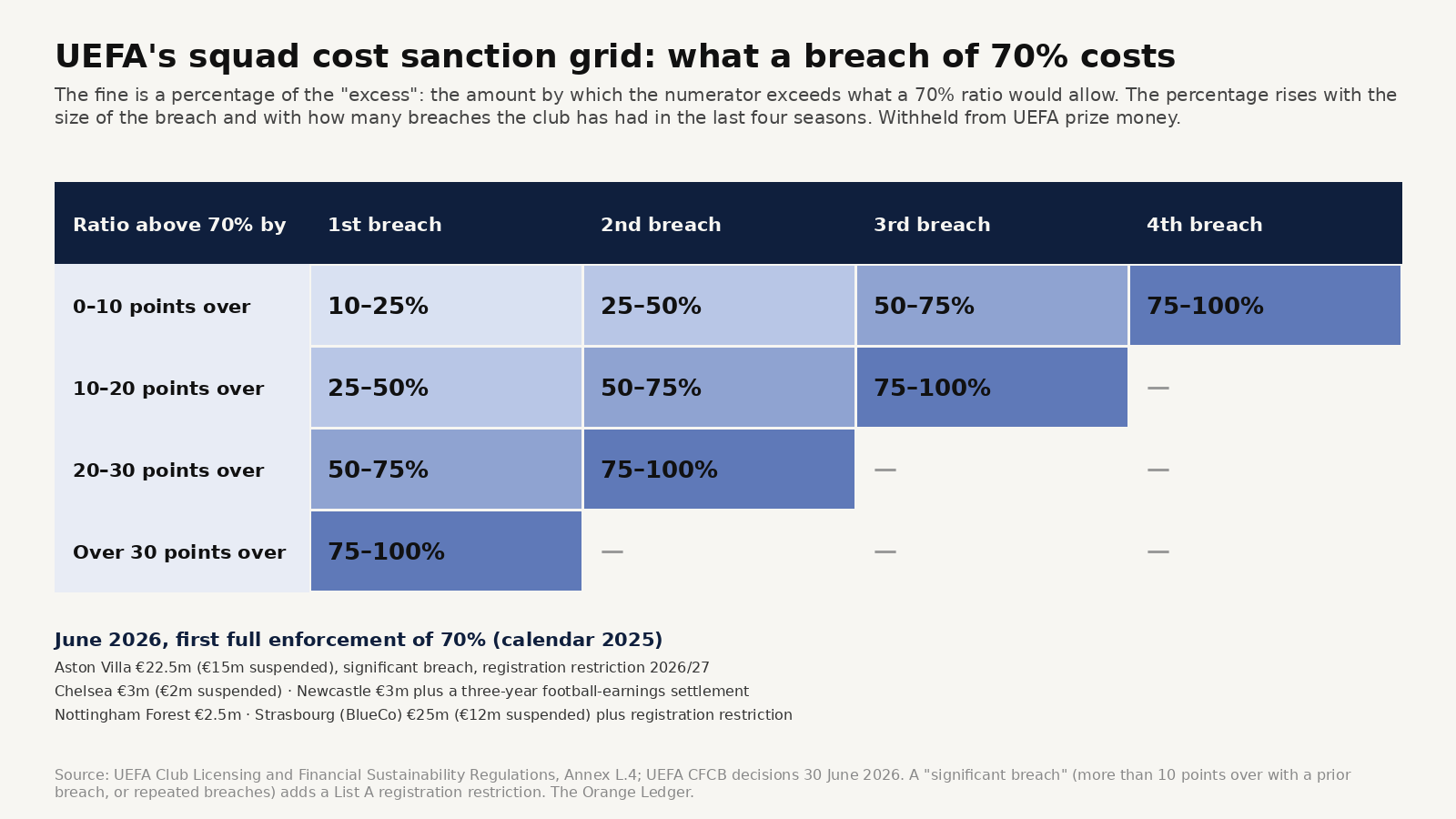
UEFA classes a breach as “significant” in three cases: a ratio more than 20 percentage points over the limit; a ratio more than 10 percentage points over by a club that has breached at least once in the previous three seasons; or any breach by a club that has breached two or more times in those seasons (Annex L.2). A significant breach brings further measures on top of the fine, such as a restriction on the club’s List A, the squad it can name for UEFA competition, and escalation can reach exclusion.
June 2026 shows the grid at work. Villa, over the line for the second year running and by a wide margin, took a €22.5m fine with €15m suspended on continued improvement, plus the registration restriction. Chelsea, also a repeat offender but with an improving trend, took €3m with €2m suspended. Newcastle took €3m on squad cost and, separately, a three-year football-earnings settlement. Forest took €2.5m for a first breach. Strasbourg, in BlueCo’s multi-club group with Chelsea, took €25m with €12m suspended and their own registration restriction.
70% is not a mechanical cliff. Bologna and Napoli were also above 70% for calendar 2025, but UEFA says their deviations were fully mitigated by football-earnings surpluses, and neither was sanctioned. The regulations let the CFCB view a breach more favourably where the club is generating surpluses under the stability rule. A ratio above the line is the start of the assessment, not the end.
Settlements
A breach of the football earnings rule can end in a fine or in a settlement agreement, and the CFCB decides which. A settlement is a multi-year plan with annual targets, a conditional fine that becomes payable if the targets are missed, a List A restriction, and a conditional one-season exclusion at the end of the chain. In June 2026 Newcastle and Juventus agreed three-year settlements, Newcastle’s carrying a €10m fine of which €7m is conditional, while four other clubs that breached the rule, Nice, Santa Clara, Astana and Partizan, were fined. Chelsea’s settlement, agreed in 2025, runs to 2029 with a zero-deficit target by 2027; Villa’s runs to 2028. Settlements are why a club can be compliant one year and still be paying for an earlier one, and why a club’s transfer strategy in a settlement year is shaped by targets the public can’t see.
The rule that changes how clubs deal with each other
Buried in UEFA’s accounting annex is a provision that matters a great deal this year. When two clubs move players in opposite directions and the transactions form an “exchange”, UEFA limits what each club can book (Annex G.3.5). The selling club’s proceeds for the outgoing player are capped at that player’s net book value, the part of his cost not yet written off, adjusted for any net cash it receives. The profit it can record is therefore no more than the net cash it receives, and can be less: no paper gain can be booked on the players themselves. The buying club can capitalise the incoming player at no more than the outgoing player’s carrying amount, adjusted for any net cash it pays. Where the CFCB has doubts about an exchange, it can require both adjustments (Annex J.9).
The indicators of an exchange include deals in the same or linked contracts, deals with little cash changing hands, deals with matching payment terms, and deals concluded within 45 days of each other; the regulation says “and/or”, so they aren’t all required at once. The effect is to prevent clubs creating artificial accounting gains through reciprocal or economically linked player transfers. Swapping academy players at inflated prices, a Premier League habit in the PSR years, is the obvious high-profit example: two academy players carry no book value, so if each is “sold” for £30m and no net cash changes hands, each club books £30m of profit in its own accounts and nothing under UEFA’s rule.
Appendix 2 of the Premier League Handbook does not contain UEFA’s exchange-specific accounting adjustment. That does not put Premier League transfers outside fair-value control, but the League’s control works differently. Under its separate associated party transaction (APT) rules, deals between associated parties are given a fair market value assessment, and large transactions with non-associated parties are submitted as Threshold Transactions, so that the Board can test whether they are in fact associated-party deals or otherwise not conducted at arm’s length. An ordinary transfer between two independent clubs therefore receives no standalone fair-value test merely because it is a player registration.
The League’s control asks a different question. Linked deals in opposite directions can therefore produce domestic accounting profits that UEFA may restrict for its own calculation, and the 2026 summer produced several candidates. Villa sold Rogers and Martínez to Chelsea and took Jackson and Garnacho the other way, all inside 45 days; Brighton and Tottenham exchanged centre-backs days apart for nearly equal fees. Whether the CFCB classes any of them as exchanges is a decision for 2027, and the money involved is not small.
Related-party player transfers, between clubs under common ownership, are also adjusted rather than simply accepted at their reported values (Annex G.3.7). The buying club records the greater of what it actually paid and the selling club’s adjusted net book value for the player; the selling club records the lower of what it actually received and its own net book value. A transfer inside a group therefore cannot create a profit for the seller under UEFA’s rules, and cannot reduce the buyer’s cost below what the player was already carried at. UEFA’s wider fair-value rules also allow the CFCB to commission further independent valuations and, where two assessments are made, to use their average (Annex J.8). For a group like BlueCo, with Chelsea and Strasbourg trading players, that means the reported fee is the starting point of UEFA’s calculation, not the end of it.
How it fits with the Premier League’s rules
The two regimes now run in parallel for the nine English clubs in Europe, and they don’t match. The League’s explainer describes its own squad cost ratio (SCR) at 85% for all its clubs, with an allowance of up to 30 percentage points above it (the rule’s Club Error Margin, Rule A.1.17), so the red line at which sporting sanctions begin starts at 115%. It also says clubs in UEFA competition must comply with UEFA’s 70%. Appendix 2 sets out no separate European threshold: the two regimes run side by side, and an English club in Europe complies with both on their own terms.
| Item | UEFA CLFSR | Premier League SCR |
|---|---|---|
| Threshold | 70% maximum | 85% green; initial 115% red |
| European Premier League club | Must satisfy UEFA’s 70% | Still subject to the League’s 85/115, with no separate European line |
| Period | The twelve months to 31 December within the licence season | Football season |
| Wage perimeter | Players and head coach, including employer charges | Players and the Manager, including employer charges; assistants excluded (Rule A.1.22) |
| Amortisation period | The contract, at most five years (Annex G.3.4) | The contract, at most five years for contracts signed or extended on or after 12 December 2023; earlier contracts over their full term (guidance to Rule A.1.22) |
| Impairment of player registrations | On the income side, with the transfer items (Article 93.01) | In squad cost (guidance to Rule A.1.22) |
| Transfer-related result | 36 months prorated to 12 (Article 93.04) | Aggregate profit or loss over six windows, divided by three (Rule A.1.13) |
| European prize money | The club’s own distributions, as earned | A reference amount under Rule A.1.29(e), which need not be what the club earned |
| Related-party and exchange deals | Fair value; exchange proceeds and costs capped | No equivalent exchange-specific adjustment in Appendix 2; separate APT rules give associated-party deals a fair market value assessment, with large non-associated-party deals submitted as Threshold Transactions |
| Sanction | Percentage of the excess, withheld from prize money; List A restriction | Breach Notification and Accounts Confirmation Test above green; levy from 2027/28; points deduction above red |
| Cash tests | No overdue payables, declared each July and October, and in January where required | SSR: working capital, liquidity, equity, each 7 July |
The European money itself is counted quite differently, and this is the sharpest divergence between the two. UEFA measures what a club actually received. The Premier League does not. For a club that has qualified for a UEFA competition in the season being tested, Rule A.1.29(e) credits the highest of three amounts:
- what the club received from that competition in the prior year;
- its average from that competition over the last three years, where it took part;
- an estimated average distribution for reaching the round of sixteen in that competition.
The credit counts only if the club progresses past the competition’s qualifying stage. Each of the following has shown up in our club articles.
A first-time qualifier is credited with money it has never earned. Bournemouth reached Europe for the first time, so the prior-year and three-year amounts for that competition are nil. Subject to the qualifying-stage condition, the round-of-sixteen reference amount therefore becomes the one that counts.
A club promoted between competitions has its actual winnings excluded. Crystal Palace won the Conference League, earning about €21.55m, and that victory qualified them for the Europa League. Because the rule treats the competitions as separate, Palace’s prior-year Europa League amount is nil; subject to the same qualifying-stage condition, the Europa League reference amount replaces the Conference League distribution for this Premier League calculation.
And a club that leaves Europe loses the European credit entirely while keeping the revenue its European season generated. Nottingham Forest played in Europe in 2025/26 and finished sixteenth in the Premier League. The 2026/27 European credit is nil, but last season’s commercial revenue and gate receipts per home match still count, because the rule takes those from the prior season. This site’s estimate of Forest’s commercial revenue for last season, which the rule uses, makes no specific allowance for that campaign.
An English club in Europe is therefore measured twice, on different calendars. The UEFA regime uses a 70% threshold, with the mitigation provisions described above, while the Premier League has a separate green-to-red allowance before sporting sanctions apply. A summer of profitable trading can improve both ratios. The domestic and UEFA effects can diverge because the two regimes use different measurement clocks, and because UEFA may adjust linked, exchange or non-arm’s-length transactions that would otherwise produce a larger accounting gain. And a club can be fined by UEFA in June for a year in which the Premier League assessed it in March, on different numbers.
The question neither regime answers
There is a fourth question these rules do not address: counterparty exposure. UEFA checks whether a transfer instalment has become overdue, but that is different from measuring the stock of future transfer obligations between clubs. A club can be compliant today while carrying large future payables, or relying on large receivables from other clubs, that have not yet fallen due. UEFA is effectively policing whether clubs paid what was due. What neither regime directly provides is a complete measure of the stock, maturity profile and counterparty concentration of future transfer credit: who owes whom, when the cash falls due, and how exposed one club is to another failing to pay.
What to watch
The CFCB’s decisions for calendar 2026 arrive in mid-2027 and will be the first to test the summer’s exchange candidates. Chelsea’s return to Europe, if it comes, reactivates both the 70% line and their settlement.
Sources and caveats.
UEFA's rules. UEFA Club Licensing and Financial Sustainability Regulations, 2026 edition, in force 1 June 2026: Articles 81 to 84 and Annex H (no overdue payables), Article 88 (acceptable deviation), Articles 93 and 94 (squad cost ratio and rule), Annex G.3.4 (amortisation and impairment), Annex G.3.5 (exchange transactions), Annex G.3.7 (related-party transfers), Annexes J.8 and J.9 (fair-value assessment and exchange transactions), Annex K.1 (squad cost, including K.1.6 on employment taxes) and Annex L (sanctions, including L.1, L.2 and the grid at L.4). The 2025 edition for the earlier treatment of impairment, and the 2022 edition, Article 104.02, for the phase-in at 90% and 80%.
The Premier League's rules. Premier League Handbook 2026/27 (published 31 July 2026), Appendix 2, in particular Rules A.1.13, A.1.17, A.1.22, A.1.29 and A.1.53; the League's November 2025 statement and July 2026 explainer.
Decisions and reporting. UEFA CFCB statements of July 2025 and 30 June 2026, including the June 2026 fines and settlements and the Bologna and Napoli mitigation; sanction details as reported by Sky, Yahoo and Goal; Lagom Sports Compliance and Cholismo Lab explainers; Paul Quinn, theesk.org.
Estimates and readings. The round-of-sixteen reference amounts required by Rule A.1.29(e) are not public and are reconstructed from each competition's distribution structure; the club examples cited are the reconstructions published on this site, not official figures. The €400m worked example of a fine and the academy-swap example are illustrative and describe no club. The application of the exchange-transaction rule to specific 2026 deals is my reading, not a CFCB decision. This article describes the rules as the 2026 edition sets them out; it does not establish which edition's definitions UEFA applied in its June 2026 decisions on calendar 2025, which came weeks after the 2026 edition took effect.
Not advice.
Corrections and updates (6)
11 September 2026 · Regulatory interpretation · several figures: see the note
Correction, 11 September 2026. The comparison with the Premier League’s rules no longer presents 70/100 thresholds for European clubs as established, the related-party transfer treatment has been corrected against Annex G.3.7, and the Bologna and Napoli mitigation example has been added.
15 September 2026 · Regulatory interpretation · several figures: see the note
Update, 15 September 2026. Appendix 2 of the 2026/27 Premier League Handbook has now been read, so the comparison rests on both primary texts. The 70/100 question is resolved — Appendix 2 sets no separate European threshold — and a section has been added on Rule A.1.29(e), under which the League credits a club with a reference amount for European prize money rather than what it actually received.
9 October 2026 · Data correction · several figures: see the note
Correction, 9 October 2026. This article said that the commercial and gate figures Nottingham Forest’s European campaign had inflated were still in the denominator. Last season’s commercial revenue is not yet filed and is now estimated by one published method, the same for every club (how we estimate last season’s commercial revenue); the commercial estimate contains no specific allowance for that campaign. The rule still takes last season’s commercial revenue and gate receipts per home match, whatever they turn out to be.
22 October 2026 · Regulatory interpretation · no figure changed
Correction, 22 October 2026. Several descriptions of UEFA’s rules were wrong or incomplete when checked against UEFA’s 2026 regulations.
- Exchange deals. This article said UEFA’s exchange rule caps the selling club’s profit at the outgoing player’s book value plus any net cash received. Annex G.3.5 caps the selling club’s proceeds, not its profit, at the outgoing player’s net book value adjusted for net cash. The profit it can record is therefore no more than the net cash it receives.
- Impairment. The article counted impairment of players’ registration costs in squad cost. Article 93.01 of the 2026 regulations puts it on the income side, with the other transfer items, smoothed over 36 months. The 2025 edition counted it with amortisation. The Premier League’s rule still counts impairment in squad cost (guidance to Rule A.1.22), and the comparison table now shows the difference. Because an impairment is a charge, it reduces UEFA’s income-side total and raises the ratio.
- A single sale. The article said a club that sells once and stops “sees its ratio rise for three years”. Under both UEFA’s and the Premier League’s averaging, a third of the profit stays in the club’s income for three successive tests and then leaves in one step.
- Overdue payables. The article said every club declares three times a year and that fifteen days late is tolerated. Articles 81 to 84 require every club to declare on 15 July and 15 October; a January declaration applies only to a club with overdue or deferred payables, or on the CFCB’s request. The fifteen days is the gap between the date a payment falls due for the test and the declaration, not a general allowance. The article also implied that every amount due must be paid; an unpaid amount is not overdue where it has been offset, deferred by written agreement or genuinely disputed, among the exceptions in Annex H.
- Settlements. The article said a settlement, not a fine, is the usual outcome of a football earnings breach. The CFCB decides between the two; in June 2026 it agreed two settlements and fined four other clubs.
- The Villa and Chelsea deals. The article said Villa and Chelsea traded Rogers one way and Jackson, Garnacho and Martínez the other. Martínez moved from Villa to Chelsea, the same way as Rogers; only Jackson and Garnacho went the other way.
- Significant breach. The article described a significant squad cost breach incompletely: a first breach of more than 20 percentage points over the limit is significant too (Annex L.2).
- Further detail. The article now sets out both sides of the related-party rule (Annex G.3.7), how UEFA phased in the 70% limit by licence season (2022 edition, Article 104.02; 2026 edition, Article 93.04), which players count in squad cost (Annex K.1.2), UEFA’s five-year limit on amortisation and how it differs from the Premier League’s (Annex G.3.4; guidance to Rule A.1.22), how the employment-tax adjustment works and that its 2.16 reference stands until UEFA changes it (Annex K.1.6), and that a club pays any part of a fine its UEFA money does not cover (Annex L.1).
No figure changed, and the article’s comparison of the two regimes is unchanged. The errors were our reading of the regulations; the impairment change reflects the 2026 edition, which the article had not fully applied.
22 October 2026 (second) · Editorial · no figure changed
Editorial, 22 October 2026. Wording only; no figure changed. The opening now describes the June fines before naming the rules. The section on exchange deals and the League’s associated party transaction rules is split into the UEFA mechanism, the League’s control and the 2026 cases. The three amounts under Rule A.1.29(e) are set out as a list. Mechanisms are explained where they first appear: amortisation, how the transfer result is smoothed, a worked example of a fine, and why an academy swap books no profit under UEFA’s rule. Sentences describing when this article was first written, and the order in which the rulebooks were read, are removed, as are em dashes in the body. Squad cost is set out as a list. The football earnings limit now states the €90m maximum that Article 88 implies. The exemption from cost control is restated in plain words. The description of the transfer-result smoothing now distinguishes UEFA’s months from the League’s transfer windows. Nottingham Forest’s sixteenth place is identified as a Premier League finish. The sources note is divided into headed paragraphs.
25 October 2026 · Regulatory interpretation · no figure changed
Correction, 25 October 2026. No figure changed. The sentence on overdue payables said that more than ninety days late is an aggravating factor and cited Articles 81 to 84, which do not say so. Article 97 of the regulations does: payables more than ninety days overdue at a payment deadline are an aggravating factor. The sentence now cites it. The table now states the Premier League’s five-year cap as the rest of the series does, for contracts signed or extended on or after 12 December 2023, where it said only “signed” (Rule A.1.22(c), which runs from the date a contract is executed; an extension is a new contract).