
Analysis
City has 27 sponsors with no Abu Dhabi state ownership identified. What do they do now?
The independent commission has ruled on Manchester City's past. The next test is commercial: whether the companies that pay City for reasons of their own still want to pay the same price. Most of City's 34 global partners have no Abu Dhabi state ownership identified, and several signed while the case was pending. The Orange Engine shows what lost sponsorship would do to City's spending room, alone and combined with a sanction.
Figures as of 25 October 2026, scenario version V2BO · Latest figures · What the engine does not capture
Latest change to the figures, 25 October 2026: on the figures of 25 October City are at 73.7%, from 76.1%, and about £113m of lost revenue would use their room under 85%, from £86m. All 8 correction notes are at the end.
The commission’s decision does not only create a sanctions problem for Manchester City. It creates a pricing problem for every company that pays to be associated with the club.
On 29 September the Premier League published the independent commission’s core decision. As the Orange Ledger has set out, it found that for nine seasons City recorded money from its owner as sponsorship income from Abu Dhabi companies, that the club clearly intended to get round the League’s rules, and that it later tried to frustrate the investigation. City dispute the findings and have appealed (2 October 2026), and no sanction has been set.
The legal process could run for months. The commercial one has already started. Most of the companies that sponsor City today have no Abu Dhabi state ownership identified. They pay because they believe the club gives them reach, prestige and a good name to stand next to. Whether that is still what they are buying, and at what price, is now the question.
Who City’s partners are
City list 34 global partners. Paul Quinn of The Esk published a mapping of City’s board and its commercial partners on the same day as the decision. Using it, the partners fall into three groups:
| Group | Partners |
|---|---|
| Owned or controlled by the Abu Dhabi or UAE state (5) | Etihad Airways, e&, Experience Abu Dhabi, Emirates Palace Mandarin Oriental, Aldar |
| Another relationship identified, or ownership not disclosed (2) | Qualtrics, owned by Silver Lake, which holds about 17% of City Football Group; Ohana Development, whose ultimate owner is not disclosed |
| No Abu Dhabi state ownership found (27) | PUMA, OKX, Asahi, Revolut, BYD, Betway, EA Sports FC, Publicis Sapient, Wix, Trendyol, Xylem, Unilever, JinkoSolar, QNET, Socios, JNC, Joie, Veritran, CP Company, AUX, N-Able, Axi, Topps, Unilumin, VTEX, Hytro, Evelyn Partners |
The last group is described carefully. “No Abu Dhabi state ownership found” is not the same as proven independence: Quinn notes that his negative finding is not the result of exhaustive testing. But these are commercial brands for which no Abu Dhabi state ownership has been identified, and this article is about them.
Why the timing matters
Several of City’s biggest partnerships outside Abu Dhabi were signed or extended while the charges were already public. The League charged City in February 2023; the hearing ended in December 2024.
| Partner | Sector | What they signed |
|---|---|---|
| PUMA | Sportswear | Ten-year extension, July 2025, reported at about £100m a year across several City Football Group clubs |
| OKX | Crypto exchange | Sleeve deal from June 2023, reported at £55m over three years, since extended |
| Asahi Super Dry 0.0% | Beer | Official beer partner since July 2022; front of the men’s and women’s training kit from 2023/24, reported at about £20m a year |
| Betway | Betting | Multi-year global partnership from 2024/25, announced July 2024, reported at over £4m a year |
| EA Sports FC | Video games | Extended July 2024 |
| BYD | Electric vehicles | Multi-year automotive partnership, February 2026, reported at over £5m a year |
| Revolut | Fintech | Global partner and back-of-shirt partner, February 2026 |
| Trendyol | E-commerce | Official marketplace partner, August 2026 |
| AUX | Air conditioning | Global partner for 2026 to 2028, announced 20 August 2026: its first global sports partnership |
AUX signed five weeks before the decision was published. Every one of these companies knew the case existed. None of them knew what an independent commission would find: that nine seasons of accounts did not give a true and fair view, that owner money was disguised as sponsorship, that some of the club’s witnesses gave evidence they knew to be untrue, and that the club tried to frustrate the investigation.
As far as the Orange Ledger can find, none of these partners has commented publicly since the decision.
What sponsors usually do
The closest recent example is Chelsea in March 2022, although the trigger was different: UK government sanctions on the club’s owner, not a disciplinary finding.
- Three, the shirt sponsor, suspended a deal reported at about £40m a year and asked for its brand to be removed until further notice.
- Hyundai, the automotive partner, said it was assessing the relationship.
- Nike, the biggest partner, reported at about £60m a season, kept honouring its deal.
- Three resumed once the club had been sold.
The lesson is about how sponsors behave, not a prediction of what City’s will do. A sponsor does not have to walk away to hurt the value of a commercial relationship. It can pause, review, renegotiate or simply pay less next time. For City, the quieter risks include:
- Lower prices at renewal, or extensions on cheaper terms.
- More rights for the same money: extra advertising, access or content.
- Protection clauses in future deals, covering lost European football or a points deduction.
- Fewer new partners, or new partners at lower prices.
City’s individual contracts are private, and their termination terms are not known. Sponsorship agreements can include protection for brands against reputational damage or a sharp fall in exposure, but nothing here suggests that any particular City partner has such a right. Commercial damage can happen without a single sponsor announcing anything.
What lost revenue would do to City’s spending room
This is where commercial confidence turns into regulatory capacity.
The Orange Ledger’s reconstruction of City’s squad cost ratio for the first test in March 2027 puts City at 73.7% on the figures of 25 October 2026: squad costs of £627.4m against £851.3m of revenue and averaged player-sale profit. That leaves £96.3m of room before the 85% base threshold, which becomes the levy threshold from 2027/28.
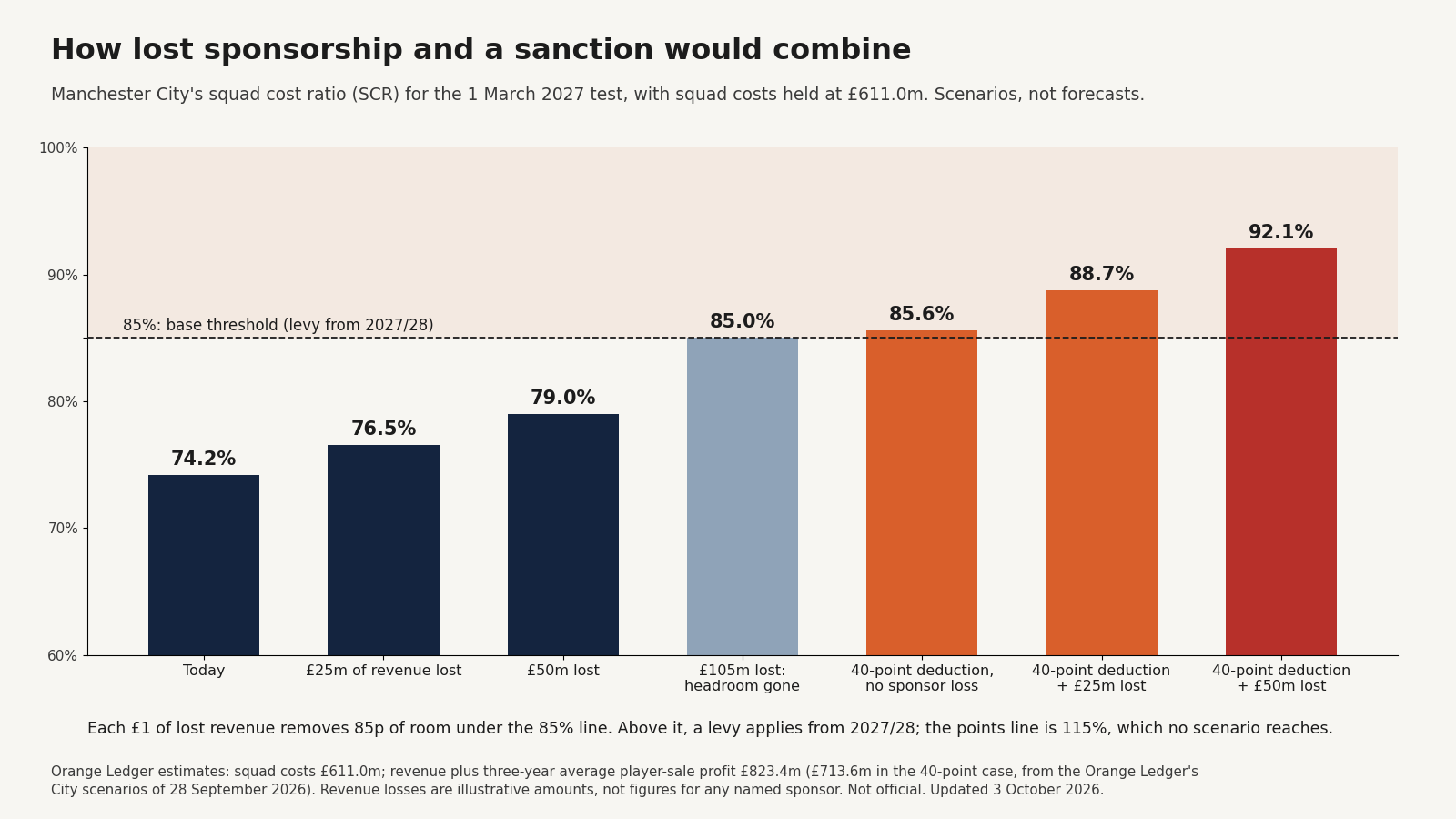
Commercial revenue counts in full in the ratio, and City’s filed accounts for 2024/25 show £340.4m of it, out of £694.1m in total. Every £1 of revenue City loses removes 85p of spending room. So:
Chart drawn on 3 October 2026, on earlier figures; the table gives the figures of 25 October 2026.
| Scenario | Revenue lost | Squad cost ratio | Room under 85% |
|---|---|---|---|
| On the figures of 25 October 2026 | £0 | 73.7% | £96.3m |
| Sponsor losses | £25m | 75.9% | £75.0m |
| Sponsor losses | £50m | 78.3% | £53.8m |
| Headroom gone | £113m | 85.0% | £0 |
| 40-point deduction, no sponsor loss, at the 2027/28 test | £0 | 85.4% | £3.2m over |
| 40-point deduction plus £25m lost, at the 2027/28 test | £25m | 88.4% | £24.4m over |
| 40-point deduction plus £50m lost, at the 2027/28 test | £50m | 91.7% | £45.7m over |
The three rows that include a 40-point deduction come from the scenario piece of 28 September, rerun on 25 October 2026, and apply at the 2027/28 test, the first a deduction would reach. The amounts lost are illustrations, not figures for any named partner. City’s accounts do not split commercial income by sponsor, and several of the largest deals, including PUMA’s, cover more than one club in the group, so no individual sponsor’s contribution to City’s own revenue can be read from the published figures.
Why a sanction and sponsor losses would feed each other
On its own, sponsor damage eats into City’s cushion: about £113m of lost revenue would use it all.
A heavy sanction works from the other direction. In the Orange Ledger’s scenarios of 28 September, a 40-point deduction, by costing City its league position and European football, would push the ratio to 85.4% at the 2027/28 test on its own, just above the 85% base threshold.
Put the two together and they reinforce each other. A sanction reduces what City can offer a sponsor: fewer televised big matches, no Champions League, less global exposure. A sponsor paying less, or not renewing, reduces the revenue behind City’s spending limit just as the sanction has already cut it. With £50m of sponsor losses on top of a 40-point deduction, City’s ratio would reach 91.7%, well above 85%. None of the scenarios reaches the 115% line where league points would be deducted, but each one shrinks what City can spend on its squad.
The modern test
The case the commission decided was about owner money dressed up as commercial income. Today’s rules are designed to stop that: deals with companies linked to a club’s owner are tested against their market value, and owner money does not count in the squad cost ratio.
That puts the weight of City’s commercial future on the other companies: the ones with no stake in the club beyond the value of the association. Their judgement is now the market price of the Manchester City badge.
For City, the next financial test may not come from the Premier League at all. It may come when an ordinary sponsor decides the badge is worth less than it was before 29 September.
More on the Manchester City caseThe ruling, what it could cost City, and what it cost the others
Sources and caveats.
The decision. The independent commission's redacted core decision and the Premier League's statement of 29 September 2026, as set out in the Orange Ledger's article of the same day. Manchester City's statement of 29 September 2026. City dispute the findings and appealed on 2 October (Premier League statement of that day); no sanction has been set.
Partners. The list of 34 global partners and the classification of state-owned, other-relationship and no-state-ownership-found partners from Paul Quinn, The Esk, "Manchester City FC & City Football Group board relationship mapping" (29 September 2026), based on mancity.com. Quinn states that his negative finding for the third group is not the result of exhaustive testing.
Deals. PUMA's extension and reported value, and OKX's reported 2023 value, as reported by Score and Change (September 2026) and SportsKhabri (2026); Asahi's training kit partnership as announced by Manchester City (4 July 2023), its reported value of about £20m a year as reported by City Xtra and OneFootball citing Łukasz Bączek (July 2023), and Footy Headlines (May 2026) comparing it with other £20m training kit deals; Betway as announced by Manchester City (26 July 2024) and its reported value as reported by City Xtra and OneFootball citing Łukasz Bączek (August 2024); EA Sports FC and Wix as described by SportsKhabri; BYD as announced on 11 February 2026 (GlobeNewswire) and its reported value as reported by City Xtra citing Łukasz Bączek (February 2026); Revolut as announced by Revolut and Manchester City on 13 February 2026; Trendyol as reported by Sportscape (August 2026); AUX as announced by Manchester City and reported by Macau Business (August 2026). Values are as reported, not disclosed by the club.
Chelsea, 2022. Three's suspension as reported by ESPN and Reuters (10 and 11 March 2022) and its resumption as reported in June 2022; Hyundai and Nike as reported by Goal (March 2022).
Contracts. City's sponsorship agreements are private. Nothing in this article states or implies that any named partner has a right to end, suspend or renegotiate its agreement.
Orange Ledger estimates. Squad costs, revenue and the squad cost ratio are the Orange Ledger's independent estimates for the 1 March 2027 test. City's 2024/25 revenue and commercial revenue are from the club's filed accounts. The revenue losses are illustrative amounts. The 40-point scenario is from the Orange Ledger's scenario analysis of 28 September 2026 and is not a prediction of any sanction. The levy applies from 2027/28. Not official.
Corrections and updates (8)
9 October 2026 · Editorial · several figures: see the note
Note, 9 October 2026: this article is a dated snapshot. Its calculations are not current. The baseline figures are from the engine snapshot V2BO, of 5 October 2026, and the chart and the scenario figures from earlier runs, as the notes below record; none has been rerun under the release of 9 October 2026, which changed how last season’s commercial revenue is estimated (how we estimate last season’s commercial revenue). Every squad cost ratio, room and scenario figure below is a figure of that snapshot. The current figures are in City’s own article and the full table. No current comparison is drawn from this piece.
1 October 2026 · Data correction · several figures: see the note
Update, 1 October 2026. The squad cost ratio figures below use the Orange Ledger’s corrected reconstruction of Manchester City, in which agents’ fees are taken from the FA’s published figure rather than an estimate: City’s squad costs are £611.9m, from £621.8m, and the ratio is 74.2%, from 75.4%. That gives City more room, so every scenario is recomputed: about £105m of lost revenue, rather than £93m, would now use up the headroom, and a 40-point deduction on its own would take City to 85.7%, just above the line, rather than 87.1%. The article’s argument is unchanged.
1 October 2026 (evening) · Data correction · several figures: see the note
Update, 1 October 2026, evening. City’s squad cost is now £612.1m, from £611.9m, after Enzo Fernández’s fee was taken at £125m on both sides of his transfer from Chelsea. The room before the 85% line is £88.8m, so about £104m of lost revenue would now use it up, and the combined case of a 40-point deduction and £50m of lost sponsorship reaches 92.2%. The £25m case is 76.6%; the other scenario ratios are unchanged.
2 October 2026 · Data correction · several figures: see the note
Update, 2 October 2026. The figures below use the corrected Manchester City reconstruction. Contract extensions now recorded for Ederson and John Stones, and Savinho’s five-year term, lower City’s squad cost to £611.0m, from £612.1m, and the three-year average of sale profit falls to £115.0m, so the ratio is 74.1% and the room before the 85% line is £89.4m. About £105m of lost revenue would now use it up, the figure given in the first update of 1 October, rather than the £104m of the evening update. Every scenario ratio falls by about a tenth of a point: £25m lost gives 76.5%, £50m lost 78.9%, and a 40-point deduction 85.6% on its own, 88.7% with £25m lost and 92.1% with £50m lost. None reaches the 115% line, and the argument is unchanged.
3 October 2026 · Data correction · several figures: see the note
Update, 3 October 2026. City’s ratio is now 74.2%, from 74.1%, and the room before the 85% line £88.9m, from £89.4m, after home matches were counted from match reports and last season’s matchday receipts were re-estimated (How we estimate matchday revenue). The rows that follow arithmetically from those figures are recomputed: revenue and averaged player-sale profit are now £823.4m, from £824.0m; £25m of lost revenue still gives 76.5% and leaves £67.6m of room, from £68.2m; £50m lost gives 79.0%, from 78.9%, and £46.4m of room, from £46.9m; and about £105m of lost revenue would still use up the headroom. The three rows that include a 40-point deduction are not recalculated: they wait for the deduction piece and still rest on the earlier figures, in the table and in the chart. A separate review of agents’ fees on signings since the last accounts is under way and may raise this figure; we will report its result.
4 October 2026 · Methodology change · several figures: see the note
Update, 4 October 2026. City’s ratio is now 76.1%, from 74.2%, squad costs £619.2m, from £611.0m, revenue and averaged player-sale profit £813.5m, from £823.4m, and the room before the 85% line £72.2m, from £88.9m, after registrations were counted at the reported fee plus 12% and merchandise at gross profit, and cup prize money was rebuilt from each club’s cup ties (Three definitions in the squad cost rule, and what they change). The rows that follow arithmetically from those figures are recomputed: £25m of lost revenue now gives 78.5%, from 76.5%, and leaves £51.0m of room, from £67.6m; £50m lost gives 81.1%, from 79.0%, and £29.7m of room, from £46.4m; and about £85m of lost revenue, from £105m, would use up the headroom. The three rows that include a 40-point deduction are still not recalculated: they wait for the deduction piece and are still on the earlier basis, with squad costs of £611.0m. The chart has not been redrawn and prints the figures of 3 October.
5 October 2026 · Methodology change · several figures: see the note
Update, 5 October 2026. City’s ratio is unchanged at 76.1%, squad costs are £621.9m, from £619.2m, revenue and averaged player-sale profit £817.5m, from £813.5m, and the room before the 85% line £73.0m, from £72.2m, after contract lengths were measured from their dates and the women’s team’s ticket and broadcasting revenue was counted (the engine changelog). The rows that follow arithmetically from those figures are recomputed: £25m of lost revenue still gives 78.5% and leaves £51.8m of room, from £51.0m; £50m lost gives 81.0%, from 81.1%, and £30.5m of room, from £29.7m; and about £86m of lost revenue, from £85m, would use up the headroom. The three rows that include a 40-point deduction are still not recalculated: they wait for the deduction piece and are still on the earlier basis, with squad costs of £611.0m. The chart has not been redrawn and prints the figures of 3 October. Baseline updated to V2BO; scenario outputs remain from the prior scenario run.
25 October 2026 · Methodology change · several figures: see the note
Correction, 25 October 2026. The table is restated on the Orange Ledger’s figures of 25 October and on the deduction scenario rerun the same day, where it gave the snapshot of 5 October and the scenario of 2 October. Two readings of the rule we have since corrected moved City’s figures: profit on player sales is averaged over the six most recent transfer windows (Rules A.1.13 and A.1.53), and the five-year cap reaches contracts already on the books that were signed or extended on or after 12 December 2023 (Rule A.1.22(c)).
- Moved: City are at 73.7%, from 76.1%, with £96.3m of room under 85%, from £73.0m, so about £113m of lost revenue would use it all, from £86m. With £25m and £50m lost the ratio is 75.9% and 78.3%, from 78.5% and 81.0%. A 40-point deduction gives 85.4%, from 85.6%, and 88.4% and 91.7% with £25m and £50m lost, from 88.7% and 92.1%.
- The conclusion holds: sponsor losses alone leave City inside the line; with a 40-point deduction every case is over it, and none reaches 115%.
- Also corrected: the deduction rows now say they apply at the 2027/28 test, the first a deduction would reach, where they sat beside the March 2027 figures; the chart, drawn on 3 October on earlier figures, now says so under it; and Ohana Development, whose owner is not disclosed, is listed under a heading that says so. City’s appeal of 2 October is recorded where the piece said City would appeal. See the engine changelog.