
Analysis
A 40-point deduction would turn Manchester City into Chelsea. Fifty-five would follow them back up
A scenario, not a forecast. An independent commission has found Manchester City guilty of the Premier League's charges; City have appealed, and no sanction has been set. If a points deduction did follow, the Premier League's spending rule would feel it a year late and remember it for three. A 40-point deduction would take City back over the spending line and leave them, like Chelsea now, relying on player sales. A 55-point deduction would send them down, and even if they came straight back, the rule would still be taking points from them in their second season back.
Figures as of 26 October 2026, scenario version V2CF · Latest figures · What the engine does not capture
Latest change to the figures, 26 October 2026: the scenario is rerun on the figures of 26 October; after a 40-point deduction the ratio is 86.2%, from 85.4%, and after 55 points City lose 19 points in their second season back, from 17. All 11 correction notes are at the end.
A post was doing the rounds on X this morning. Its argument was that relegating Manchester City would not simply move one club down a division: it would ripple through broadcasting, sponsorship, the fixture list and the whole matchday economy of Manchester. It is a fair question, and it deserves numbers rather than adjectives. So this piece takes the spending rule the Premier League now uses and asks what a points deduction would do inside it, season by season.
I should say where I stand. I support Arsenal, who finished second to City in 2022/23 and 2023/24, and some Arsenal memories do not fade. Emmanuel Adebayor, weeks after leaving us for City, running the full length of the pitch at Eastlands in September 2009 to slide on his knees in front of the away end is one of them. So I will admit the temptation, and that is exactly why my view on the case stays out of this entirely. What follows is arithmetic on the rule, and it is pure speculation about a sanction that has not been decided.
It also picks up where yesterday’s piece on Chelsea and Manchester City left off. That piece found City needing little profit from player sales to stay inside the Premier League’s spending limit, and only because a large part of their counted revenue came from finishing high and playing in Europe. A points deduction would reach exactly that money.
This is speculation, and it is labelled as such throughout. The Athletic reported on 25 September that the independent commission had found 114 of the Premier League’s 115 charges against Manchester City proven. When this was written, on 28 September, the decision had not been published, no sanction had been set, City deny wrongdoing and are expected to appeal, and the commission can choose from fines, points deductions, expulsion and compensation orders, or a combination. Nothing here predicts which, if any, will follow. It asks a narrower question: if a deduction came, what would the spending rule make of it?
Two sizes are modelled. Forty points, which on last season’s 78 would leave City in the division but out of Europe. Fifty-five, which would send them down.
Every figure starts from my reconstruction of City’s squad, rebuilt player by player from the club’s filed accounts and checked against the Premier League’s own registration lists. The scenarios then change only the revenue lines that the rule’s text says a deduction would reach. Where I first had to make an assumption, about the allowance a promoted club brings back and about how the Championship counts its costs, the Premier League’s and the EFL’s own published guidance settled it.
The rule works with a year’s delay
The squad cost ratio compares what a squad costs with what a club earns from football, plus its profit from selling players in the six most recent transfer windows, divided by three. Much of the earnings side is based on last season, not this one. That matters for timing.
A deduction applied during 2026/27 would not change City’s figure for the test on 1 March 2027. That test pays league money on last season’s second place, and City are already playing in this season’s Champions League. The damage would arrive at the 2027/28 test, the first one to see a season finished with the points removed.
The club would feel it sooner than the rule does. Premier League prize money is paid on where a club actually finishes, so a drop from second to sixteenth would cut City’s merit payment for 2026/27 by about £53m in their accounts. The rule only looks at a club’s actual season figures again if it was over the 85% line at the March test, and at 74.4%, City’s figure now, City would not be. Those lower actual figures would instead feed into the following season’s calculation.
Three cushions, and one thing with no cushion at all
The rule was written to stop one bad season wrecking a club’s calculation, and three of its revenue lines have a floor built in.
- League prize money. The rule pays at the best of three positions: last season’s finish, the average finish over three seasons, or fifteenth place. City’s last two finishes were third and second. Add a season of fourteenth and the three-year average is sixth; add sixteenth or seventeenth and it is seventh. So a collapse down the table costs City only about £15m to £19m of league money in the rule, not the full drop from second to the bottom half.
- Commercial income. The rule counts last season’s figure, so sponsorship earned during the deduction season still counts in full the following year.
- Television fees. These are paid on the highest of last season’s televised games, the three-season average, or fifteen, so they fall only slowly.
European money has no cushion. It counts only for a club that qualifies for Europe in the season being tested. City’s European money in the rule is £84.4m of UEFA distributions and £13.8m of extra home gates, and a club that finishes outside the European places gets neither.
Scenario one: 40 points
City keep their place in the Premier League and finish somewhere in the lower half, outside Europe. League money falls to seventh place on the three-year average, and the European money goes.
| 2027/28 test, £m unless stated | Manchester City now | After a 40-point deduction | Chelsea now |
|---|---|---|---|
| Squad cost | 633.1 | 633.1 | 528.5 |
| Countable football revenue | 732.9 | 615.9 | 459.3 |
| of which from league position and European football | 147.1 | 30.1 | 30.1 |
| SCR before player trading | 86.4% | 102.8% | 115.1% |
| Three-year average of player-sale profit | 118.4 | 118.4 | 133.5 |
| Squad cost ratio | 74.4% | 86.2% | 88.3% |
| Sale profit needed each year to reach 85% | 11.9 | 128.9 | 162.5 |
The squad cost and the sale-profit average are held still, so the table isolates what the deduction itself does. Every figure in this piece is on the Orange Ledger’s figures of 26 October 2026; the scenario is version V2CF.
City’s revenue falls by £117.0m, and their position moves across the line towards Chelsea’s. League money at seventh on the three-year average, no European football, a ratio of 86.2% against Chelsea’s 88.3%, and a need for about £129m a year of profit from selling players against Chelsea’s £163m. The £30.1m of league money in the third row is not a coincidence: Chelsea’s three-year average is also seventh.
The selling pressure is concrete. The average for that test takes the sales of six transfer windows from February 2025: £0.2m of profit from February to June 2025, £91.1m in 2025/26, this season’s £145.8m so far, and 2027/28. To reach 85%, 2027/28 would have to produce about £150m of profit on sales, a little more than this season’s sales have produced so far.
And that is the gentler case, because the cushions only last a year. A second season outside Europe would start to reduce the commercial figure the rule counts, and the three-year average for league money would carry the low finish for three tests.
Scenario two: 55 points, one season down, straight back up
Fifty-five points from last season’s 78 leaves 23, which is relegation. To keep this to what the rule does, the scenario makes three simplifying choices:
- City are relegated at the end of 2026/27, spend 2027/28 in the Championship and win promotion straight back for 2028/29.
- They sell nobody from 2027/28 onwards, and buy nobody either, so the squad cost stays at £633.1m.
- Commercial income is shown at three levels, because nobody outside the club knows what its sponsorship contracts say about relegation. In each case it is assumed to recover fully once City are back.
The season in the Championship
A relegated club receives a parachute payment, 55% of a set share of the Premier League’s broadcasting money in its first season down, about £49m in 2024/25. If it goes straight back up, the payments stop.
The Championship has its own spending rule, adopted in May 2026 and published in full in the EFL’s Regulations for 2026/27. It counts player wages, first-team manager costs and agents’ fees against 85% of the club’s relevant turnover plus 85% of its net player trading, with transfer fees counted when they fall due under the contract rather than spread over its length. Owners can top that up by up to £34m over three years and no more than £16m in a season, the figures the published rules give for 2026/27, slightly above the £33m and £15m announced in May; the rules set the allowance by a formula tied to parachute and solidarity payments, so it moves when they do. It is the one place in this story where owner money counts, and only a little. Clubs relegated from the Premier League get a transition period, with the in-season testing starting from the January window.
It is not the Premier League’s rule with a different name, and that matters here. The Premier League spreads transfer fees over each player’s contract and adds player-sale profit on an accounting basis; the Championship counts fees as they fall due and trading as the net of what is paid and received, so the £633.1m squad cost used everywhere else in this piece cannot simply be set against Championship income. Whether City would breach the Championship’s rule, and by how much, would need a separate reconstruction on the EFL’s own definitions. This piece does not attempt it.
The scenario simply assumes City come back up. That is the most generous assumption in the piece, because an EFL sanction could itself stand in the way. The Championship season still matters to what follows, but only through two things the Premier League’s rule reads from it: City’s income that season, and the fact that, in this scenario, nobody was sold.
The first season back
The Premier League’s rule treats a promoted club differently, and in City’s case the differences cut both ways.
- League money is paid at fifteenth place, whatever the club’s history: about £122.6m including the equal share, against £171.5m now.
- Commercial income is cushioned. A promoted club counts the better of last season’s figure or its average over three seasons, so City’s two Premier League years would hold the figure up even if the Championship year fell.
- Matchday income is not. It is counted at last season’s average per home game, which would be a Championship season’s prices.
- There is no European money, and no parachute payment.
- The sale-profit average has only one good year left in it. The £12.9m of profit from February to June 2026 and this season’s £145.8m, divided by three with nothing after them, is £52.9m.
| 2028/29, first season back | Every pound of commercial income kept | Three-quarters kept | Half kept |
|---|---|---|---|
| Revenue the rule counts, £m | 548.7 | 518.0 | 487.4 |
| SCR before player trading | 115.4% | 122.2% | 129.9% |
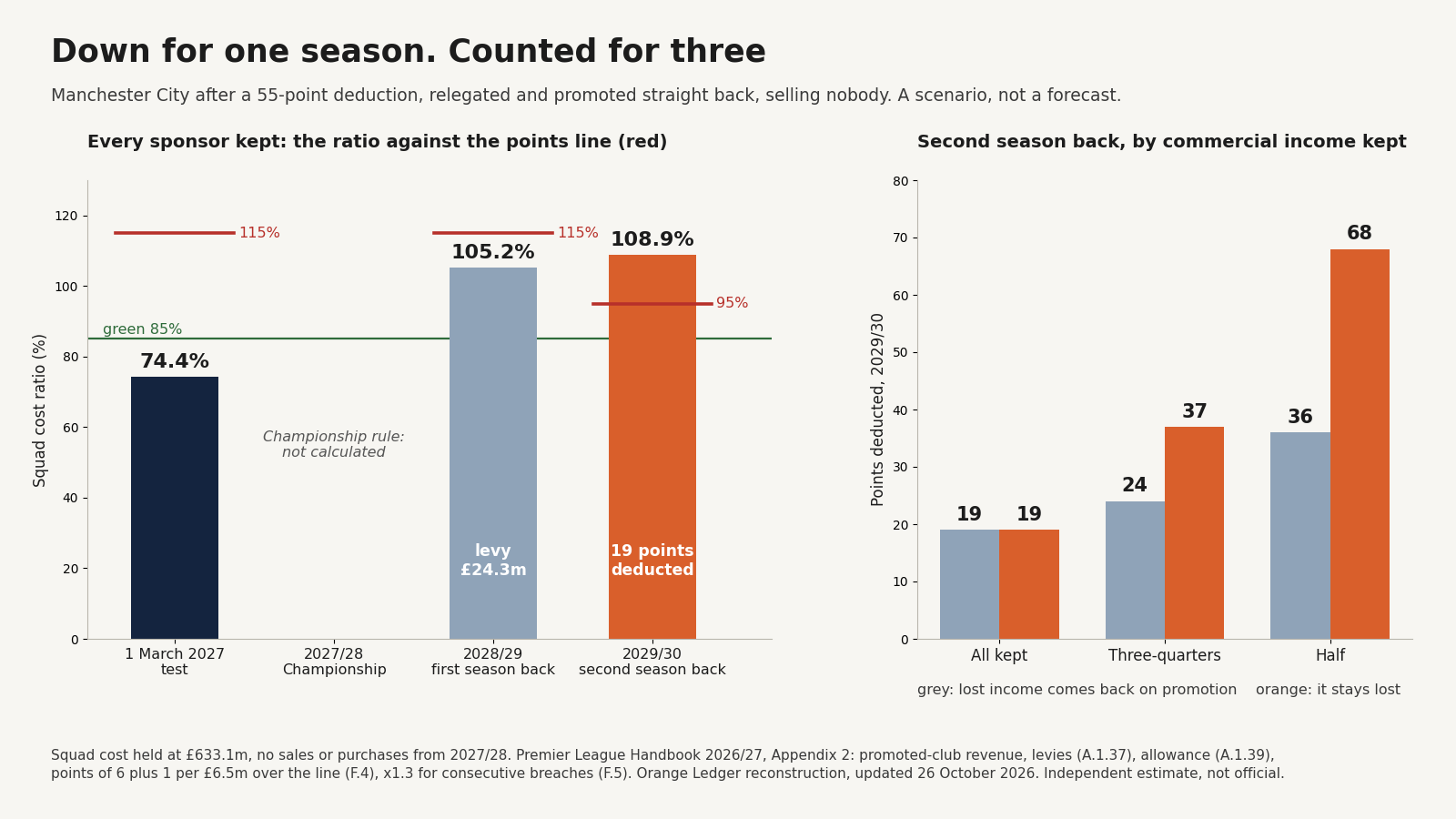
| Squad cost ratio | 105.2% | 110.9% | 117.2% |
| Levy, £m | 24.3 | 38.4 | 55.6 |
| Points deducted | none | none | 7 |
| Sanction line for the following season | 95% | 89% | 85% |
In the most generous column City come back at 105.2%, inside the 115% line where league points are deducted, but pay a £24m levy and see their allowance cut from 30 percentage points to 10. At half the commercial income they lose 8 league points in their first season back.
The second season back
By 2029/30 the last of today’s sale profit has rolled out of the average and the allowance has been spent. Even with commercial income fully back at £367.6m and matchday income back at Premier League levels, a £633m squad against about £582m of revenue is 108.9%.
| 2029/30, second season back | Every pound kept in 2027/28 | Three-quarters kept | Half kept |
|---|---|---|---|
| Squad cost ratio | 108.9% | 108.9% | 108.9% |
| Sanction line | 95% | 89% | 85% |
| Levy, £m | 33.3 | 33.3 | 33.3 |
| Points deducted | 19 | 24 | 36 |
On the most generous assumptions, City lose 19 points in their second season back. In the harshest column the deduction is 36, because the deduction for a second breach in a row is multiplied by 1.3.
If the sponsors do not come back
The tables above are kind in one important way: they assume every sponsor returns in full once City are back in the Premier League. That may be the least realistic assumption in the piece. Commercial partners pay for exposure, audience and association. Relegation changes all three, and contracts may contain terms allowing fees to fall or deals to be renegotiated. Because those contracts are private, the model shows three outcomes rather than assuming one.
So here is the second season back again, this time with the commercial income lost in the Championship year staying lost.
| 2029/30, second season back, lost income not recovered | Every pound kept | Three-quarters kept | Half kept |
|---|---|---|---|
| Revenue the rule counts, £m | 581.6 | 489.7 | 397.8 |
| Squad cost ratio | 108.9% | 129.3% | 159.1% |
| Levy, £m | 33.3 | 95.4 | 218.3 |
| Points deducted | 19 | 37 | 68 |
At three-quarters of the commercial income, City would lose 37 points in their second season back. At half, the deduction rises to 68. A deduction on that scale would make another relegation extraordinarily difficult to avoid, and the cycle could begin again.
Matchday income points the same way. Championship tickets are cheaper, crowds for a relegated side can fall, and the rule reads the first season back from the Championship season’s average per game. At a third of City’s filed average per game instead of half, the three-quarters column comes to about 112 to 113% in the very first season back, just inside the 115% line.
The relegation lasts one season. The rule remembers it for three: through the sale-profit average, through the commercial figure and through an allowance that each breach uses up.
The same choice without a deduction
The contrast is what makes the point. With no deduction at all, City could stop selling players and sit at 78.0%, 80.6%, then 86.4% by 2029/30. The only cost would be a levy of about £0.10m in the third year, with no points at risk. A 55-point deduction turns a club that can afford to stop selling into one that cannot afford to stop for a single season.
Holding the squad cost still makes every path look worse than it would be in practice. A club that stops trading also stops buying, contracts expire and transfer fees finish being written off, and relegation clauses could cut wages sharply in the Championship year. Selling nobody is the scenario’s assumption, not a plan any club would follow; it shows how much of the work selling would have to do.
Who gains if City go down
The question of what happens to English football without Manchester City has a precise answer inside the rule, because the rule’s money does not disappear. It moves.
- The club that finishes eighteenth stays up. With City in the bottom three on a deduction, only two other clubs go down. The survivor’s league money is counted at no lower than fifteenth place, about £122.6m including the equal share, instead of a first-year parachute payment of about £49m: roughly £74m more revenue in its own calculation.
- Every club that finished below City’s sporting position moves up a place, worth about £3.76m each in league prize money.
- City’s European place goes to someone else, along with the European money the rule counts, which for a Champions League club is the largest single line a deduction removes.
- Levies paid by a club over the line are shared among the clubs that stayed inside it.
The broadcasting money itself is agreed for a fixed period, so the pot shared out would not shrink the moment City left. What their absence would do to the value of the next deal, and to the matchday economy around the Etihad, is outside what the rule measures and outside this piece.
What the two scenarios have in common
In both, the first thing a deduction takes is money the rule does not protect: European football. In both, the answer the rule leaves City with is the one Chelsea already live with: selling players at a profit, every year, at a scale few clubs reach.
My view is that the rule behaves exactly as it was designed to, and that is the problem it would face here. Its cushions were built to protect a club from one bad season on the pitch: a poor finish, a missed European place, a sponsor walking away. They were not built for a sanction. The same smoothing that softens a bad season would stretch a punishment across three, and the part of a club’s income the rule cannot protect, European football, is the first thing a deduction takes. If the punishment were a points deduction on this scale, the spending rule would turn a one-season sporting sanction into a multi-year financial one.
What this doesn’t say
- That any sanction will be imposed, or what it would be. When this was written the decision was unpublished; it was published on 29 September, City appealed on 2 October, and no sanction has been set. Forty and fifty-five points are chosen to show two different mechanisms, not as predictions.
- When a sanction would apply. Both scenarios assume a deduction in 2026/27; a later one moves every date by a year.
- That City would be promoted straight back. It is assumed, to isolate what the rule does, and an EFL sanction in the Championship year could prevent it.
- That the squad cost would stay where it is. It is held still to isolate the effect of the deduction; in reality City would act, and contracts would run down.
- Whether City would breach the Championship’s rule. It defines squad costs and income differently from the Premier League’s, and would need its own reconstruction.
- What sanctions the Championship’s rule carries. Its sanctions are not set out in the EFL’s published guidance in a form that allows a calculation.
- What City’s sponsors would do. The tables show three levels of commercial income because the contracts are not public.
What it does say
- The spending rule would feel a deduction one test late: the 1 March 2027 figure is unaffected, although City’s 2026/27 accounts would carry about £53m less prize money.
- League money is cushioned by the three-year average. European money is not, and it is £98.2m of City’s counted revenue.
- At 40 points City would sit at about 86.2%, just above the line and 2.1 percentage points below Chelsea’s 88.3%, and would need about £129m a year of profit from selling players to reach 85%, against about £12m now.
- At 55 points, one season down and straight back up without selling, City would return at 105.2% even if every sponsor stayed, pay a £24m levy, and lose 19 points in their second season back as the allowance runs out. If a quarter of the commercial income were lost for good, that second-season deduction would be 37 points.
- A City relegation would move money inside the rule rather than remove it: the club finishing eighteenth would stay up, worth about £74m more revenue in its own calculation than a parachute payment.
- Without a deduction, the same decision to stop selling would cost a levy of about £0.10m.
The post on X asked what happens to English football when one of its biggest clubs is removed from the Premier League. The rule’s answer is colder than the question. The money does not vanish: it moves to the club that stays up in eighteenth, to whoever takes City’s European place, and, through levies, to the clubs that stayed inside the line. City would be left holding the one lever Chelsea already know well, selling players at a profit, and the spending rule would still be counting the cost in 2030.
More on the Manchester City caseThe ruling, what it could cost City, and what it cost the others
Sources and caveats.
The starting figures. Manchester City's squad cost, revenue and sale-profit average are the Orange Ledger's reconstruction for the 1 March 2027 test, set out in full in the Manchester City reconstruction. Chelsea's are from the Chelsea reconstruction.
The rules applied. Premier League Handbook 2026/27, Appendix 2, Rule A.1.29: for a member club, league money at the best of the previous finish, the three-year average finish and fifteenth place; for a promoted club, league money at fifteenth place and commercial income at the highest of the previous season's figure, the three-season average and £15m; television fees at the highest of the previous count, the three-season average and fifteen; gate receipts at the previous season's average per home game; and European money only for a club qualified for, and past the qualifying stage of, a UEFA competition in the season tested. Parachute payments under Rule D.25.
Levies and sanctions. Levies under Rule A.1.37: the overspend multiplied by the percentage points above 85%, rounded to a whole number, payable from 2027/28 and payable even by a relegated club. The allowance of up to 30 points is reduced after each breach under Rule A.1.39. Sporting sanctions under Rules F.4 and F.5: six points plus one for each £6.5m, or part of it, above the sanction line, multiplied by 1.3 for a second consecutive breach. The paths assume the actual season figures match the March estimates and do not apply the relief of up to 10% available under Rules E.7 and E.8.
How the scenarios are built. Each changes only the revenue lines named, applied to the reconstruction's own components: league money of £3.76m a place on an equal share of £100m, £84.4m of UEFA distributions and £13.8m of European home gates. The 40-point case assumes a finish outside the European places, which puts league money at seventh on the three-year average for any finish from fifteenth to seventeenth. The 55-point case assumes no sales and no purchases from 2027/28, squad cost held at £633.1m, a Championship matchday income of half City's filed average per home game, a Premier League average of £2.5m a home game from 2028/29 without European football, 19 televised matches in the first season back and 28 in the second, a finish that keeps league money at fifteenth place, commercial income of £367.6m, the figure the rule counts now, in 2025/26, 2026/27 and from 2028/29, and at the level shown in each column for 2027/28. The Premier League confirms that a promoted club starts with the full 30-point allowance, a sanction line of 115%. The non-recovery table holds commercial income in 2028/29 at the Championship-year level of each column; the matchday sensitivity uses a third of City's filed average per home game for the Championship season. The survivor calculation compares league money at fifteenth place with the 2024/25 year-one parachute payment. A year-one parachute payment of £49m is the 2024/25 figure.
The Championship's rule. Approved by Championship clubs on 15 May 2026, when the owner allowance was announced as £33m over three years, capped at £15m a season. The definitions of squad costs and allowable income, the current allowance of £34m and £16m, and the transition period for relegated clubs are from the EFL's published Financial Regulation guidance. Its sanctions are not set out there in a form that allows a calculation, and no Championship ratio is calculated here.
Promoted clubs. The Premier League's published explanation of the system, of 21 July 2026, states that the allowance is initially 30% for all clubs and for any promoted club, giving a starting sanction line of 115%. A promoted club may also claim levy relief if it complied with the rules that applied to it in the two previous seasons; a club that sold nobody in the Championship is unlikely to qualify, and none is applied here.
The case. The reported finding on 114 of 115 charges is attributed to The Athletic, Reuters and the Financial Times. The decision was unpublished at the time of writing. It was published on 29 September 2026; City appealed on 2 October (Premier League statement of that day), an Appeal Board hears the appeal in private, and no sanction has been set. This is a scenario analysis. It takes no view on the case or on what sanction, if any, would be appropriate.
Independent estimate, not an official calculation, and not advice. Scenario figures produced 27 September 2026; recalculated 1 and 2 October 2026.
Corrections and updates (11)
9 October 2026 · Editorial · several figures: see the note
Note, 9 October 2026: this article is a dated snapshot. Its calculations are not current. The baseline figures are from the engine snapshot V2BO, of 5 October 2026, and the scenario figures from an earlier run, as the notes below record; none has been rerun under the release of 9 October 2026, which changed how last season's commercial revenue is estimated (how we estimate last season's commercial revenue). Every figure below, including those given for Manchester City and Chelsea outside the scenarios, is a figure of that snapshot. The current figures are in City's own article and the full table. No current comparison is drawn from this piece.
29 September 2026 · New evidence · several figures: see the note
Update, 29 September 2026. The Premier League has now published the independent commission's core decision. It found Manchester City guilty of all the charges relating to breaches of the League's financial rules between 2009/10 and 2017/18, including 'sham' commercial contracts that inflated revenue and reduced costs by more than £900m, and upheld three of the four charges that City failed to cooperate with the investigation. No sanction has been set: that will be decided at a separate, private hearing. City say the decision contains material errors of law, principle and fact and will appeal; the deadline is 2 October. The scenarios below are unchanged. They remain scenarios, not predictions of any sanction.
1 October 2026 · Data correction · several figures: see the note
Update, 1 October 2026. The scenarios are recalculated on the Orange Ledger's corrected reconstructions, in which agents' fees are taken from the FA's published figures. Manchester City's squad cost is £611.9m, from £621.8m, and Chelsea's ratio is 88.4%, from 87.6%, so each path is a little gentler for City. At 40 points City would sit at 85.7% rather than 87.1%, now just above the line and about three points below Chelsea rather than level with them, needing about £121m a year of sale profit rather than £133m. At 55 points the second season back costs 20 to 65 points rather than 23 to 68. One sensitivity no longer holds: with Championship matchday income at a third rather than half, the three-quarters column now stays just inside the 115% line in the first season back, where it had crossed it for a 7-point deduction. The argument is unchanged: the rule would still be taking points in the second season back.
1 October 2026 (evening) · Data correction · several figures: see the note
Update, 1 October 2026, evening. City's squad cost is now £612.1m, from £611.9m, after Enzo Fernández's fee was taken at £125m on both sides of his transfer from Chelsea. No points total changes, and neither does any headline figure: a 40-point deduction still takes City to 85.7%. The levies move by £0.1m to £0.2m, the profit 2027/28 would need to produce rises to about £113m, and in the second season back the ratios where lost income stays lost are 129.5% and 158.4%.
2 October 2026 · Data correction · several figures: see the note
Update, 2 October 2026. The scenarios are recalculated on the corrected Manchester City and Chelsea reconstructions. City's squad cost is £611.0m, from £612.1m, mainly because contract extensions for Ederson and John Stones and Savinho's five-year term are now recorded, and City's three-year average of sale profit is £115.0m, from £115.6m. Chelsea's ratio is 88.6%, from 88.4%. Two points totals change, both in the half-kept column. City's lower squad cost takes the overspend below one of the £6.5m steps that set the deduction, so the first season back costs 8 points rather than 9, and the second season back, with sponsors recovered, 35 rather than 36. At 40 points City would sit at 85.6% rather than 85.7%, three points below Chelsea, needing about £120m a year of sale profit, and 2027/28 would need to produce about £111m. In the first season back the most generous column is 105.6% with a £25.0m levy, and in the second season back the ratio is 109.3% with a £32.6m levy. No other points total moves, and the argument is unchanged.
2 October 2026 (evening) · Regulatory interpretation · several figures: see the note
Correction, 2 October 2026, evening. The section on the Championship's own spending rule is now checked against the rules as published in the EFL's Regulations for 2026/27. The owner allowance of £34m over three years and £16m in a season stands; it is the figure the published rules give for 2026/27, set by a formula tied to parachute and solidarity payments. Two passages are corrected: the rule counts agents' fees as well as player wages and first-team manager costs, and the full rule text has been published, which this piece had said it had not. No figure in the scenarios changes.
3 October 2026 · Data correction · several figures: see the note
Update, 3 October 2026. Manchester City's starting ratio is now 74.2%, from 74.1%, and 86.3% before player trading, from 86.2%, after home matches were counted from match reports and last season's matchday receipts were re-estimated (How we estimate matchday revenue). Chelsea's comparison figure is now 88.0%, from 88.6%. Today's figures for both clubs are updated in the table and the text: City count £708.3m of revenue, from £709.0m, of which £139.9m comes from league position and European football, from £140.4m, and need £10.5m a year of sale profit to reach 85%, from £9.8m; with no deduction and no further sales they would sit at 77.2%, 80.3% and 86.3% at the next three tests, from 77.1%, 80.2% and 86.2%. Chelsea count £480.2m, from £475.9m, and need £143.2m, from £147.4m. The scenario figures are being recalculated: every figure after a deduction, in the table's middle column, the scenario tables and the two charts, still rests on the earlier revenue, and will be reissued here once the way matchday revenue enters each scenario has been set out. A separate review of agents' fees on signings since the last accounts is under way and may raise this figure; we will report its result.
4 October 2026 · Methodology change · several figures: see the note
Update, 4 October 2026. Manchester City's starting ratio is now 76.1%, from 74.2%, and 88.1% before player trading, from 86.3%, after registrations were counted at the reported fee plus 12% and merchandise at gross profit, and cup prize money was rebuilt from each club's cup ties (Three definitions in the squad cost rule, and what they change). City's squad cost today is £619.2m, from £611.0m, and their three-year average of sale profit £110.3m, from £115.0m, so they need £25.4m a year of sale profit to reach 85%, from £10.5m; with no deduction and no further sales they would sit at 79.2%, 82.4% and 88.1% at the next three tests, from 77.2%, 80.3% and 86.3%, and the levy in the third year would be about £0.6m, from £0.1m. Chelsea's comparison figures are now 94.0%, from 88.0%, and 116.4% before player trading, from 110.3%: a squad cost of £529.3m, from £529.8m, counted revenue of £454.9m, from £480.2m, an average of sale profit of £108.3m, from £122.0m, and £167.8m a year of sale profit needed, from £143.2m. The scenario figures are still being recalculated and are still on the earlier basis: every figure after a deduction, in the table's middle column, the scenario tables and the two charts, rests on a squad cost of £611.0m and sale profits of £91.9m and £157.9m, which today's method puts at £619.2m, £90.6m and £145.2m. They will be reissued here once the way revenue enters each scenario has been set out.
5 October 2026 · Methodology change · several figures: see the note
Update, 5 October 2026. Manchester City's starting ratio is unchanged at 76.1%, and 88.0% before player trading, from 88.1%, after contract lengths were measured from their dates and the women's team's ticket and broadcasting revenue was counted (the engine changelog). City's squad cost today is £621.9m, from £619.2m, their countable revenue £706.8m, from £703.1m, and their three-year average of sale profit £110.7m, from £110.3m, so they need £24.8m a year of sale profit to reach 85%, from £25.4m; with no deduction and no further sales they would sit at 79.1%, 82.3% and 88.0% at the next three tests, from 79.2%, 82.4% and 88.1%, and the levy in the third year would still be about £0.6m. Chelsea's comparison figures are now 94.3%, from 94.0%, and 116.8% before player trading, from 116.4%: a squad cost of £531.5m, from £529.3m, an average of sale profit of £108.9m, from £108.3m, and £170.4m a year of sale profit needed, from £167.8m. The scenario figures are still being recalculated and are still on the earlier basis: every figure after a deduction, in the table's middle column, the scenario tables and the two charts, rests on a squad cost of £611.0m and sale profits of £91.9m and £157.9m, which today's method now puts at £621.9m, £91.1m and £145.8m. Baseline updated to V2BO; scenario outputs remain from the prior scenario run.
25 October 2026 · Methodology change · several figures: see the note
Correction, 25 October 2026. The scenario is rerun on the Orange Ledger’s figures of 25 October, as scenario version V2CD, and every figure in it is restated. Two readings of the rule we have since corrected had not reached it. Profit on player sales. The rule averages the profit on sales in the six most recent transfer windows (Rules A.1.13 and A.1.53); the scenario counted whole financial years. Each test’s average now takes its own windows: the first season back counts the £12.9m of February to June 2026 as well as this season’s £145.8m, £52.9m from £52.6m. The five-year cap. It now reaches contracts already on the books that were signed or extended on or after 12 December 2023 (Rule A.1.22(c)), which is in City’s squad cost of £627.4m, from £611.0m. The 40-point case is rebuilt from City’s own revenue lines, so the European money it removes is now £84.4m of UEFA distributions and £13.8m of home gates; the seasons after relegation keep the scenario’s own assumptions, starting from the commercial income the rule now counts, £367.6m, from £345m.
- Moved: after a 40-point deduction the ratio is 85.4%, from 85.6%, and City need about £122m a year of sale profit, from £120m. After 55 points, the first season back is 104.3%, 109.9% and 116.1% by column, from 105.6%, 111.1% and 117.2%, with a levy of £22.0m in the most generous column, from £25.0m, and 7 points lost at half the commercial income, from 8. The second season back is 107.9%, from 109.3%, and the points lost are 17, 22 and 35 if lost income returns, from 20, 24 and 35, and 17, 35 and 66 if it does not, from 20, 36 and 65. Without a deduction City would sit at 77.2%, 79.8% and 85.6%, from 79.1%, 82.3% and 88.0%, with a levy of about £0.04m, from £0.6m. The comparison columns are City and Chelsea now, 73.7% and 89.1%, where they were the snapshot of 5 October.
- The conclusion holds: a 40-point deduction takes City just over the line; a 55-point one still costs them points in their second season back.
- Also corrected: the opening no longer quotes a figure of 5 October in a piece dated 28 September; the list of what this piece does not say now agrees with its sources on the Championship’s sanctions; and City’s appeal of 2 October is recorded. The chart and the cover are redrawn. See the engine changelog.
26 October 2026 · Regulatory interpretation · several figures: see the note
Correction, 26 October 2026. The scenario is rerun on the figures of 26 October, as scenario version V2CF. Two inputs move. The fee Manchester City paid Chelsea for Enzo Maresca now counts in the squad cost, spread over his three-year contract (Rule A.1.22(d); reported at £17.2m in June 2026, not yet in filed accounts), so the squad cost held through the scenario is £633.1m, from £627.4m. And City’s sale of Kayky to Bahia in June 2025, at a loss of £2.0m, now counts in the February to June 2025 window (Rules A.1.13 and A.1.53), which leaves £0.2m of profit in it, from £2.2m. Today City are at 74.4%, from 73.7%, and 86.4% before player trading, from 85.6%. After a 40-point deduction the ratio is 86.2%, from 85.4%, 102.8% before player trading, from 101.9%, and the sale profit needed is £128.9m a year, from £122.2m; 2027/28 would need about £150m, from about £127m. After 55 points the first season back is 105.2%, 110.9% and 117.2% by commercial income kept, from 104.3%, 109.9% and 116.1%, with levies of £24.3m, £38.4m and £55.6m, from £22.0m, £35.5m and £52.1m, sanction lines of 95% and 89%, from 96% and 90%, and 8 points lost at half, from 7. The second season back is 108.9%, from 107.9%, with a levy of £33.3m, from £30.6m, and 19, 24 and 36 points lost, from 17, 22 and 35; if lost income stays lost, 19, 37 and 68 points, from 17, 35 and 66. With no deduction the path is 78.0%, 80.6% and 86.4%, from 77.2%, 79.8% and 85.6%, and the third-year levy about £0.10m, from £0.04m. Chelsea today are 88.3%, from 89.1%. The chart and the cover are redrawn.