
Regulation series
The history of financial rules in football, Part 1: the Bosman era to UEFA's Financial Fair Play
Part 1 of the Orange Ledger's series on football's financial rules. Before the Premier League's new squad cost ratio, before PSR, there was a simpler problem: clubs across Europe were spending money they did not have, and players and staff were going unpaid. This is how UEFA's Financial Fair Play began, how it worked, how it was tested against Manchester City and Paris Saint-Germain, and why it was rebuilt in 2022 around a cap on squad costs.
Latest note, 3 November 2026: data correction. Both correction notes are at the end.
Every argument about football’s financial rules eventually reaches the same question: who were they written for? One view, common among supporters of clubs with wealthy new owners, is that the rules were built by the established clubs to keep newcomers out. The history points somewhere else. Fairness between clubs was among UEFA’s stated aims from the start, but the rules were first written to deal with clubs that were spending money they did not have.
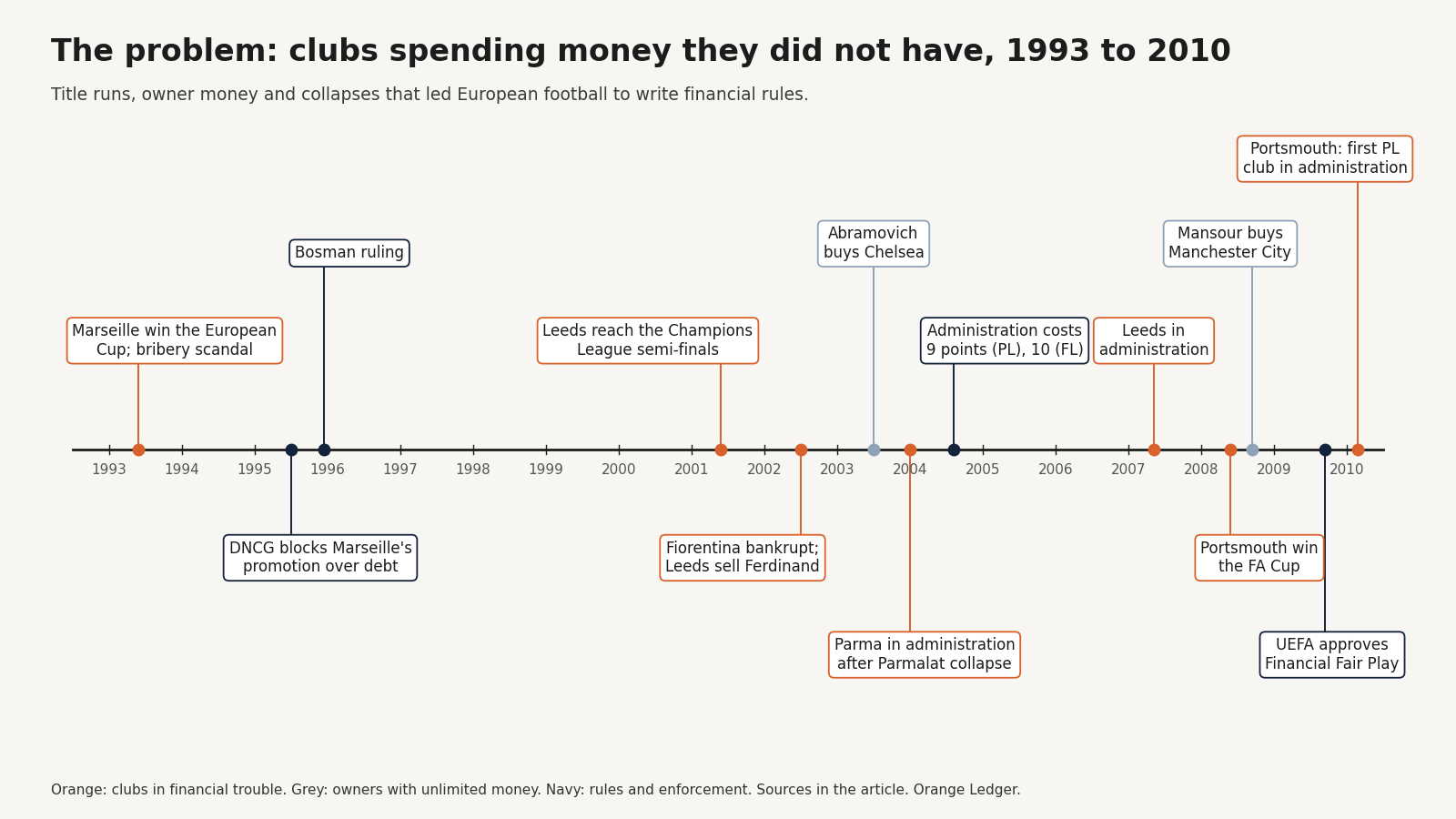
The problem: spending without the money to pay for it
What the Bosman ruling changed
Jean-Marc Bosman was a Belgian midfielder at RFC Liège. Before his contract expired in June 1990, Liège offered him a new one at about a quarter of his salary, and he refused. He wanted to join the French second-division club USL Dunkerque. Under the rules of the time, Liège could still demand a transfer fee for him, even though his contract had ended. The clubs agreed a one-year loan, but Liège, doubting that Dunkerque could pay, did not request the clearance certificate the move needed. The move collapsed, and Liège suspended him. He was stuck at a club he no longer had a contract with and could not leave.
Bosman went to court. On 15 December 1995, the European Court of Justice ruled that two features of football’s transfer system broke EU law on the free movement of workers:
- Transfer fees for out-of-contract players. A player whose contract had ended could now move to a club in another EU country for nothing.
- Nationality quotas. Leagues could no longer limit how many players from other EU countries a club fielded.
The ruling did not touch fees for players still under contract. That detail turned out to matter enormously, because it changed where a player’s value came from.
Before Bosman, a club owned a player’s value even after his contract ended: someone still had to pay to take him. After Bosman, that value disappeared on the day the contract ran out. The effects on club finances were large:
- Players’ value moved to their contracts. A player was worth a transfer fee only while under contract. Clubs responded with longer contracts and sold players before they reached the final year, or risked losing them for nothing.
- Money moved from clubs to players. A player free to leave could ask the club he joined for the money that would once have gone to his old club as a fee, in higher wages or a signing-on payment. The first high-profile case was Edgar Davids, who left Ajax for AC Milan on a free transfer in 1996.
- The market for players became Europe-wide. With quotas gone, the richest clubs could sign as many of the best EU players as they could afford, and competition for top players intensified.
- Wages grew. Player wages have risen substantially since 1995, especially at the top of the game, and fees for players under contract rose too, as long contracts became the way clubs protected a player’s value.
The ruling was not on its own the cause of what followed. It arrived alongside rapidly growing income from television and sponsorship, and clubs competed to turn that growth into better squads, increasingly by paying higher wages.
The spending era
What followed, across Europe, was a period in which clubs competed for players with money they had not yet earned. From the 2004/05 season, English football wrote the price of failure into its rules: a Premier League club entering administration would lose nine points, a Football League club ten. Two English clubs show what the gamble looked like from the inside.
Leeds United: borrowing against the dream
In 2001, Leeds United reached the semi-finals of the Champions League. Under chairman Peter Ridsdale, the club had built its squad on borrowed money. It raised about £60m through a 25-year loan secured on its future gate receipts, and financed some signings through arrangements with finance companies that were repaid over the length of each player’s contract. The plan depended on one thing: the club playing in the Champions League, year after year, to pay the money back.
It did not. Leeds failed to qualify again, and by the summer of 2002 the debt was around £80m. The squad was sold to pay it:
- Rio Ferdinand went to Manchester United for about £30m in 2002.
- Robbie Keane, Robbie Fowler, Lee Bowyer, Olivier Dacourt and Jonathan Woodgate followed within months, many for less than they had been valued at.
- By the time Ridsdale stepped down in March 2003, the club owed about £103m.
Leeds were relegated from the Premier League in 2004, after 14 seasons. In May 2007, facing a winding-up order from the tax authorities over about £6m of unpaid tax, the club entered administration, was docked 10 points and dropped into the third tier for the first time in its history. Because it left administration without a formal agreement with its creditors, the Football League imposed a further 15-point deduction for the following season. Leeds did not return to the Premier League until 2020, sixteen years after they left.
Portsmouth: an FA Cup, then the bill
Portsmouth’s rise came a few years later. After Alexandre Gaydamak took control in 2006, the club signed players such as Sol Campbell, Jermain Defoe, Glen Johnson and Peter Crouch on high wages, funded largely by borrowing that Gaydamak guaranteed. In 2008 Portsmouth won the FA Cup, the club’s first major trophy in almost 60 years, and qualified for Europe.
The money ran out within months. When the 2008 financial crisis hit Gaydamak, the club changed hands again and again: to Sulaiman Al-Fahim, then Ali Al-Faraj, then Balram Chainrai, four owners in one season. Players went unpaid between December 2009 and February 2010.
- On 26 February 2010, Portsmouth became the first Premier League club to enter administration, owing about £12m in tax, with total debts then estimated at £70m.
- The nine-point deduction, confirmed on 17 March 2010, took the club from 19 points to 10, and relegation followed.
- A second administration came in 2012. Portsmouth were relegated twice more, in 2012 and 2013, and reached the fourth tier.
- The club was rescued by its own supporters: the Pompey Supporters Trust took ownership in April 2013.
Five years separated an FA Cup win from fourth-tier football.
Elsewhere in Europe
The same pattern played out across the continent.
- Fiorentina went bankrupt in 2002 and had to restart in Italy’s fourth tier, returning to Serie A by 2004.
- Parma, the UEFA Cup winners of the 1990s whose spending was tied to the food company Parmalat, went into administration in early 2004 after Parmalat collapsed in December 2003, and went bankrupt again in 2015, restarting in Serie D.
- Rangers, one of Scotland’s two dominant clubs, entered administration in February 2012 after failing to pay tax and National Insurance during Craig Whyte’s ownership, having also used employee benefit trusts to pay players and staff between 2001 and 2010 (the UK Supreme Court ruled in 2017 that those payments were taxable earnings). The tax authorities rejected a deal with creditors, the old company was liquidated in October 2012, and the club restarted in Scotland’s fourth tier.
The damage was never only to the clubs. When a club overspends and fails, the people owed money include its players, its staff, other clubs waiting for transfer instalments, and the tax authorities.
France had already seen it
France had a financial regulator long before UEFA did: the DNCG, the body that checks French clubs’ accounts and can block a club from its division if its finances do not stand up. Its most famous case followed the most famous club of the era.
In May 1993, Olympique de Marseille, under the businessman and politician Bernard Tapie, beat AC Milan 1-0 to become the first French club to win the European Cup. A bribery scandal had broken days before the final: Marseille had approached three Valenciennes players to ease off in a league match, so that the team could win the French title and rest before Munich. One of them, Jacques Glassmann, refused and reported it. Marseille kept the European title but were stripped of the French championship, barred from defending the Champions League and, in 1994, relegated to the second division. Tapie was later jailed.
The financial reckoning came next. Marseille won the second division in 1994/95, but the DNCG refused to let them go back up: the club was heavily in debt. The scandal that made the headlines was about bribery, but the regulator’s decision was about money, and it showed what an independent check on a club’s finances could do.
That French model is the direct link to what UEFA built later. France’s football authorities had a financial regulation system in place by 1990, the first football governing body to do so, according to a 2019 academic study of the DNCG and UEFA’s rules. When Michel Platini, a Frenchman and former France captain, became UEFA president in 2007, he launched the project that became Financial Fair Play, and UEFA itself described the initiative as spearheaded by Platini. The Independent’s Miguel Delaney writes that Platini had long been conscious that France had the strictest regulation in Europe, and wanted to recreate it at European level. When UEFA adopted its rules, the DNCG welcomed them as the creation of a “European DNCG”.
The two systems were never identical. The same 2019 study found that, in practice, the DNCG and UEFA’s rules pursued different objectives, and that French clubs were subject to both. But the idea that football needed an independent check on club finances came to UEFA from France.
A second pressure: owners with deep pockets
Rich owners spending their own money on a club were not new. Three examples from before 2003:
- AC Milan. Silvio Berlusconi bought the club in 1986, when it was close to bankruptcy, and funded a rebuild that brought in players such as Ruud Gullit and Marco van Basten. Milan won the European Cup in 1989, 1990 and 1994.
- Blackburn Rovers. Jack Walker, who had made his fortune in steel, took over his home-town club in 1991 and spent about £25m on players in his first three years, breaking the British transfer record twice to sign Alan Shearer and Chris Sutton. Blackburn went from the old Second Division to Premier League champions in 1995.
- Lazio. Under Sergio Cragnotti, whose food company Cirio funded heavy spending, Lazio won Serie A in 2000. When Cirio defaulted on its bonds in 2002, Cragnotti left, Lazio was run by its banks, and its best players were sold.
Parma, whose spending was tied to Parmalat, followed the same pattern. When an owner’s business ran into trouble, the club’s spending stopped with it, and the club was left with costs it could not cover.
What changed in the 2000s was the scale. Roman Abramovich bought Chelsea in 2003 and funded the club almost entirely through loans, which Chelsea’s 2016/17 accounts put at £1.17bn. Sheikh Mansour bought Manchester City in 2008 and invested more than £1.3bn in new shares over the following decade. With fortunes on that scale, the owner running out of money was a remote risk, although nothing obliged an owner to go on paying.
Neither club looked at risk of failing while its owner kept covering its losses. But their spending added upward pressure to transfer fees and wages across a market in which clubs without a benefactor were competing for the same players.
UEFA’s answer: Financial Fair Play
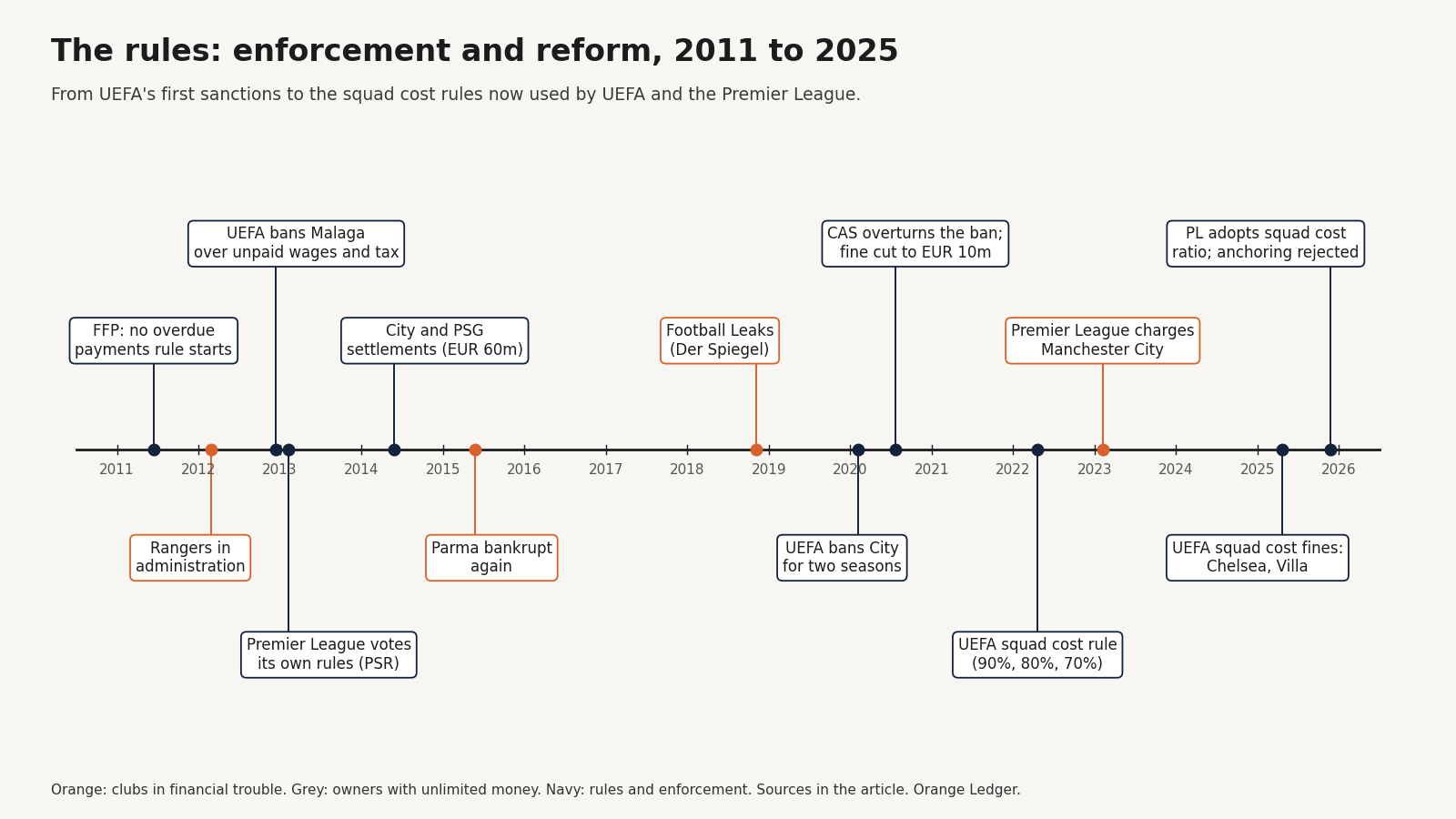
UEFA, which runs European club competitions, already ran a licensing system: to play in its competitions, a club had to meet basic criteria set by its national association. Financial Fair Play was built on top of that licensing system.
UEFA’s Executive Committee approved the Financial Fair Play concept on 21 September 2009, two years after Platini took office. It had been recommended by UEFA’s Professional Football Strategy Council, which includes representatives of clubs, leagues and players, and it had the backing of the European Club Association, the body representing Europe’s clubs. UEFA gave the major objective as improving financial fairness in European competitions and the long-term stability of European club football, and said the measures would encourage long-term investment in youth development and facilities.
The rules had two parts.
No overdue payments. From June 2011, every club in a UEFA competition had to show that it owed nothing overdue to other clubs, to its own employees or to the tax authorities. All 237 clubs in the 2011/12 and 2012/13 competitions were checked.
The break-even requirement. Over a rolling assessment period, a club’s “relevant” spending could not exceed its “relevant” income by more than a set amount, called the acceptable deviation.
- Relevant income meant the money a club earned from football: gate receipts, broadcasting, sponsorship and commercial income, and profit on selling players.
- Relevant spending meant the cost of running the football club, including wages and the cost of transfer fees, spread over each player’s contract as the accounts amortise it. Spending on stadiums, training grounds and youth development was left out, so that clubs were not discouraged from investing in things that last.
- The acceptable deviation was €5m. It could rise to €45m if the owner covered the excess with a contribution to the club’s capital, such as buying new shares, rather than a loan. From 2015/16 the upper figure fell to €30m.
The first assessment came in the 2013/14 season, using clubs’ accounts for 2011/12 and 2012/13. Later assessments covered three years. In 2012, UEFA created a dedicated body to enforce the rules, the Club Financial Control Body (CFCB).
UEFA’s own simulation, run on clubs’ results before the rules applied, showed the scale of the problem: 46 clubs, 21% of those in the 2012/13 competitions, would have had losses above the €5m limit. They came from 22 countries.
The first test: Manchester City and Paris Saint-Germain, 2014
Before the break-even rule produced its first sanctions, the overdue-payments rule had already bitten. In December 2012, UEFA banned Málaga, then in their first Champions League campaign after a Qatari owner’s spending spree of nearly €60m on players, from the next European competition they qualified for, because the club owed money to players, other clubs and the Spanish tax authorities. Málaga reached the quarter-finals that season, then lost their appeal at the Court of Arbitration for Sport in June 2013 and missed the Europa League place they had earned.
The first break-even sanctions came in May 2014, when nine clubs were punished. The two heaviest settlements were with Manchester City and Paris Saint-Germain, both backed by Gulf ownership and both champions of their leagues.
- Each was fined €60m, of which €40m would be returned if the club kept to the terms of its settlement.
- Each could register only 21 players for the Champions League, instead of the usual 25.
- Each agreed not to increase its wage bill and to limit transfer spending significantly for two seasons. City’s settlement also capped their losses at €20m for 2014 and €10m for 2015.
UEFA also valued PSG’s sponsorship agreement with the Qatar Tourism Authority significantly below the figure the club had put on it. That is the first appearance in this story of a question that runs through the whole series: whether a club’s reported income reflects what a deal is really worth. City accepted the settlement while stating a “fundamental disagreement” with UEFA over how players bought before 2010 were treated.
The second test: the 2020 case
In November 2018, the German magazine Der Spiegel published emails from the Football Leaks archive concerning Manchester City’s sponsorship arrangements. City said the documents had been illegally obtained and taken out of context. UEFA opened a formal investigation in March 2019.
In February 2020, UEFA’s CFCB ruled that City had committed serious breaches by overstating sponsorship revenue in their accounts and in the information they gave UEFA between 2012 and 2016, and by failing to cooperate with the investigation. It banned City from UEFA competitions for two seasons and fined the club €30m.
City appealed to the Court of Arbitration for Sport. In July 2020 the court set aside the ban. It found that most of the alleged breaches were either not established or time-barred. It upheld the finding that City had failed to cooperate, and cut the fine by two-thirds, to €10m.
The case showed both the ambition and the limits of the rules. A regulator could investigate how a club’s income was reported, but proving it, within the time limits in the rules and against a club able to fight every point, was another matter. The same period, 2009/10 to 2017/18, is at the centre of the Premier League’s own case against City. On 29 September 2026, the League published the core decision of the independent commission. It found City guilty of all the charges relating to breaches of the League’s financial rules over those nine seasons, including arranging ‘sham’ contracts with commercial partners, part of a disguised funding scheme paid for by the club’s owner, that inflated revenue and reduced costs by more than £900m. It also upheld three of the four charges that City failed to cooperate with the League’s investigation. That is a very different conclusion from the one CAS reached on UEFA’s narrower case in 2020. No sanction had been set at the time of writing, and City said the decision contains material errors of law, principle and fact and that they would appeal. City lodged its appeal on 1 October, as the Premier League confirmed on 2 October; an Appeal Board hears it in private, and no outcome had been published by 3 November 2026.
The 2022 reform: a cap on squad costs
By the early 2020s, UEFA concluded that the break-even rule was not enough. Clubs could stay inside a loss limit while spending an ever larger share of their income on players. On 7 April 2022, UEFA’s Executive Committee approved new Financial Sustainability Regulations. UEFA’s president, Aleksander Ceferin, said the first regulations, introduced in 2010, had “served its primary purpose”.
The new rules stand on three pillars:
- Solvency: the no-overdue-payments rule, strengthened.
- Stability: the football earnings rule, a successor to break-even, with the acceptable loss doubled from €30m to €60m over three years, and up to €30m more over the three years, €10m a year, for clubs in good financial health.
- Cost control: a new squad cost rule. A club’s spending on player and head-coach wages, the cost of transfer fees spread over each player’s contract, and agents’ fees may not exceed a set share of its adjusted operating revenue plus its net result from player sales and other transfer income and expenses. Under the fully phased-in rule, the transfer items are averaged over three years. The limit was phased in, measured over each calendar year: 90% for 2023, 80% for 2024 and 70% from 2025.
The squad cost rule was a change of approach. The old rule asked whether a club was losing too much money. The new one asks how much of its income a club spends on its squad. It is the model the Premier League would follow, with a looser limit, from 2026/27.
In 2025, UEFA fined the clubs whose squad cost ratio had been above the 80% limit that applied in 2024, all of them between 80% and 90%: Chelsea €11m, Aston Villa €6m, Beşiktaş €0.9m and Panathinaikos €0.4m. In June 2026, against the full 70% limit for 2025, UEFA fined nine clubs under the rule, four of them English: Aston Villa €22.5m, €15m of it conditional, Chelsea €3m, €2m of it conditional, Newcastle United €3m and Nottingham Forest €2.5m.
What the history shows
Three points from UEFA’s experience carry through the rest of this series.
- The rules began mainly as protection against failure. UEFA named fairness in its competitions as an aim alongside long-term stability, but the first targets were unpaid wages, unpaid transfer fees and clubs going bust.
- Owner money was always the difficult case. A club with a wealthy owner is unlikely to fail while the owner keeps paying, but its spending affects every other club’s costs. FFP’s answer was to count only money a club earns, with a limited exception for owners buying new shares.
- Every rule based on income depends on knowing what the income really is. From PSG’s tourism deal to City’s sponsorship arrangements, the hardest cases have been about whether reported revenue was what it claimed to be.
The argument that the rules protect the established clubs has one fair point in it. A rule that ties spending to income favours clubs that already earn the most. The Independent’s chief football writer, Miguel Delaney, argues that this is a fair criticism of how football’s money is shared out, not of the rules themselves, which were not written or first driven by the big clubs. It is a debate this series returns to in Parts 4 and 5.
The Premier League took a different, more permissive route. Part 2 covers how English football wrote its own version in 2013, how it worked, and why it was replaced.
Next in the seriesPart 2: the Premier League's own rules, PSR 2013 to 2026
Sources and caveats.
UEFA. UEFA: "UEFA EXCO approves financial fair play", 21 September 2009. UEFA CFCB: Compliance and investigation activity report 2011-13. UEFA: explainer on the new Financial Sustainability regulations, April 2022. UEFA CFCB First Chamber decisions on the 2024 squad cost ratio, and its decisions of 30 June 2026 on the 2025 squad cost ratio. UEFA Club Licensing and Financial Sustainability Regulations, edition 2022, Article 92 (calculation of the squad cost ratio) and Article 93.
How FFP worked. Acceptable deviation, monitoring periods and first assessment as set out by Daniel Geey (sports lawyer) and in Deloitte's analysis reported by LawInSport (2012); UEFA's pre-rule simulation (46 clubs, 21%) as reported there. LSE Centre for Economic Performance discussion paper 1952 (2023) on the break-even requirement.
The Bosman ruling. Court of Justice of the European Communities, Case C-415/93, Union royale belge des sociétés de football association ASBL v Jean-Marc Bosman, judgment of 15 December 1995, which sets out the contract offer, the loan agreed with Dunkerque and the certificate Liège did not request. Background of the case and its effects as summarised in histories of the ruling.
English clubs. Leeds United: the securitised loan, the sales, the debt of about £103m in March 2003, administration on 4 May 2007 and the 10- and 15-point penalties, as reported by the Yorkshire Evening Post, These Football Times and contemporary coverage. Portsmouth: Gaydamak's ownership, the changes of owner, unpaid wages, both administrations and the supporters' trust takeover of April 2013, as reported by These Football Times and Sporting Intelligence (25 February 2010); the deduction of 17 March 2010, from 19 points to 10, as reported by Al Jazeera that day. Administration penalties from 2004/05 as recorded at the time. Abramovich's loans as stated in Chelsea's 2016/17 accounts and Mansour's investment as stated in City's 2017/18 accounts, both as reported by the Irish Times (September 2018).
Elsewhere in Europe. Fiorentina (2002) and Parma (2004, 2015) as widely reported; Rangers' administration, the rejected creditors' agreement and liquidation (2012) and the 2017 Supreme Court ruling on employee benefit trusts as recorded in contemporary reporting. Málaga: UEFA sanction of December 2012 and CAS decision of June 2013 as reported by AP and Al Jazeera.
Marseille. The 1993 final, the Valenciennes bribery, the stripped title and the 1994 relegation as reported by the Irish Times and in the club's own history (om.fr); the approach to three Valenciennes players and Jacques Glassmann's refusal as recorded in accounts of the 1995 trial; the DNCG's refusal of promotion in 1995 because of the club's debts as recorded by Olympique de Marseille (om.fr).
France, the DNCG and Platini. N. Dermit-Richard, N. Scelles and S. Morrow, "French DNCG management control versus UEFA Financial Fair Play: a divergent conception of financial regulation objectives", Soccer and Society, 20(3), 2019, on the French system in place from 1990 and the DNCG's description of FFP as a "European DNCG". UEFA.com on the financial fair play concept as an initiative spearheaded by Michel Platini. Slate.fr (2014) on Platini launching the project in 2007. Miguel Delaney, The Independent (September 2026), on Platini and the DNCG.
Owners before Abramovich. Berlusconi's purchase of AC Milan in 1986 as recorded in histories of the club; Jack Walker's spending at Blackburn and the 1995 title as recorded in histories of the club and of Walker; Lazio, Cragnotti and the Cirio default of 2002 as recorded in histories of the club.
The 2014 settlements. France 24, the Irish Times, CNN and ITV News, 16 May 2014.
The 2020 case. CFCB decision of 14 February 2020 and CAS award of 13 July 2020 as reported, including the CAS statement quoted by CBS Sports and CNN. Der Spiegel's Football Leaks articles of November 2018 and UEFA's investigation as reported by the Manchester Evening News. The Premier League's case against Manchester City: charges announced 6 February 2023; the independent commission's core decision as published by the Premier League on 29 September 2026 (redacted), and the League's statement of the same day; Manchester City's statement of 29 September 2026; the Premier League's statement of 2 October 2026 on City's appeal; City's statement that it lodged the appeal at 7pm on 1 October, as reported by Al Jazeera on 2 October 2026. No sanction had been set at the time of writing.
The 2022 reform. UEFA's explainer (April 2022); Aleksander Čeferin as quoted in UEFA's announcement of 7 April 2022.
Opinion cited. Miguel Delaney, Inside Football (YouTube), September 2026, cited as his view.
The full source register for this series is held with the Orange Engine.
Corrections and updates (2)
25 October 2026 · Data correction · no figure changed
Correction, 25 October 2026. No figure changed. The section on the City case ended with City’s deadline to appeal, 2 October. City appealed that day (Premier League statement of 2 October 2026), and the Appeal Board hears it in private; the sentence now says so. UEFA’s squad cost limit was dated by season, 90% in 2023/24 to 70% from 2025/26; UEFA measures it over the calendar year, 90% for 2023, 80% for 2024 and 70% from 2025, as the UEFA explainer and the fines in the next paragraph have it. And the extra loss allowed for clubs in good financial health is now given as UEFA states it, €30m over three years.
3 November 2026 · Data correction · the article contains no model estimates
Correction, 3 November 2026. Bosman: Liège offered him a new contract at about a quarter of his salary, which he refused; a loan to Dunkerque was agreed but collapsed when Liège, doubting Dunkerque could pay, did not request the clearance certificate, and Liège then suspended him. The article had said Liège demanded a fee Dunkerque would not pay and then cut his wages. Portsmouth’s deduction took the club from 19 points to 10, not from 16 to seven. Marseille approached three Valenciennes players; one, Jacques Glassmann, refused and reported it. The article had said all three were paid. Parma went into administration in early 2004, after Parmalat’s collapse in December 2003. Financial Fair Play counted transfer fees as the accounts spread them over each contract. UEFA’s squad cost ratio divides squad costs by adjusted operating revenue plus the net result from player sales and other transfer items, the transfer items averaged over three years once the rule is fully phased in (Article 92); the article had given revenue alone. The 2020 CAS award: the article now says only what the award decided, that most of the alleged breaches were not established or were time-barred. City lodged its 2026 appeal on 1 October, not 2 October. The aims of 2009 are now given as UEFA stated them, fairness in its competitions alongside long-term stability, and the article says the rules began mainly, not only, as protection against failure. Owners: the article said Chelsea and Manchester City could not fail; it now says failure was unlikely while their owners kept paying. Added: UEFA’s fines of June 2026 under the 70% limit. Two outlets this publication does not cite are no longer named in the sources.