
Regulation series
The history of financial rules in football, Part 2: the Premier League's own rules, PSR 2013 to 2026
Part 2 of the Orange Ledger's series on football's financial rules. In 2013 the Premier League wrote its own version of UEFA's rules: a limit of £105m of losses over three seasons. This is how the Profitability and Sustainability Rules worked, how clubs learned to manage them, the points deductions that followed, the legal fight over deals with owner-linked companies, and why the League replaced them from 2026/27.
Latest note, 3 November 2026: correction and additions. Both correction notes are at the end.
UEFA’s rules only applied to clubs playing in European competitions. In most seasons, that left more than half of the Premier League outside them. In 2013 the League decided to write its own.
The Profitability and Sustainability Rules, known as PSR, ran for more than a decade. They produced the first Premier League points deductions for breaking its spending rules, a string of creative accounting, and a legal battle over sponsorship deals that reached the heart of the League’s rulebook. From the 2026/27 season they have been replaced. This is the story of how they worked and why they went.
The 2013 vote
The clubs voted on 7 February 2013. The rules passed by 13 votes to six, with one abstention, a narrow margin. They limited a club’s losses to £105m over three seasons and restricted how much of the new television money could go on wages. The six clubs against were Fulham, West Bromwich Albion, Manchester City, Aston Villa, Swansea City and Southampton; Reading abstained. Chelsea, expected by some to oppose the rules, voted in favour.
The Premier League’s chief executive at the time, Richard Scudamore, said the aim was to stop the kind of rapid, owner-funded rise seen at Chelsea and Manchester City, and that the League would seek points deductions for a breach. At the time, only City, Chelsea and Liverpool had reported losses of more than £105m over the previous three years.
The vote matters for a reason that is easy to forget in today’s arguments: the rules were not imposed on the clubs from outside. The clubs wrote them and voted for them, by the majority their own constitution required.
Was it a “red cartel” rule?
A common argument among supporters of clubs with wealthy owners is that the financial rules were pushed through by a “red cartel” of Arsenal, Liverpool and Manchester United to protect their place at the top. Some of them did lobby for tougher rules. In a letter to the League’s chief executive, Richard Scudamore, before Christmas 2012, reported the following January, Arsenal, Liverpool, Manchester United and Tottenham said the League’s proposals did not go far enough and that owner investment should be limited further. But the rules that passed were looser than they had asked for, and the vote does not show three clubs imposing them.
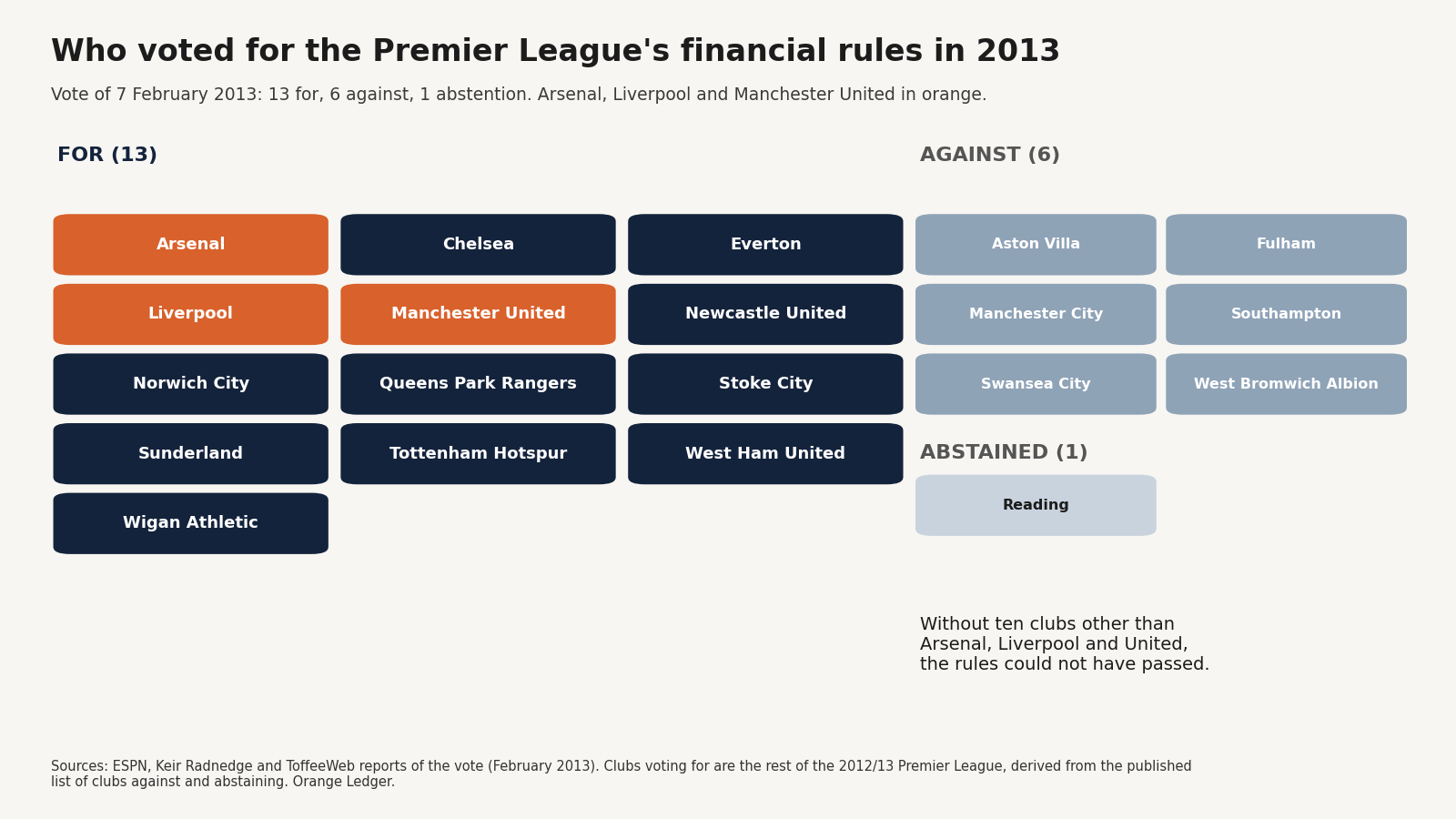
- Arsenal, Liverpool and Manchester United were three of 13. The rules could not have passed without ten other clubs, most of them mid-table or smaller clubs such as Norwich, Stoke, Sunderland and Wigan.
- Chelsea, the club whose owner had done most to change English football’s finances, voted in favour.
- Liverpool voted for rules that constrained Liverpool. It was one of only three clubs, with City and Chelsea, whose losses over the previous three years were above the new £105m limit.
- The opposition was not a group of challengers to the top clubs. Apart from Manchester City, the clubs voting against were Aston Villa, Fulham, Southampton, Swansea and West Bromwich Albion.
The vote shows a league-wide majority, not three clubs acting alone. Whether the rules later worked in the biggest clubs’ favour is a separate question, and one this series returns to in Parts 4 and 5.
How PSR worked
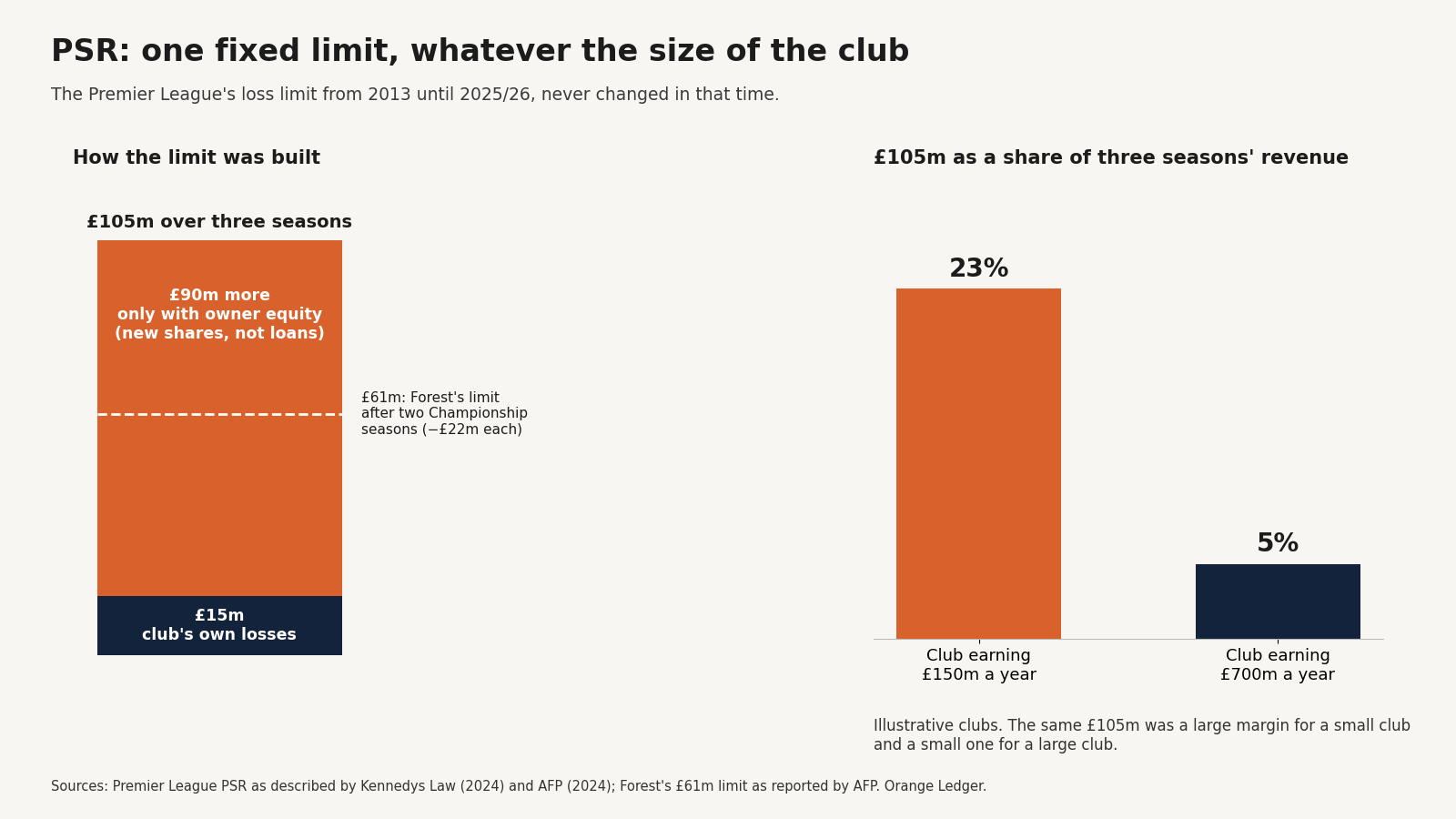
The core of the rules was a single number: a club could lose no more than £105m over three seasons.
That limit was built in two layers:
- £15m of losses over three seasons, or £5m a year, was allowed on the club’s own account.
- Up to £90m more was allowed only if the owner provided “secure funding”: new money for shares, or an irrevocable commitment to buy them. A loan did not count. Without that commitment, the limit stayed at £15m.
PSR did not stop an owner putting money into a club. It decided how much of the resulting loss the rules would tolerate. Money from an owner buying new shares could pay for the losses and unlock the higher allowance, but it did not count as income and did not make the loss any smaller. That distinction becomes much more important under the rules that replaced PSR, where owner funding can strengthen a club financially but does not itself increase the revenue used to calculate how much it may spend on its squad.
Several kinds of spending were left out of the calculation, because the League saw them as good for the game rather than a route to buying success:
- Infrastructure: the cost of stadiums and training grounds, through their depreciation.
- Youth development: the cost of running an academy.
- Women’s football.
- Community work.
Clubs outside the Premier League faced a lower limit. The Championship allowed £13m of losses a year, and for every season in the Championship within its three-year window, a Premier League club’s limit fell by £22m. That is why Nottingham Forest, promoted in 2022, had a limit of £61m rather than £105m.
Transfer fees counted the way accountants count them. A player signed for £50m on a five-year contract appeared as a £10m cost in each of the five years, not £50m in the year he was bought. Accountants call this amortisation. In 2023, Chelsea signed several players on contracts of seven and eight years, which spread the cost more thinly still. For contracts signed or extended on or after 12 December 2023, the League capped the spreading at five years, whatever the contract’s length; earlier contracts kept their full term.
Alongside the loss limit, the 2013 rules added short-term cost controls for the first three seasons. A club whose player costs were above a threshold, £52m in 2013/14 rising to £60m in 2015/16, could raise them by up to £4m a year. A larger rise had to come from contracts signed by 31 January 2013, from growth in the club’s own revenue, or from profit on player trading. The aim was to stop the new television money going straight into wages. The controls were renewed with higher thresholds for three more seasons, to 2018/19, and not extended after that.
Compared with UEFA. The Premier League’s version was the more permissive of the two. UEFA’s limit at the time was €45m over its assessment period, then €30m; the Premier League’s was £105m. Clubs playing in Europe had to satisfy both.
The first punishments
For a decade, no club was punished under PSR. Then, in a single season, three sanctions arrived.
- Everton, November 2023. An independent commission found that Everton’s losses in the three years to 2021/22 were £19.5m above the limit. Everton had argued the true figure was much lower. The club was docked 10 points, reduced to six on appeal in February 2024.
- Nottingham Forest, March 2024. Forest admitted losses £34.5m above their £61m limit. The League had sought eight points, less two for Forest’s cooperation. Forest were docked four.
- Everton, April 2024. A second breach, of £16.6m, for the three years to 2022/23, with a dispute over the costs of the club’s new stadium. The starting point was five points; Everton were docked two after mitigation.
Both clubs complained publicly that separate commissions had treated similar cases differently. Both stayed up.
Everton’s first breach had a second cost. In June 2026 a Premier League commission ordered Everton to pay Burnley about £35m, £26m in damages and £9m in interest, finding that the breach was connected to the 2021/22 season in which Burnley were relegated and Everton stayed up. Everton appealed, disputing the finding that its breach had caused Burnley’s relegation.
How clubs managed the numbers
A rule based on profit and loss can be managed by changing the profit and loss. As the limits started to bite, clubs found ways to do it.
Selling academy players. An academy player has cost the club nothing in transfer fees, so whatever he is sold for counts almost entirely as profit. The costs of producing him had already been left out of the calculation. For a club near the limit, selling a homegrown player was the quickest way back under it.
The June 2024 trades. Most clubs’ accounts close on 30 June. In the last days of June 2024, several clubs near the limit traded players with each other:
- Aston Villa signed Ian Maatsen from Chelsea for a reported £37.5m, and Chelsea signed Villa’s Omari Kellyman, who had made two brief first-team appearances, for a reported £19m.
- Everton sold Lewis Dobbin to Aston Villa, and bought Tim Iroegbunam from Villa, each for around £9m.
Each sale produced a profit in the selling club’s accounts before the deadline, while the cost of the player bought in was spread over his contract. The deals were within the accounting rules, but the League reminded all 20 clubs of its rules on the fair valuation of players involved in transfers.
The reason this worked is a difference in timing between a sale and a purchase. A simple example:
- A club sells an academy player for £20m. Because he cost nothing in transfer fees, almost the full £20m counts as profit in the year of the sale.
- The same club buys a replacement for £20m on a five-year contract. Only £4m of that fee counts as a cost in the first year.
The club has spent and received the same £20m in the transfer market, but its result for the season has improved by about £16m. When two clubs near the limit trade players with each other, both can benefit in the same way.
Selling assets to sister companies. Chelsea sold two hotels to a company under the same ownership, and in June 2024 sold its women’s team to another sister company for nearly £200m, turning each sale into profit in the club’s accounts. Everton and Aston Villa later sold their women’s teams to their own parent companies in the same way. For 2024/25, all 20 clubs were reported to have met the rules.
None of these moves led to a PSR sanction. A profit in the accounts is not the same as the League accepting the price, though: a sale to a company under the same ownership had to be at fair market value, and Chelsea’s accounts for 2023/24 recorded the women’s team sale as subject to the League’s assessment, with the price to be adjusted if the League valued it differently. Together, the moves showed that a limit on losses could be met by changing where a cost or a profit landed, without changing what the club spent on its team.
The fight over owner-linked deals
The deepest challenge to the rules came from income rather than spending.
In December 2021, shortly after Saudi Arabia’s Public Investment Fund bought Newcastle United, the League introduced rules on associated party transactions: deals between a club and a company linked to its owner, such as a sponsorship with a company the owner controls. The rules required such deals to be at “fair market value”, so that an owner could not simply channel money into the club through an inflated sponsorship and raise the club’s income, and so its spending limit. Newcastle and Manchester City voted against.
Why fair value matters is easiest to see with numbers. If a company linked to the owner pays £100m a year for a sponsorship that an independent company would pay £30m for, the extra £70m is the owner’s money dressed up as income. Under PSR, it reduces the club’s loss by the same amount.
In 2023, the League rejected proposed sponsorship deals between Manchester City and Etihad Airways and First Abu Dhabi Bank. City challenged the rules themselves.
- October 2024. An independent tribunal found parts of the rules unlawful. It identified the exclusion of shareholder loans from the fair-value test, some of the changes made in early 2024, and the fact that clubs could not comment on the comparison data used against them. Interest-free loans from owners, used by several clubs, were being treated more favourably than sponsorship deals.
- November 2024. The League amended the rules. City launched a second challenge, arguing the new rules were also unlawful.
- February 2025. A tribunal ruled that the original rules, in force from 2021 to 2024, were void and unenforceable as a whole.
- September 2025. City and the League settled the second challenge. City accepted that the current rules are valid and binding, and both sides agreed to make no further comment.
The fair-value question has not gone away. It is the same question that ran through UEFA’s cases in Part 1, and it sits under every rule that ties spending to income.
Separately, the Premier League charged Manchester City in February 2023 over the period from 2009/10 to 2017/18, including the accuracy of the financial information the club reported and its compliance with the League’s financial rules. On 29 September 2026, the League published the independent commission’s core decision. It found City guilty of all the charges relating to breaches of the League’s financial rules, including arranging ‘sham’ commercial contracts, part of a disguised funding scheme paid for by the club’s owner, that inflated revenue and reduced costs by more than £900m so that the club appeared to comply. Had the deals been reported accurately, the commission found, City would have breached both the League’s and UEFA’s loss limits by a very large amount. It also upheld three of the four charges that City failed to cooperate with the investigation. No sanction had been set at the time of writing, and City said the decision contains material errors of law, principle and fact and that it would appeal.
In March 2026, Chelsea were fined £10m over £47.5m of payments made between 2011 and 2018 that had not been disclosed to the League; a separate breach of the rules on registering academy players brought the total penalties announced that day to £10.75m. The League found that Chelsea would not have breached PSR even with those payments included.
Why the League replaced PSR
By the mid-2020s, the weaknesses of a limit on losses were hard to ignore.
- The number never moved. The £105m limit was set in 2013 and never raised, while revenues, wages and transfer fees rose sharply.
- For established Premier League clubs, it was the same fixed number regardless of scale. £105m was a small margin for a club earning £700m a year and a very large one for a club earning £150m.
- It measured losses, not spending. A club could pass by selling academy players, a hotel or a women’s team, without changing what it spent on its squad.
- It was slow. A breach was found only after a club’s accounts were filed and a commission had heard the case, often years after the spending.
PSR also mixed together two different questions. Was the squad affordable? And was the club financially healthy overall? A single loss figure tried to answer both. A club could pass by selling assets while spending heavily on players, and another could fail because of losses elsewhere in the business while its squad was affordable.
Richard Masters, the League’s chief executive, said in 2024 that the rules had been introduced to ensure unsustainable spending could not go too far. In November 2025, the clubs voted to replace them from 2026/27 with a system that splits the two questions: a squad cost ratio, which measures the cost of the squad against football revenue plus the average profit or loss on player sales over the last six transfer windows, about three years, and separate tests of each club’s cash, working capital and balance sheet.
What PSR shows
Three lessons from PSR carry into the rest of the series.
- A loss limit can be met without spending less on players. Where a cost or a profit lands in the accounts can matter as much as the spending itself.
- A fixed number ages badly. £105m was never raised as revenues grew. It let the smallest clubs lose a much larger share of their income, while the biggest clubs’ revenue still gave them far more to spend.
- Income is the battleground. Whether an owner-linked deal reflects its real value decides how much a club can spend, and it has been fought over at every level of the game.
Next in the seriesPart 3: the new system, SCR and SSR from 2026/27
Sources and caveats.
The 2013 vote. Keir Radnedge (8 February 2013) and ToffeeWeb's report of the vote, including the vote count, the clubs voting against and abstaining, and Richard Scudamore's comments. The 13 clubs voting in favour are the remaining members of the Premier League in 2012/13, derived from the published list of clubs voting against and abstaining. The letter from Arsenal, Liverpool, Manchester United and Tottenham as first reported by the Daily Mail and summarised by To Know The Game (15 January 2013).
How PSR worked. The £105m limit, the £15m and secure-funding layers, exclusions and the Championship reduction as described by Kennedys Law (2024) and Capital Law; the Championship allowance and promoted-club adjustments as set out by The Swiss Ramble (2023); Forest's £61m limit and the five-year cap on spreading transfer fees from December 2023 as reported by AFP (January 2024). The short-term cost control rule (Rule E.18 of the 2013/14 Premier League Handbook), its thresholds and permitted funding, as quoted by Fieldfisher and summarised by Pinsent Masons (2013); the renewed rule for 2016/17 to 2018/19 as described by Accountancy Age (January 2019) and set out in the Premier League Handbook 2019/20.
The first punishments. Everton and Nottingham Forest decisions as reported by AFP and the Nottingham Post (2023-24). The commission's award to Burnley as reported by OneFootball and Yahoo Sports (June 2026); Everton's statement of 10 June 2026 on its appeal as reported by TNT Sports and ToffeeWeb.
How clubs managed the numbers. Academy sales as described by Brabners (2026). The June 2024 transfers and fees as reported by Football365 and OneFootball; the League's letter to clubs on the fair valuation of players as reported by Yahoo Sports (June 2024). Women's team sales and the 2024/25 compliance of all 20 clubs as reported by Sports Illustrated, citing The Times. Chelsea's hotel sale as reported at the time. The women's team sale recorded in Chelsea's 2023/24 accounts as subject to the League's fair-value assessment, as reported by Sportico.
Associated party transactions. Introduction in December 2021 and the vote as reported by Quastels (2025); the October 2024 tribunal findings as summarised by Farrer & Co and Stefan Borson; the February 2025 ruling that the 2021-24 rules were void and unenforceable as reported at the time; the settlement of 8 September 2025 as stated by Manchester City and reported by The Lawyer.
Cases. The Premier League's charges against Manchester City were announced on 6 February 2023; the independent commission's core decision as published by the Premier League on 29 September 2026 (redacted), and the League's statement of the same day; Manchester City's statement of 29 September 2026. No sanction had been set at the time of writing. Chelsea's sanctions of 16 March 2026 (£10m for the undisclosed payments, £750,000 for the academy registration breach) as reported by the Bureau of Investigative Journalism; the sale of Chelsea's women's team to a sister company as reported by AFP (April 2026).
Why PSR was replaced. Richard Masters as quoted by AFP (January 2024); the Premier League's statement of 21 November 2025 on the new financial rules.
The full source register for this series is held with the Orange Engine.
Corrections and updates (2)
25 October 2026 · Regulatory interpretation · no figure changed
Correction, 25 October 2026. No figure changed. The five-year cap was said to apply from December 2023 whatever the length of the contract, straight after Chelsea’s seven- and eight-year deals of 2023, which it does not reach. It applies to contracts signed or extended on or after 12 December 2023; earlier contracts keep their full term. The sentence on owner-linked sponsorship described a rule that ties spending to income, which is the squad cost rule, where £1 of revenue is worth 85p of spending room; under PSR, the rule this piece is about, it reduces the club’s loss by the same amount. And the vote of 2013 now says what the rules required: losses of no more than £105m over three seasons, and a limit on how much new television money could go on wages.
3 November 2026 · Correction · the article contains no model estimates
Correction, 3 November 2026. The 2013 vote: the article said the vote did not support the argument that the biggest clubs pushed for the rules. Arsenal, Liverpool, Manchester United and Tottenham did lobby for tougher rules, in a letter to Richard Scudamore before Christmas 2012, reported in January 2013; the article now says so, and that the rules that passed were looser than they asked for. Short-term cost controls: the article said a larger wage rise above the £4m a year allowed could be funded only by commercial or matchday income. Growth in a club’s own revenue, profit on player trading and contracts signed by 31 January 2013 could all justify it, and the threshold rose from £52m to £60m over three seasons. The article now also says the controls were renewed to 2018/19. The squad cost ratio: the article said the new ratio measures squad costs against revenue; it measures them against football revenue plus the average profit or loss on player sales. The fixed limit: the closing section said a fixed limit became easier for the biggest clubs and harder for the smallest, which contradicted the article’s own chart; it now says the smallest clubs could lose a larger share of their income, while the biggest kept far more spending power. Owner-linked sales: the article said none of the moves broke PSR; it now says none led to a sanction, and that the League’s assessment of a sale’s value is separate from the profit in the accounts. Added: the commission’s June 2026 award of about £35m to Burnley over Everton’s first breach, which Everton has appealed. The sources no longer name outlets this publication does not cite.