
Regulation series
The history of financial rules in football, Part 6: the drop into the Championship
Part 6 of the Orange Ledger's series on football's financial rules, and the second part in the author's own voice. Clubs relegated from the Premier League in the last four years lost 42% of their revenue on average, falling from about £137m to £79m, and still ended up with almost three times as much as a Championship club without a parachute. Leicester City, Burnley and Sheffield Wednesday show what happens at the edge, and what could be done instead.
Latest note, 3 November 2026: data correction. Both correction notes are at the end.
Part 5 ended with a warning: English football has become a network of clubs that owe each other money, and the biggest shock that can hit any of them is relegation. This final part is about that shock, the step from the Premier League to the Championship, and what happens to the clubs that fall.
The cliff
Comparing the average Premier League club with the average Championship club exaggerates the drop, because the Premier League average includes Manchester City and Liverpool. The fairer comparison is the clubs that actually fall. The Orange Ledger has collected the filed accounts of all 12 clubs relegated from the Premier League in the last four years, from Fulham, West Bromwich Albion and Sheffield United in 2021 to Luton Town, Burnley and Sheffield United again in 2024.
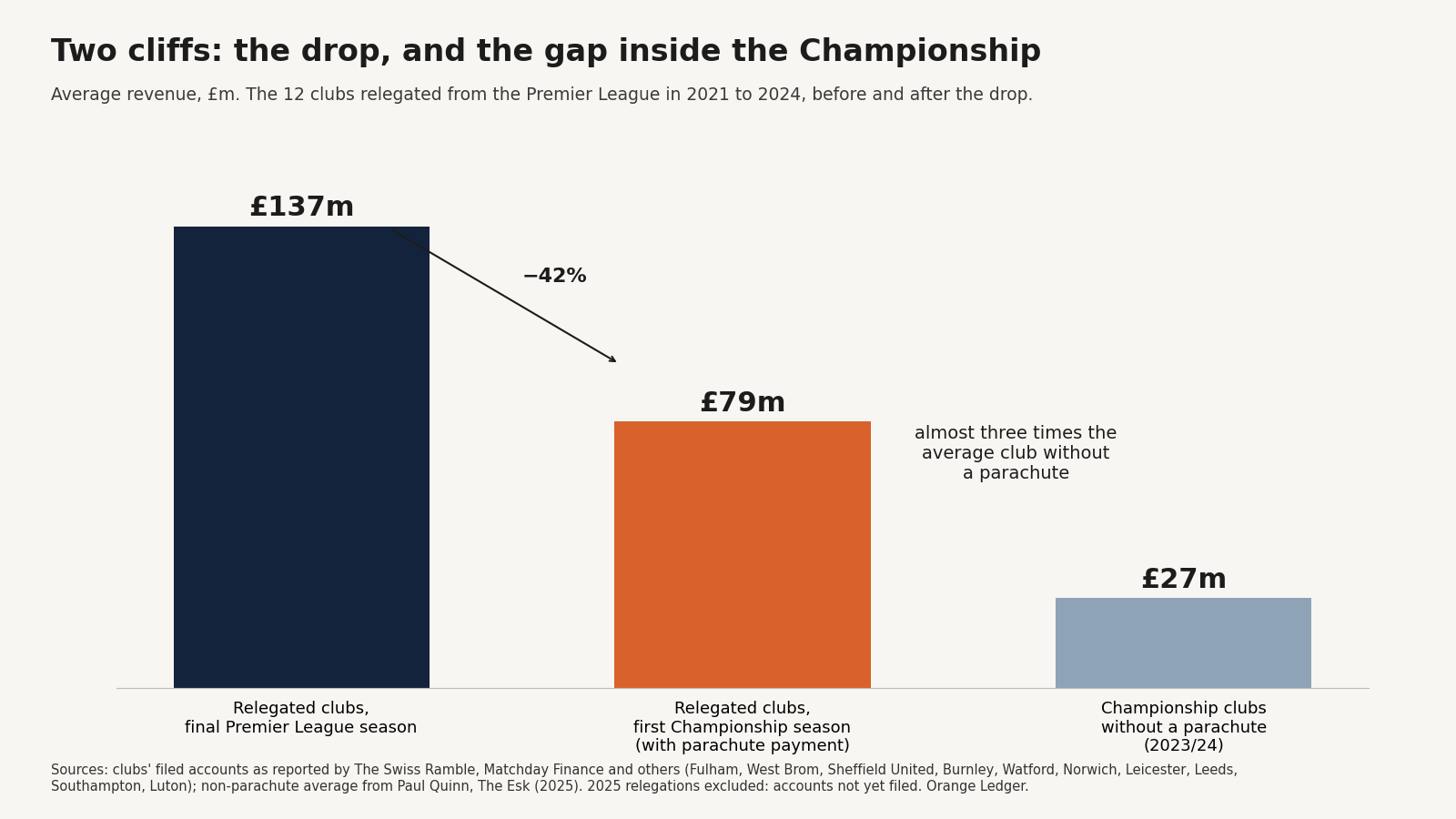
- In their final Premier League season, those clubs earned an average of about £137m.
- In their first Championship season, even with the parachute payment, they earned about £79m: a fall of 42%.
- A Championship club without a parachute earned about £27m in 2023/24, the latest season with that comparison.
So there are two cliffs. The first is the drop itself: a relegated club loses more than £55m of revenue in a single summer. The second is inside the Championship: even after falling, a relegated club has almost three times the revenue of the clubs it now plays against.
The costs do not fall at the same speed as the revenue. Players’ contracts run on, and, as Part 5 showed, transfer fees are paid in instalments over several years. A club that signed players on the assumption of Premier League revenue still owes the instalments when that revenue has gone.
The Championship itself is not a healthy place to land. In 2024/25 its clubs lost £355m before tax, and only a handful of the 24 reported a pre-tax profit. The EFL’s chair, Rick Parry, has pointed out that when the Premier League began in 1992 its turnover was £45m against the Football League’s £34m, a gap of £11m. It is now more than £3bn.
The gap does not stop at the Championship. Each step down the pyramid is another fall:
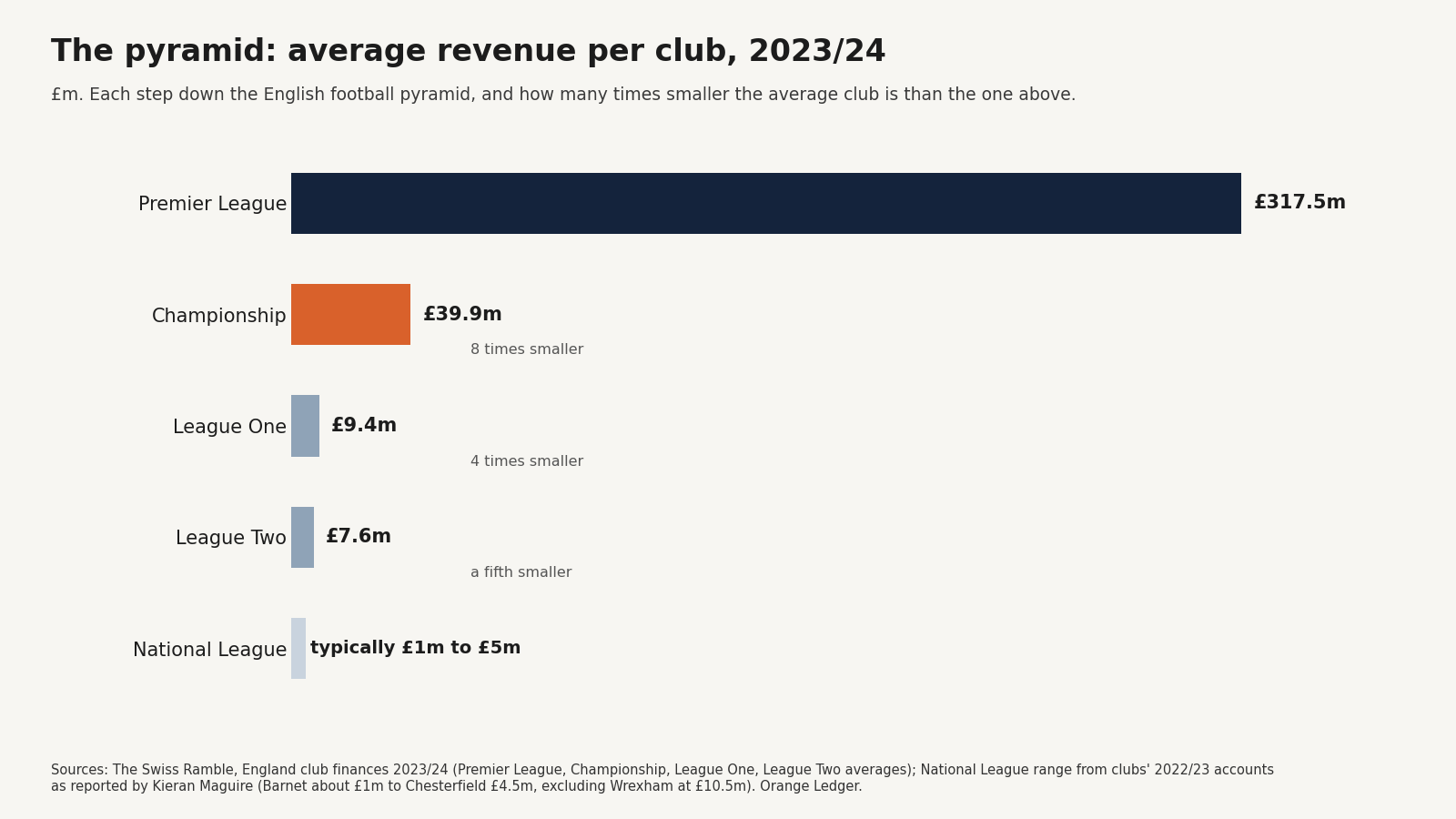
- Premier League: an average of £317.5m per club in 2023/24.
- Championship: £39.9m, eight times smaller, and the average club lost around £15m.
- League One: £9.4m, four times smaller again, with average losses of around £5m in 2023/24.
- League Two: £7.6m, with average losses of more than £2m.
- National League: most clubs earn between £1m and £5m, and the average club loses around £1m a year.
Below the Premier League, losing money is the norm at every level, and many clubs remain dependent on owners continuing to fund those losses. Bury showed what can happen when that support and the wider financial structure fail.
The parachute
The Premier League softens the fall with parachute payments. A relegated club receives a share of the “equal share” of television money it would have earned in the Premier League:
- 55% in its first season down: £48.9m in 2024/25.
- 45% in its second season: £40.1m.
- 20% in a third season: £17.8m, but only for clubs that spent more than one season in the Premier League before going down.
After that the payments stop, and the club drops to the much smaller solidarity payment every Championship club receives. Sheffield United’s income from the Premier League, for example, was expected to fall from about £40m in 2025/26 to about £5.5m in 2026/27, a drop of around £35m in a single summer.
Parachutes do two things at once. They help relegated clubs pay the contracts they signed in the Premier League. But they also give those clubs far more money than the rest of the Championship, which makes the division less competitive and encourages everyone else to overspend to keep up.
Up and down
The result is a group of clubs that bounce between the two divisions. In each of the 2023/24 and 2024/25 seasons, all three promoted clubs were relegated at the first attempt. This summer’s promoted clubs, Coventry City, Hull City and Ipswich Town, spent more than £400m between them on new players. Paul Quinn, in his analysis of football’s inter-club debts, describes relegation as the trigger event for the whole system: television income falls by half, while transfer instalments fall due in full, on schedule, whatever the division.
Three clubs at the edge
Leicester City: from champions to the third tier
Leicester won the Premier League in 2016 as 5,000-1 outsiders, and the FA Cup in 2021. They were relegated in 2023, came straight back up, and went down again in 2025 with six wins in 38 games.
An independent commission found that in the three years to 2023/24, the seasons that ended with promotion, Leicester breached the EFL’s spending rules by £20.8m; the club lost more than £200m over those three seasons. The six-point deduction was upheld on appeal, and in April 2026 Leicester were relegated to League One, only the fifth club to fall from the Premier League to the third tier in consecutive seasons. The club spent heavily to get back to the top, broke the second tier’s rules doing it, and was punished after it had already started to fall again.
Burnley: a club bought with its own money
Burnley was debt-free, with about £42m in the bank, when the American investment firm ALK Capital bought it at the end of 2020 for a reported £170m. Much of the price was funded by the club itself: a £65m loan from MSD, secured against the club’s ground and future income at an interest rate reported at around 9%, and around £37m taken from the club’s own cash. It was, in short, a leveraged buyout of the kind Manchester United went through under the Glazers, described in an earlier Orange Ledger article.
Relegation in 2022 triggered early repayment of much of that loan. Since then Burnley have gone up and down twice more: promoted in 2023, relegated in 2024, promoted in 2025 and relegated again in April 2026. At the time of writing they are bottom of the Championship after eight games without a win.
Sheffield Wednesday: what failure looks like
Sheffield Wednesday entered administration in October 2025, after repeatedly paying wages late, and were docked 18 points in total. When the club was sold in May 2026, football creditors were paid in full under the EFL’s rules, while many other unsecured creditors received 25p in the pound. Seven years earlier, Bury had been expelled from the Football League altogether after its own financial crisis. Clubs do not only fall between divisions. Some fall out of the league.
What has been tried, and who said no
English football has argued for years about sending more money down the pyramid. Every serious attempt has stalled at the same place: the Premier League’s own clubs.
- Project Big Picture, 2020. Liverpool and Manchester United proposed giving the EFL 25% of the Premier League’s future television income, a £250m rescue fund for the Covid crisis, and an end to parachute payments. The price was special voting powers for the nine longest-serving Premier League clubs. The proposal was ultimately rejected by the Premier League collectively: all 20 clubs, including Liverpool and Manchester United, agreed not to pursue it, largely because of that power grab, and the money went with it.
- The Covid rescue, 2020 to 2021. On the same day it rejected Project Big Picture, the Premier League offered League One and League Two clubs a further £50m in grants and interest-free loans, on top of £27.2m already advanced. Championship clubs were left out, and the arguments over support for them went on for months.
- The fan-led review, 2021. The government’s review of football governance, led by Tracey Crouch, recommended a levy on Premier League clubs’ purchases from abroad and from each other, with purchases from EFL clubs excluded, to be shared down the pyramid. It estimated that a 10% levy would have raised about £160m a year. The Premier League’s clubs objected, and it was not adopted; the review’s main outcome was the regulator.
- The EFL’s demand. The EFL has long asked for a 75/25 split of the two leagues’ combined broadcasting income, and has argued for parachute payments to be scrapped. The Premier League has never agreed.
- The “New Deal”, 2024. The version the Premier League had on the table in March 2024 would have paid the EFL an extra £836m, on top of the existing solidarity payments. A revised version would have required Championship clubs to spend no more than 70% of their revenue on player costs. The planned vote was abandoned in March 2024 because the proposal lacked the 14 Premier League clubs needed for approval.
- The regulator’s backstop. The Football Governance Act, which became law in July 2025, created an Independent Football Regulator with a power of last resort: if the Premier League and the EFL cannot agree how money is shared, the regulator can impose a settlement. Those powers came into force on 29 October 2026, after this article was first published: either league can now ask the regulator to step in, and mediation comes before any imposed settlement.
The pattern is clear. The Premier League’s clubs have repeatedly accepted that the pyramid needs more money, and repeatedly failed to agree on how much. That is why the question now sits with the regulator.
My proposals
The Championship needs two things: more money, and a reason for more people to watch it. I would do five things.
1. A solidarity round. Once a season, every Premier League club would host a Championship club in a fixture drawn at random.
- The three clubs just relegated from the Premier League would always take part. The remaining 17 places would be set by last season’s Championship table, with the three clubs newly promoted from League One and the club that finished just above the relegation places sitting out.
- The television money and gate receipts from all 20 matches would go into one pool, shared equally among all 24 Championship clubs, including those that did not play. No club would gain or lose because of the opponent it drew.
- The matches would not count towards either league table. If points counted, the draw would decide too much: one Championship club might face Manchester City, another a newly promoted side, and the four clubs sitting out would have no chance to earn points at all. Keeping the round outside the league tables protects promotion and relegation in both divisions, while keeping everything the round is for: exposure, a new television product, gate money and a fair share for every Championship club.
2. A league-wide documentary. Formula 1’s Netflix series, Drive to Survive, followed every team, not only the winners, and turned the back of the grid into characters audiences cared about. Sunderland ’Til I Die and Welcome to Wrexham have shown how much appeal the underdog story has in English football. Wrexham’s revenue rose from about £6m in 2021/22, its first full season under Ryan Reynolds and Rob McElhenney, to £26.7m in 2023/24, more than every club in League One. A series with league-wide access, commissioned centrally and with its income shared like other central money, would bring a global audience to smaller clubs. And because commercial income counts towards the squad cost ratio (SCR), the share of revenue a club may spend on its squad, a club that grows its following raises its own spending limit the sustainable way.
3. Reward buying from the pyramid. Premier League clubs spend billions on transfers every summer. I would use a small part of that market to strengthen the clubs below. A Premier League club signing a player from abroad, or from another Premier League club, would pay a small solidarity levy on the fee, of perhaps 3% to 5%. Signings from EFL clubs would be exempt.
That does not tell any club whom to sign. It simply makes an EFL player slightly cheaper to buy. A £30m signing from abroad would attract an extra £1.5m at 5%; a £30m signing from a Championship club would not. The Premier League’s existing 4% transfer levy would apply to both, as it does now. Across a whole transfer market, that small difference makes developing players in the EFL more valuable.
The money then flows down the pyramid twice. The selling club receives the transfer fee directly, and the levy collected on every other deal is shared among clubs that did not happen to sell a player that year. Sell-on clauses and training compensation can carry part of that money further down still, to clubs involved earlier in the player’s development.
The idea is not new. The fan-led review of football governance proposed the same mechanism in 2021: a levy on Premier League clubs’ purchases from abroad and from each other, with purchases from EFL clubs excluded. It estimated that a 10% levy would have raised about £160m a year. I would start lower, so that the levy nudges clubs towards the pyramid without distorting transfer prices. The aim is to make developing players a better business.
4. The same discipline one division down. The Championship has replaced its loss rules with squad cost rules from 2026/27, at 85% of income, the Premier League’s level, but not on the Premier League’s terms: a capped amount of owner equity can add to a club’s spending room, which the Premier League’s ratio does not allow. Transfer fees count differently too: the Championship uses net transfer receipts and payments on a cash basis, while the Premier League spreads signing fees over contracts and averages profit or loss on player sales. And players under 21 on permanent contracts are left out of the Championship’s squad costs until they become established first-team players. For the reasons set out in Part 5, I think 85% is too high, and in the Championship, where clubs already lose money at every level, it is even harder to justify. The Premier League itself once proposed a 70% limit for Championship clubs as part of the New Deal. I would set the Championship’s limit at 70% on its own calculation, with the same bonus for promoted clubs as in my Premier League proposal, and extend the register of inter-club debts described in Part 5 to the whole pyramid. That would stop clubs betting their future on promotion.
5. Turn the cliff into a slope. I would not abolish parachute payments overnight. The 42% fall in revenue in this article shows why they exist: contracts and transfer instalments do not disappear when a club is relegated. But the answer cannot be to give three clubs £40m to £50m a year while the clubs beside them operate on £27m.
I would reduce parachute payments gradually as more central money is distributed across the whole Championship, from the solidarity round, the transfer levy, a fairer settlement with the Premier League and a shared documentary. The objective is a slope rather than two cliffs: enough temporary protection that relegation does not threaten a club’s survival, but not so much that relegated clubs start the next season with almost three times the revenue of their rivals. As the Championship becomes richer, parachute payments should become smaller, and eventually unnecessary.
Could Wrexham happen under an SCR of 70%?
The obvious objection is that a tighter limit would kill the kind of rise that made Wrexham famous. The club’s accounts suggest it would not.
Wrexham’s published accounts show total staff costs, not the squad cost ratio itself: they include every employee, not only players, and they do not separate the cost of transfer fees. But they show the shape of the club’s rise clearly. In 2020/21, the season of the takeover, Wrexham’s revenue was £1.5m. After that:
| Season | Division | Revenue | Staff costs | Share of revenue | Result |
|---|---|---|---|---|---|
| 2022/23 | National League | £10.5m | £6.9m | 66% | Loss of £5.1m |
| 2023/24 | League Two | £26.7m | £11.0m | 41% | Loss of £2.7m |
| 2024/25 | League One | £33.3m | £19.9m | 60% | Loss of £15.2m* |
*Includes a one-off write-off of £3.8m. Staff costs include all employees, not only players.
Three things stand out.
- The rise was led by revenue. Wrexham’s income grew more than twentyfold in four seasons, mainly through sponsorship, which reached £17.3m in 2024/25 on the back of the club’s global profile. The club earns nothing directly from the documentary itself.
- Wrexham’s staff costs stayed below 70% of revenue. In the seasons shown, total staff costs never exceeded about two-thirds of revenue, and player wages alone were lower still. That suggests some room under a tighter limit, but does not establish what the club’s position under the Championship’s squad cost rules would have been.
- Even at around 60%, the club lost money. In 2024/25 Wrexham lost £15.2m after tax, including a one-off write-off of £3.8m of cash held with a payments firm that collapsed. In its early seasons the owners lent the club almost £9m to cover losses, and they have since put in tens of millions of pounds of new share capital. A club pushing for promotion loses money even well below 85%.
The real test is Wrexham’s first season in the Championship, 2025/26. The club was among the division’s biggest spenders on transfers in summer 2025, with player wages reported at about £18m a year, which commentators estimated would need revenue of around £50m to support. The accounts for that season, due next year, will show whether the revenue arrived. If it did, wages would sit well within 70% of revenue, though the club’s position under the rules would also depend on its transfer payments and owner funding. If it did not, a 70% limit would probably have slowed that summer’s spending.
So Wrexham’s accounts suggest that a rise led by revenue could survive a tighter limit. They do not prove it: that would need the club’s player and manager costs, its transfer payments and its owner funding counted the way the Championship’s rules count them. What such a limit would stop is the other model: an owner spending far ahead of revenue to buy promotion. Birmingham City lost £34m in League One in 2024/25, the largest loss in the division, when the average club there lost around £7m.
What the six parts add up to
Across six parts, the same lesson keeps returning. Football’s financial rules began as protection against clubs spending money they did not have. Three decades later the rules are more sophisticated, but the underlying incentive remains: spend now, because standing still means falling behind. Today the Premier League loses almost £1bn a year, its clubs owe each other billions, and the drop into the Championship can take a club from champions to the third tier within a decade.
Rules can slow that race. They cannot fix it alone. The answer is an English football economy in which clubs can make a profit, relegation is a slope rather than a cliff, more of the money reaches the clubs below, and those clubs are given the exposure to grow their own revenue rather than simply being told to spend less.
Financial regulation should not be about making football poorer. It should be about making clubs strong enough to survive their own ambition.
End of the series. Start againPart 1: the Bosman era to UEFA's Financial Fair Play
Sources and caveats.
This part includes opinion. The proposals in this part are the author's view. The facts behind them are sourced below.
Relegated clubs' revenue. The Orange Ledger's dataset of the 12 clubs relegated in 2021 to 2024, from their filed accounts as reported by The Swiss Ramble (Fulham, West Bromwich Albion, Burnley, Watford, Norwich City, Leicester City, Leeds United, Southampton), Matchday Finance, Luton Town's own financial statements, the Yorkshire Post and Game of the People (Sheffield United), Football Insider, Insider Media and theaccounts.uk. Leicester's 2022/23 accounts cover 13 months; the 2020/21 Premier League season was played largely without crowds; some 2024/25 figures are rounded. The 2025 relegations are excluded because their 2025/26 Championship accounts have not yet been filed. The non-parachute average of £26.7m in 2023/24 is from Paul Quinn, The Esk (August 2025).
Revenue and losses. Deloitte, Annual Review of Football Finance 2026: Championship pre-tax losses of £355m in 2024/25, as stated in both Deloitte's Football League clubs page and its press release of 8 July 2026; the two give different counts of clubs in profit (two and three), so the article gives none. Rick Parry's comparison of 1992 and current turnover as reported by the Irish Daily Mirror (March 2024).
Parachute payments. The 55%, 45% and 20% structure and the 2024/25 amounts of £48.9m, £40.1m and £17.8m as set out by World in Sport (August 2026) and The Ball Business (2026), including the Sheffield United example.
Promotion and relegation. The relegation of all three promoted clubs in 2023/24 and 2024/25, the spending of the 2026/27 promoted clubs and relegation as a trigger for transfer debts from Paul Quinn, The Esk (3 September 2026).
Leicester City. The commission's finding, the six-point deduction and the appeal as stated by the Premier League (8 April 2026) and reported by AFP (2026); relegation to League One as reported by NBC (April 2026).
Burnley. The 2020 takeover, the MSD loan, the use of the club's cash and the early repayment triggered by relegation as reported by Fortune (February 2021), the Daily Mail (May and September 2022) and The Swiss Ramble; relegation on 22 April 2026 as reported by the Premier League; the current league position as recorded by Wikipedia (September 2026).
Sheffield Wednesday and Bury. Sheffield Wednesday's administration and sale as set out by Paul Quinn (The Esk, 3 September 2026). Bury's expulsion from the EFL on 27 August 2019 as widely reported.
Wrexham. Revenue, staff costs and results from the club's filed accounts as reported by AP and Fortune (2022/23, including the owners' loans of £8.98m), Paul Quinn's analysis of the 2024/25 accounts in The Esk (May 2026, including the 2023/24 comparatives, the £3.8m write-off and the new share capital), Touchline (sponsorship income of £17.3m in 2024/25) and The Wrexham Insider (the club's chief executive, Shaun Harvey, in April 2024, on the documentary bringing no direct revenue) and Non League Insider (2020/21 and 2021/22). Reported player wages and the revenue estimate for 2025/26 from The Wrexham Insider (September 2025), citing Capology and finance commentators. Shares of revenue calculated by the Orange Ledger. Birmingham City's 2024/25 loss and the League One average from Deloitte's Annual Review of Football Finance 2026.
The EFL's squad cost rules. The EFL's statement of 15 May 2026 on the Championship's squad cost rules (85% of income, with a capped owner equity top-up); net player trading on a cash basis and the exclusion of players under 21 who are not established, as explained in the EFL's financial regulation guidance and its answers to questions on the squad cost rules (efl.com, accessed 3 November 2026); and the 85% limit as reported by Loughborough University's summary of the Leonard Curtis Football Finance Report (September 2026).
The pyramid. Average revenue per division in 2023/24 from The Swiss Ramble, England club finances 2023/24; average losses per division from LCP's analysis of men's football club finances (2025); National League revenues from clubs' 2022/23 accounts as reported by Kieran Maguire via Non League Insider. Wrexham's revenue from Insider Media and Non League Insider.
Past attempts. Project Big Picture's terms and the Premier League's statement of 14 October 2020 that all 20 clubs had agreed not to pursue it, and the rescue package offered that day, as reported by Al Jazeera, FourFourTwo and The Independent (October 2020). The EFL's call for a 25% share as summarised by the House of Commons Library (2025). The fan-led review's solidarity transfer levy, its exclusion of purchases from EFL clubs and the £160m estimate from the review itself (November 2021) and as reported by AFP; Premier League clubs' objections as reported by the Daily Mirror (November 2021). The New Deal as below.
The New Deal and the regulator. The £836m package and the abandoned vote as reported by OneFootball (The Mag, 12 March 2024); the revised proposal's 70% limit for Championship clubs as reported by the Mail on Sunday (March 2024); the Football Governance Act 2025 and the regulator's backstop powers as described by Latham & Watkins (2025) and the House of Commons Library (2025); their coming into force on 29 October 2026 as stated by the Independent Football Regulator.
The full source register for this series is held with the Orange Engine.
Corrections and updates (2)
25 October 2026 · Data correction · no figure changed
Correction, 25 October 2026. No figure changed. The example of a levy-free signing named Coventry, who were promoted in 2026 and are a Premier League club; it now says a Championship club. And the average League One loss of around £5m is dated to 2023/24, the season of the revenue figures beside it; the £7m given later is for 2024/25. And Wrexham’s fit within 70% in 2025/26 was stated as certain, before the accounts that would show it; it is now a probability, as the article’s own estimate for League One is.
3 November 2026 · Data correction · one figure changed: New Deal £900m → £836m; one count removed
Correction, 3 November 2026. The article said the Premier League’s New Deal for the EFL collapsed when only 10 Premier League clubs backed it. No vote was held: the planned vote in March 2024 was abandoned because the proposal lacked the 14 clubs needed, and reports of how many clubs were for or against differ, so the article no longer gives a count. The article also described the package as worth around £900m over six years. The figure reported for the version on the table in March 2024 is an extra £836m on top of existing solidarity payments; reports differ on whether it ran over five years or six, so the article gives no length. The article said three of the 24 Championship clubs made a pre-tax profit in 2024/25. Deloitte’s own publications differ, one saying two and the other three, so the article now gives no count; the £355m loss is the same in both. The article said the EFL had chosen the same level as the Premier League; the level is the same, 85%, but the calculation is not: the Championship lets a capped amount of owner equity add to a club’s spending room, counts net player trading on a cash basis, and leaves out players under 21 who are not yet established. The proposal of 70% is now stated on the Championship’s own calculation. The example of a transfer levy gave a £30m signing from abroad a total cost of £31.5m; the £1.5m is the extra levy, and the Premier League’s existing 4% levy applies to every signing. The article said Wrexham’s rise would survive a limit of 70%, that the club would largely have stayed inside it, that its League One season would probably have come close to the line, and that it would probably fit within 70% in the Championship if its revenue reached about £50m. The accounts suggest room under a tighter limit, but cannot prove any of this: staff costs are not the cost the rule counts, and the rule also turns on transfer payments and owner funding. Those conclusions are removed or qualified. Added: the regulator’s powers to settle how money is shared came into force on 29 October 2026. The sources no longer name outlets this publication does not cite; the Leicester City appeal is now sourced to the Premier League’s statement of 8 April 2026, and Wrexham’s sponsorship income and the documentary to Touchline and The Wrexham Insider.