
Analysis
What £900m buys at Crystal Palace under the squad cost rule
Crystal Palace's owners are reported to value the club at £900m. Under the Premier League's squad cost rule a new owner's money cannot be spent on the squad directly. It can be spent on the stadium, and a bigger stadium raises what the squad may cost. We size that for the new Main Stand: a few million pounds a year.
Figures as of 28 October 2026, Orange Engine release V2CG · Latest figures · What the engine does not capture
Latest change to the figures, 3 November 2026: Palace’s ratio is 79.3%, from 78.2%, because Anan Khalaili’s fee is the reported £21.0m, not £8.0m. All 10 correction notes are at the end.
Crystal Palace’s owners have hired the Raine Group and value the club at £900m, City A.M. reported on 5 October, citing multiple sources. Palace declined to comment, and City A.M.’s sources said investment, not a sale, is the priority. In June the Financial Times reported that the three American shareholders, Josh Harris, David Blitzer and Woody Johnson, who own 79% between them, were working with Raine and were open to options including a full sale.
This article asks one narrow question about any such deal: what does owning Palace allow under the Premier League’s squad cost rule?
The answer, in three sentences:
- Palace are inside the rule today, at 78.2%, but only because of player sales: before them the figure is 100.4%.
- A new owner’s money does not raise what Palace may spend on players. Revenue does.
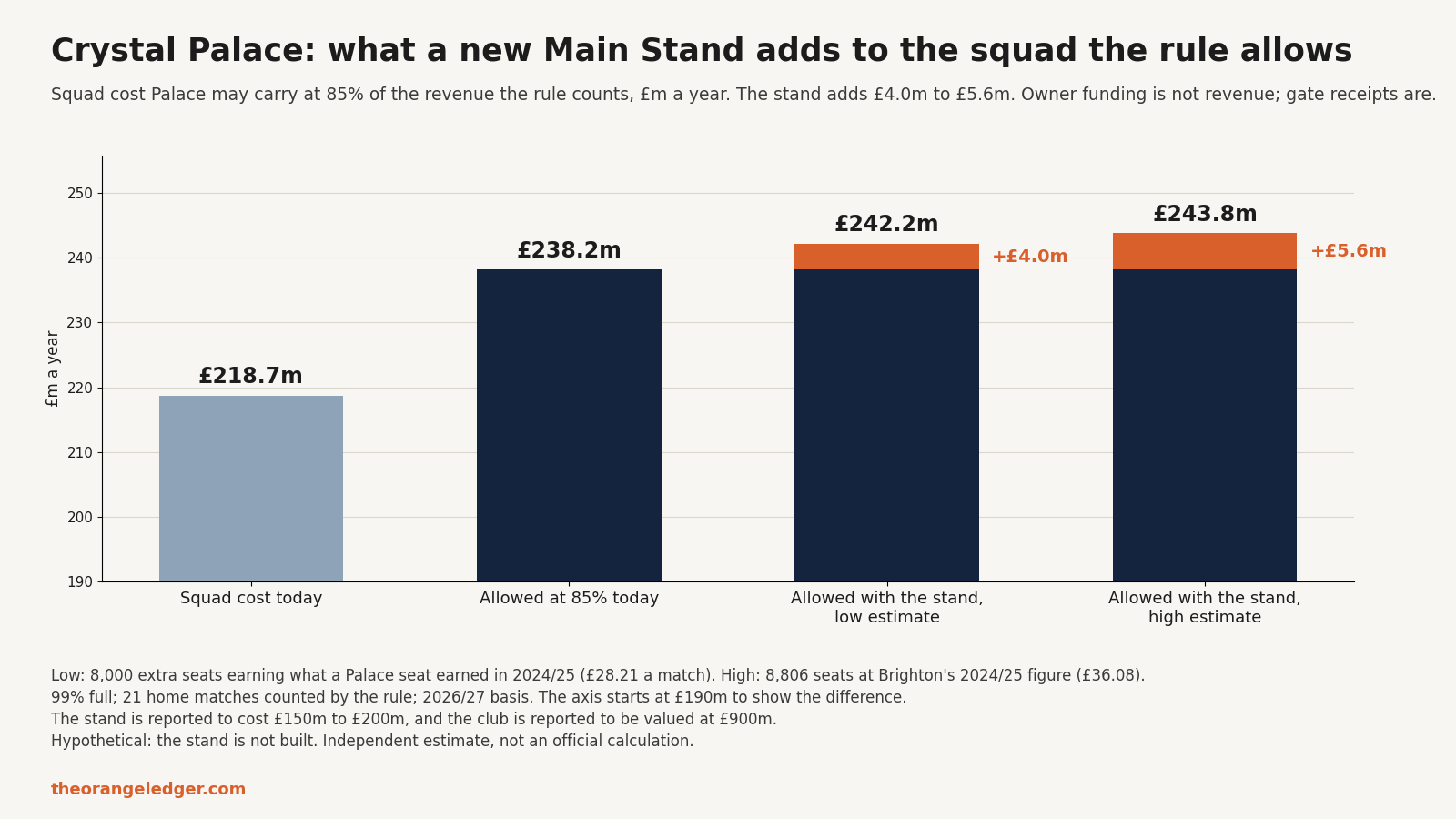
- The one large thing an owner can pay for that becomes revenue is the new Main Stand, and on our estimate it would raise the squad Palace may carry by £4.0m to £5.6m a year.
Everything about a sale here is as reported. The sizing of the stand is our estimate, on stated assumptions, and it is hypothetical: the stand is not built and, on the chairman’s own account, not yet fully financed.
Where Palace stand
The rule divides what a squad costs in a year by the club’s football revenue. Our explainer sets it out. A club at or below 85% is compliant.
| Crystal Palace, 2026/27 | |
|---|---|
| Squad cost ratio | 78.2% |
| Assumption range | 71.7% to 80.9% |
| Assumption range against 85% | entirely below the line |
| Before player trading | 100.4% |
| Squad cost | £218.7m |
| Football revenue, before player sales | £217.9m |
| Three-year average profit on player sales | £61.6m |
| Green headroom | £18.9m |
The rule adds to revenue a third of the profit on player sales in the last six transfer windows, about three seasons. For Palace that average is £61.6m: £66.1m in 2024/25, £65.4m in 2025/26 and £53.4m in 2026/27. Take it away and the squad costs slightly more than the revenue the rule counts: £0.8m more. Palace’s compliance is built on selling players well, and each sale drops out of the average after six transfer windows, about three seasons.
Why a buyer’s money cannot buy a bigger squad
The rule’s denominator is football revenue: central payments from the League, gate receipts, commercial income, prize money, and the average of player-sale profit. Money an owner puts in as equity or as a loan is none of those. A buyer could clear every debt Palace has and the squad the club is allowed to carry would not change by a pound.
Sponsorship from a company connected to the owner is revenue only at fair market value, which the League assesses. That route exists, but it is not a tap.
What an owner’s money can do is build things that earn revenue. Gate receipts are in the denominator, and the rule counts them in a particular way: last season’s receipts per home match, multiplied by this season’s league matches plus the club’s recent average of home cup ties. So a bigger stadium feeds the rule one season after it starts filling.
The Main Stand, sized
Palace have planned a new Main Stand at Selhurst Park since 2017. The Financial Times reported that it would add 8,000 seats and take capacity to more than 34,000. Reported costs run from roughly £150m (Inside World Football) to £200m (Inside Croydon). City A.M. reported that the chairman, Steve Parish, said last week that the club did not yet have all the financing in place.
What would those seats be worth under the rule? We estimate it the way we estimate every club’s matchday line, from the last filed accounts:
- What a seat earns now. Palace’s gate receipts in 2024/25 were £15.6m over 22 home matches in a ground we hold at 25,194 seats: £28.21 a seat a match.
- How many seats. 8,000 as reported, or 8,806 if capacity reaches 34,000 from today’s figure.
- How full. 99%, the rate our model already uses for Selhurst Park.
- How many matches the rule counts. 21: the 19 league matches plus Palace’s three-season average of home cup ties, rounded up, which is 2.
- What a new seat earns. At the low end, the same as an existing one. For the upper benchmark, we use Brighton’s current receipts per seat, not because Palace will necessarily achieve them, but because it gives a comparable modern-stadium yield at roughly the capacity Selhurst Park would become: £36.08 a match, from Brighton’s 2024/25 accounts on the same arithmetic.
| Low | High | |
|---|---|---|
| Extra seats | 8,000 | 8,806 |
| Receipts per seat per match | £28.21 | £36.08 |
| Extra gate receipts the rule counts, a season | £4.7m | £6.6m |
| Extra squad cost allowed at 85% | £4.0m | £5.6m |
| As a share of today’s squad cost | 1.8% | 2.6% |
That is the whole of the gate-receipts effect we can size: £4.0m to £5.6m a year of additional squad-cost capacity, against a stand reported to cost £150m to £200m. Those are not comparable as an investment return: the stand would also generate hospitality, commercial and non-matchday income that we cannot isolate from Palace’s accounts. The comparison simply shows how little additional squad spending ordinary extra seating creates under the rule.
An illustration outside the range. Suppose every new seat earned what Tottenham’s stadium averages: £69.39 a seat a match in 2024/25, from Tottenham’s accounts on the same arithmetic (£126.5m over 29 home matches and 62,850 seats). That is 2.5 times what a Palace seat earns now, and nothing suggests Selhurst Park would match it. The extra squad cost allowed would then be about £10.8m a year, or 4.9% of today’s squad cost. The conclusion holds: even on that yield the stand moves the squad by a few per cent.
Three things would make the figure larger, and we have not sized them:
- Hospitality and events. A new stand’s premium seats, catering and non-matchday use are commercial income in Palace’s accounts. The rule counts commercial income too, some of it only at profit. The accounts do not split it, so we add nothing.
- Europe. In a season with European home matches the rule counts those too. With this season’s 25 matches the high end would be £6.7m.
- Prices. We hold ticket prices at their 2024/25 level.
And one thing would make it smaller for a while: building a stand around an existing one can take seats out of use during the works.
The price in context
£900m is 4.6 times Palace’s turnover of £196.6m in 2024/25, the last filed year, and 4.1 times the £217.9m of football revenue before player sales for this season.
It is also well above what the club was valued at a little over a year ago. City A.M. says Woody Johnson paid a reported £190m for 43% in 2025, which implies about £442m for the whole club: £900m is 2.0 times that. The Financial Times put the valuation at that sale at £550m, which makes it 1.6 times. We cannot reconcile the two reported figures and give both.
None of that is a view on whether £900m is the right price. Buyers of football clubs pay for scarcity, for a London ground, for a place in the League and for what they expect media rights to do. The squad cost rule does not value those things directly. It recognises them only when they turn into qualifying football revenue. What it does say is narrow and worth knowing before a cheque is written: the squad a buyer inherits is as large as Palace’s revenue and its player sales allow, a richer owner does not change that, and the stand that needs financing would move it by a few million pounds a year.
What this doesn’t say
- That Palace are for sale. City A.M.’s sources say investment is the priority; the Financial Times reported in June that a full sale was among the options. Palace declined to comment.
- That any buyer intends to build the stand, or not to.
- That the stand would earn what we estimate. The low figure assumes new seats earn what today’s do; the high one borrows another club’s yield. Neither is a forecast of Palace’s pricing.
- That gate receipts mean the same thing in every club’s accounts. Clubs draw the line between tickets and hospitality differently, which is one reason the range is wide.
- That 78.2% is Palace’s official figure. The League does not publish club ratios.
Sources and caveats.
The reports. City A.M., 5 October 2026 (Frank Dalleres and Matt Hardy): the £900m valuation, Raine’s appointment, the reported £190m for 43%, capacity from 25,000 to 34,000, and the chairman’s remark on financing. Financial Times, 16 June 2026, read as republished by The Irish Times: the three shareholders’ exploration of a sale with Raine, “a variety of options including a full sale”, 8,000 extra seats, and a valuation of £550m at Johnson’s purchase. Inside Croydon, 16 June 2026: the shareholdings and the £200m figure for the stand. Inside World Football, 6 October 2026: roughly £150m.
Palace’s figures. Our reconstruction from CPFC 2010 Limited’s consolidated accounts for 2024/25 and the transfer record to 23 September 2026 (engine V2BV). Last season’s commercial revenue is an estimate, from the method set out in how we estimate last season’s commercial revenue. The stand estimate uses filed 2024/25 gate receipts for Palace and Brighton, the seat counts in our model, and Rule A.1.29(d) of Appendix 2 of the Premier League Handbook 2026/27 for the matches counted.
Independent estimate, not an official calculation, and not advice. The stand scenario is hypothetical.
Corrections and updates (9)
7 October 2026 · New evidence · several figures: see the note
Correction, 7 October 2026. Palace’s ratio is 78.9%, from 78.5%, and 101.8% before profit on player sales, from 101.2%, after corrections to our record of the club’s signings: Borna Sosa’s fee is a reported £3m, where we had none, six signing dates follow the club’s own announcements, and Oscar Mingueza’s contract is four years (see our reconstruction of Palace). Squad cost is £218.7m, from £217.5m, and the room under 85% is £16.8m, from £18.1m. The range is 74.7% to 82.3%, from 74.2% to 81.8%, and 1.2% of modelled outcomes are above 85%, from 0.8%. At Tottenham’s receipts per seat the extra squad cost allowed is 4.9% of today’s squad cost, from 5.0%. Revenue does not move, so the estimate of what the new Main Stand adds is unchanged.
9 October 2026 · Methodology change · several figures: see the note
Correction, 9 October 2026. Palace’s ratio is 78.1%, from 78.9%, and 100.4% before profit on player sales, from 101.8%. Palace’s 2025/26 accounts are not filed, so last season’s commercial revenue is an estimate, and it is now made by one published method, the same for every club: £36.1m, from £33.0m, which was a judgement of ours (how we estimate last season’s commercial revenue; see also our reconstruction of Palace). The revenue the rule counts is £217.9m, from £214.9m, so the squad cost allowed at 85% today is £238.2m, from £235.6m, and the room under 85% is £19.5m, from £16.8m. With the new Main Stand the squad cost allowed is £242.2m on the low estimate and £243.8m on the high estimate, from £239.6m and £241.2m. The range is 72.8% to 81.5%, from 74.7% to 82.3%, and 1.0% of modelled outcomes are above 85%, from 1.2%. £900m is 4.1 times the revenue the rule counts, from 4.2. Squad cost does not move, and nor does the estimate of what the new Main Stand adds, £4.0m to £5.6m a year. The chart is redrawn.
15 October 2026 · Editorial · several figures: see the note
Clarification, 15 October 2026. Wording only; no figure changed. The ranges in this article are assumption ranges, the spread of the model’s inputs between assumed bounds, not calibrated or confidence intervals, and the shares of modelled outcomes above 85% quoted in the notes above are withdrawn.
16 October 2026 · Assumption revision · several figures: see the note
Updated 16 October 2026: loans out now recorded; wage relief shown in ranges. Palace’s central figure is unchanged at 78.1%. Every club’s players out on loan are now recorded; nobody has said how much of the wages of Palace’s loanees the borrowing clubs pay, so the possible saving widens the assumption range, which is now 71.5% to 80.6%, from 72.8% to 81.5%. No figure the stand calculation uses moves. See the engine changelog.
21 October 2026 · Data correction · SCR 78.1% → 77.8% · before player sales 100.4% → 100.0%
Correction, 21 October 2026. Palace’s ratio is 77.8%, from 78.1%, and 100.0% before profit on player sales, from 100.4%; the assumption range is 71.2% to 80.3%, from 71.5% to 80.6%. Two signing dates now follow the club’s own completion announcements and Quinten Timber’s contract runs to 2031, as the club announced, so the squad cost is £217.9m, from £218.7m, and the room under 85% £20.3m, from £19.5m. Before profit on player sales the squad now costs as much as the revenue the rule counts, £0.1m less, where it had cost slightly more. What the new Main Stand adds does not change (£4.0m to £5.6m), and the chart is redrawn with today’s squad cost. See the engine changelog.
24 October 2026 · Methodology change · no figure changed
Correction, 24 October 2026. No figure changed. This article said the rule counts the last three seasons’ profit on player sales, and that each year’s sales drop out after three seasons. The rule takes the profit or loss on sales in the six most recent transfer windows and divides it by three (Rules A.1.13 and A.1.53). Six windows cover about three seasons, but a club’s sales from February to June stay in the average for one test longer than the rest of its financial year. Both sentences now say six transfer windows. Palace’s average, £62.3m, already counts by window.
25 October 2026 · Editorial · no figure changed
Correction, 25 October 2026. No figure changed. The table called £217.9m the revenue the rule counts, beside a squad cost of the same amount and a ratio of 77.8%, and the chart’s description used the same words for the revenue including the £62.3m average of sale profit. The £217.9m is football revenue before player sales; the rule divides by that plus the average, which is why the ratio is 77.8%. The table and the comparison with the £900m now say so.
26 October 2026 · Regulatory interpretation · several figures: see the note
Correction, 26 October 2026. Fees paid and received for head coaches now count, and filed loan income is in the ranges. A fee one club pays another for a head coach is part of the squad cost, spread over his contract (Rule A.1.22(d)); compensation a club receives for releasing one counts with the profit on player sales (Rule A.1.29(g)). We had counted neither. Fees received for lending players count with the profit on player sales (the guidance to Rule A.1.29(g)); the accounts do not split them from wages recharged, so they widen the range and leave the central figures alone. Palace’s ratio is 78.1%, from 77.8%, and 100.4% before player trading, from 100.0%, because the fee Palace paid Lens for Pierre Sage (€3m reported in June 2026, up to €5m) counts in the squad cost: the squad cost is £218.7m, from £217.9m, and the headroom £19.4m, from £20.3m. The range is 71.5% to 80.7%, from 71.2% to 80.3%.
28 October 2026 · Data correction · several figures: see the note
Correction, 28 October 2026. We checked every transfer in our records against published sources and corrected sixteen entries at eleven clubs where the club’s announcement or a reputable report, read on the page, gives a different fee, contract length or date. Palace’s ratio is 78.2%, from 78.1%: Daniel Munoz’s sale brought £20m guaranteed, not £22m, and the add-ons count only once they fall due (Rule A.1.29(g)). The three-year average of sale profit is £61.6m, from £62.3m, with 2026/27’s sales at £53.4m, from £55.3m; the headroom is £18.9m, from £19.4m. The range is 71.7% to 80.9%, from 71.5% to 80.7%.
3 November 2026 · Data correction · SCR 78.2% → 79.3% · before player sales 100.4% → 101.7%
Correction, 3 November 2026. The ratio is 79.3%, from 78.2%, in a range of 72.7% to 81.9%, from 71.7% to 80.9%, and 101.7% before player trading, from 100.4%. Anan Khalaili’s fee is the reported £21.0m, where we had £8.0m with no source. Palace now sit just above Brighton in the ranking. The figures that follow from the ratio move with it: the squad cost is about £221.7m, from £218.7m, and the headroom under 85% about £15.9m, from £18.9m.