
Analysis
Saudi clubs owe an estimated €180m to €260m on Premier League transfers. Nobody publishes the number.
Twenty-two players, €823m of fees, and a receivables book concentrated on one club that changed hands in September. What LIV Golf, the Chinese Super League and NEOM say about the risk, and why no one in England can read the debtor's accounts.
SCR 2026/27·Post-summer projection
Latest note, 25 October 2026: data correction, no figure changed. All 3 correction notes are at the end.
When a Premier League club sells a player to a Saudi club, the fee is announced, the player flies out, and the money is typically paid over three or four years. That last part is the bit nobody tracks. Every deferred instalment is, in effect, credit from the seller to the buyer: cross-border, owed by a club that publishes no audited accounts, and protected by whatever guarantees the contract contains, which nobody outside the two clubs can see.
For three years that didn’t matter, because the buyers were owned by the Public Investment Fund, one of the largest pools of capital on earth, and PIF was reported to pay fast. This summer the largest buyer changed hands, the fund changed its priorities, and the region around them got less predictable. The money still owed didn’t change. Some of it sits on English clubs’ balance sheets and some may have been sold on to lenders, and this piece is an attempt to say how large it is and who owes it. On the article’s stated assumptions, Saudi clubs still owe an estimated €181m to €263m on these deals, and about half of it is owed by Al-Hilal.
What was sold
I took every Premier League club’s departures from Transfermarkt’s transfer pages, summer and winter windows, 2021 to 2026, kept the fee-paying moves to Saudi clubs, and added two that the pages missed at the time (Durán in January 2025; Martinelli, completed after the English deadline). Fees are as reported, in euros, add-ons excluded. That gives twenty-two deals worth €823m in four years.
| Window | Deals | €m | The big ones |
|---|---|---|---|
| Summer 2023 | 11 | 313 | Neves 55, Mitrović 53, Fabinho 47, Mahrez 35, Laporte 28, Saint-Maximin 27 |
| Summer 2024 | 5 | 155 | Diaby 60, Toney 42, Cancelo 25, Ângelo 23 |
| January 2025 | 1 | 77 | Durán |
| Summer 2025 | 2 | 88 | Núñez 53, Félix 35 |
| Summer 2026 | 3 | 189 | Martinelli 70, Reijnders 61, Watkins 58 |
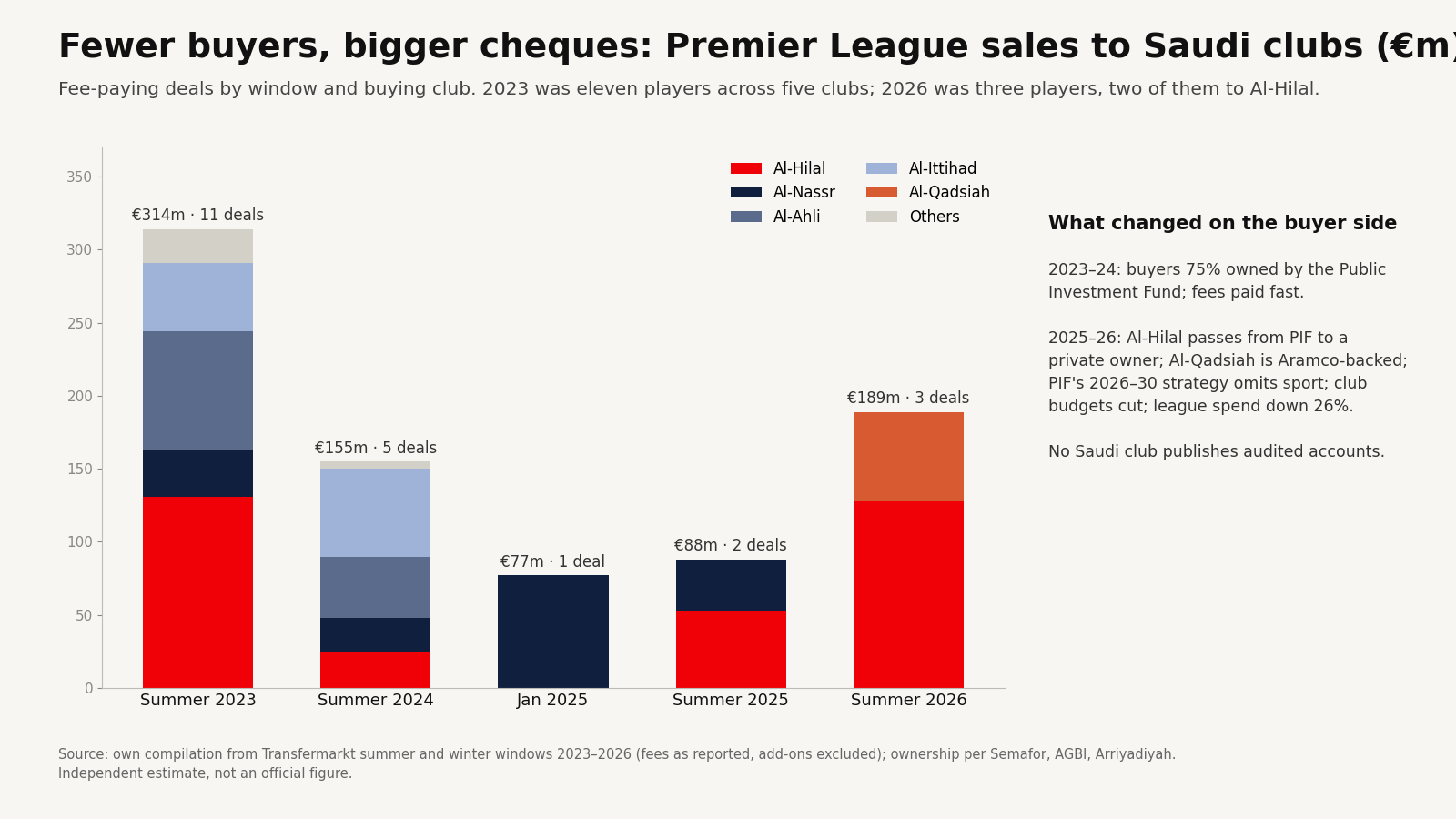
Summer 2023 was eleven players, mostly in their late twenties or older, spread across five buying clubs at €10m to €55m each. By now those instalments are largely paid. What followed was fewer, bigger, younger deals, concentrated on one buyer. Núñez, Watkins and Martinelli are about €181m of reported fees agreed with Al-Hilal, committed in the fifteen months during which Al-Hilal’s ownership changed.
Who owes what
No instalment schedule is public, so the outstanding figure rests on an assumption stated plainly: equal annual instalments, the first on completion and the rest on each anniversary, three of them in the lower estimate and four in the higher estimate, all paid when due. Counted as at September 2026, that leaves the 2023 deals settled in both estimates and the 2024 deals settled in the lower estimate.
| Club | Sold since 2023, €m | Est. outstanding, €m | Largest debtor |
|---|---|---|---|
| Aston Villa | 195 | 65 to 97 | Al-Hilal (Watkins), Al-Nassr (Durán) |
| Arsenal | 70 | 47 to 53 | Al-Hilal (Martinelli) |
| Manchester City | 149 | 41 to 52 | Al-Qadsiah (Reijnders) |
| Liverpool | 114 | 18 to 27 | Al-Hilal (Núñez) |
| Chelsea | 100 | 12 to 23 | Al-Nassr (Félix) |
| Brentford | 42 | 0 to 11 | Al-Ahli (Toney) |
| Others | 154 | 0 to 1 | 2023 and 2024 deals, settled or nearly |
| League | ≈823 | ≈181 to 263 | Al-Hilal ≈103 to 129 |
Each row is rounded separately, so the rows add to slightly more than the league total.
This estimates what the Saudi buyers still owe on these deals. It does not show who now holds each claim. A club can sell a transfer receivable to a lender for cash today, and many do: the Independent Football Regulator’s draft State of the Game report finds that Premier League clubs reported about £1.25bn of transfer receivables and £975m of transfer factoring, equivalent to 78% of what remained. Whether any of these Saudi receivables have been sold, and on what terms, is not public.
Villa’s estimated Saudi exposure is equal to between about a sixth and a quarter of their last reported revenue, and the largest part is owed by Al-Hilal, the one buyer that has changed hands. Arsenal, Liverpool and Chelsea each have a single Saudi buyer behind the whole of their estimated Saudi exposure. Between about €100m and €130m of the league’s total is owed by one club in Riyadh.
Who the debtor is now
That club is Al-Hilal, and it is no longer what it was when Neves and Mitrović signed. In 2023 PIF took 75% of Al-Hilal, Al-Nassr, Al-Ittihad and Al-Ahli and funded the league’s arrival on the world stage. PIF’s published strategy for 2026 to 2030 puts its weight on returns and private-sector participation, although when it ended LIV Golf’s funding in April it said sport remained a priority sector. Club budgets have been cut by a reported $200m to $400m. Al-Ittihad’s summer spending fell from about $100m in 2024 to $18m in 2025, and Saudi clubs have reportedly been bracing for player lawsuits over unpaid wages. Under a privatisation programme, eleven clubs have been sold and five more were offered in August.
Al-Hilal passed from PIF to Kingdom Holding Company, the listed investment vehicle controlled by Prince Alwaleed bin Talal, who owns 78% of it. The sale was agreed on 16 April and completed on 1 and 2 September: 70% of the club for SAR 840m (about $224m). That values the club’s equity at SAR 1.2bn and the whole business, debt included, at about SAR 1.4bn. PIF keeps the other 30%, and separately owns 16.9% of Kingdom Holding, so the state is still in the room. Alwaleed, a lifelong supporter and the club’s largest donor (SAR 182.6m in 2023/24), had personally funded Al-Hilal’s January window while the deal awaited approval.
The other debtors went the opposite way. In August the remaining 25% stakes in Al-Nassr, Al-Ittihad and Al-Ahli moved to PIF, which for now owns them outright. Al-Qadsiah, Reijnders’s new club, is backed by Aramco. The league introduced a cap of 75% of revenue on first-team spending, and summer 2026 spending was $407m, down 26% and the lowest since the project began.
So the counterparty on about half of the money above is no longer a sovereign fund. It is a listed company controlled by one individual, with the state as a minority partner. Most of the rest is owed by clubs that PIF now owns outright, or by a club on a state oil company’s budget line. None of them is something an English finance director can read the way they could read PIF.
Why you can’t read it
Saudi clubs do not file audited accounts on a public register. Al-Hilal Club Company publishes headline figures (revenue of SAR 1.09bn in 2023/24, a small profit, its largest donor’s contribution), which is more than most, but there is no equivalent of Companies House: no filed balance sheet, no disclosure of transfer payables by maturity, no going-concern statement, no letter of support with terms. Kingdom Holding, Al-Hilal’s new owner, is listed and publishes group accounts, but a holding company’s consolidated statements are no substitute for a schedule of what the club owes on transfers. Everything in this piece about the debtor side is reported or self-published, not audited and filed. That is unusual for a counterparty owing tens of millions over several years.
A UK company selling €50m of goods on three-year terms to a foreign buyer it could not audit would usually want a bank guarantee or credit insurance, or would sell the receivable, before extending the credit.
English clubs do sell transfer receivables, and on a large scale: the regulator’s draft report puts factoring by Premier League clubs at £779m in 2024/25, up from £55m in 2020/21. Selling a receivable moves the risk only if the sale is without recourse to the club, and a bank guarantee or an insurance policy is a different thing again.
When willingness fails: LIV Golf
Willingness is revocable, and this month produced the cleanest example yet. LIV Golf, funded by the same fund, filed for Chapter 11 on 8 September, four months after PIF said it would stop funding it after this season. PIF had the capacity to fund LIV for a century and chose not to. The filing is a restructuring rather than a closure: PIF is providing $49.6m of financing during the case, and how much LIV’s creditors, its players among them, eventually recover will be settled in court. But a business that had assumed its funding would continue now depends on a judge and new investors. Paul Quinn’s analysis of it makes the distinction that every football creditor should now make: capacity is the least informative constraint, willingness is the binding one, and willingness leaves no trace in any balance sheet until it’s gone.
English football has seen a smaller version. In 2023, 777 Partners agreed to buy Everton and lent the club around £200m while the takeover awaited approval; the approval never came, 777 collapsed, and the club’s survival ran through a regulator’s leverage and a new buyer. The money had been real right up to the point it wasn’t.
The Chinese precedent
There is a template for what a state-directed football boom looks like when the state reprioritises. Between 2016 and 2018 the Chinese Super League paid European clubs record fees and European players record wages; Oscar, Hulk and Tevez were the headline names. Then the government imposed a 100% transfer tax on loss-making clubs, later a salary cap, and the corporate owners that had underwritten the boom (Evergrande, Suning) ran into their own crises. Jiangsu, the 2020 champions, folded within months of the title. Guangzhou, eight times champions under Evergrande, was dissolved. Dozens of professional clubs disappeared across the tiers between 2020 and 2023. How the money owed to foreign clubs for players bought at the top of the cycle was finally settled has not been documented case by case, and this piece has not been able to establish it.
Saudi Arabia is not China. The state wants a 2034 World Cup, the clubs are being sold to identifiable private owners rather than abandoned, and there is a league-level spending rule. The likelier path is a managed retreat with casualties: cuts, wage disputes, stars leaving on discounts, one or two clubs in trouble. But the mechanism that ended the Chinese boom, sovereign capital reprioritised and private owners left holding a cost base, is the mechanism now running in Riyadh.
NEOM, the Games and the region
These are background risks rather than evidence that any instalment will go unpaid, but they shape the environment in which the people behind the buyers decide what to fund.
Football is one line in a much larger retrenchment. NEOM, the $500bn region in the north-west of the kingdom, was announced around The Line: a linear city 170km long, 200 metres wide and 500 metres high, mirrored on both faces, planned for nine million people with no cars. Reporting since 2024 has put the first phase at about 2.4km by 2030, for around 300,000 residents, with construction slowed and contractors’ payments stretched. The 2029 Asian Winter Games, which were to be held at Trojena in NEOM’s mountains, were moved to Almaty in Kazakhstan, with the hosting contract signed in February 2026. Stadium plans for the 2034 World Cup have been scaled back in reporting since. NEOM SC, the club that took Everton’s Doucouré on a free transfer this summer, exists because the city does. Lower oil prices, a budget deficit and a sovereign fund choosing between priorities are the reasons given. None of this stops Al-Hilal paying an instalment. All of it changes the probability that the people behind Al-Hilal still want to.
It would be foolish to forecast the conflict in the region and I won’t. What can be said is that it has already moved money and events. The Esports World Cup, another PIF-backed showcase, left Riyadh for Paris, with its organisers citing the regional situation among their reasons. Roger Mitchell, the former Scottish Premier League chief executive, wrote of missiles and a closed Strait of Hormuz in a column that football executives were circulating in September. For a creditor the questions are practical: in what currency and from which bank is the instalment paid; could a payments disruption, capital control or sanction delay it even if the buyer is willing; and how much of a club’s receivables book sits on Gulf paper in total. Two Premier League clubs, Arsenal and Villa, sold players to Al-Hilal for about €128m this summer, and West Ham, relegated in May, sold Crysencio Summerville to the same club. Nobody at any of them, as far as I can find, has answered those questions in public.
What a selling club can do
A club cannot get a player back if the buyer stops paying; it becomes a creditor. Within England the football creditor rule, which pays football creditors in full before others when an English club enters administration, protects it. Across borders the remedy is a claim to FIFA and sporting sanctions on the debtor, which work against a slow payer and do nothing against an insolvent one. The tools that do work are the ones every exporter uses: bank guarantees, acceleration on default, security over the receivable, and selling the receivable to a financier without recourse, so that the credit risk sits with someone who prices it. Selling receivables is now common in English football; whether guarantees or security are, the public record does not show. Quinn has suggested that any single counterparty above 15% of a club’s receivables should be treated as a concentration to be mitigated; that is his threshold, not a rule. Testing a club against it needs the club’s whole receivables book, from every buyer, and these numbers cover only the Saudi part. What they do show is that the Saudi part is concentrated: most of Villa’s is owed by Al-Hilal, and Arsenal’s, Liverpool’s and Chelsea’s are each owed by a single Saudi club.
This is a book that exists, that no one publishes, and that has changed character since it was written.
Caveats.
The deals. Fees are Transfermarkt's reported figures, not contracts, with add-ons and sell-ons excluded. Clubs that sold after relegation (West Ham's Summerville to Al-Hilal) are not in the Premier League set, so the exposure is understated.
The estimate. Instalment schedules, guarantees and currencies are not public. The outstanding figures assume equal annual instalments, the first on completion and the rest on each anniversary, all paid when due, counted as at September 2026; they should be read as a range. Villa's share of revenue compares the estimate with the £359.3m of turnover in the club company's last filed accounts, converted at the rate implied by the article's own totals.
Saudi clubs and the region. Club budgets and ownership are as reported by PIF's own statements, Bloomberg, Inside World Football, Semafor and AGBI; Saudi clubs publish no audited accounts on a public register. LIV Golf's filing and financing are from the court filing as reported. The Asian Winter Games are from the Olympic Council of Asia. Chinese Super League history is from contemporaneous reporting.
Independent estimate, not an official calculation, and not advice.
Corrections and updates (3)
22 October 2026 · Data correction · several figures: see the note
Correction, 22 October 2026. This article estimated that Premier League clubs were owed about €262m to €402m by Saudi clubs, and its headline said roughly €260m. A review of the calculation found that it had not counted the instalments falling due on the 2024 and 2025 deals’ anniversaries in summer 2026, although the article’s stated assumption, equal annual instalments paid when due, counts them as paid by September 2026. On that assumption the estimate is about €181m to €263m, and the headline now gives that range.
- Dependent figures: by club, Aston Villa about €65m to €97m (from €85m to €112m), Manchester City €41m to €52m (from €49m to €74m), Liverpool €18m to €27m (from €35m to €55m), Chelsea €12m to €23m (from €31m to €48m), Brentford nil to €11m (from €14m to €21m), and others nil to €1m (from €2m to €38m). Arsenal is unchanged at €47m to €53m. Al-Hilal’s share is about €103m to €129m (from about €129m). Villa’s estimate is between about a sixth and a quarter of their last reported revenue, rather than close to a quarter.
- Al-Hilal this summer: the article said three English clubs took about €185m of Al-Hilal paper. Within the article’s Premier League set it was two clubs, Arsenal and Villa, and about €128m; West Ham’s sale of Summerville came after relegation.
- Ownership: the article said Villa’s receivables were owed by three clubs whose ownership had changed. Only Al-Hilal has passed out of PIF’s control; in August PIF took the remaining stakes in Al-Nassr and Al-Ittihad.
- PIF and sport: the article said PIF’s 2026 to 2030 strategy no longer lists sport among its priorities. PIF said in April, when ending LIV Golf’s funding, that sport remained a priority sector, and the article now says both.
- The Asian Winter Games: the article said they were postponed. They were moved to Almaty, with the hosting contract signed in February 2026.
- LIV Golf: the article said LIV moved to insolvency with losses falling on its counterparties. Its Chapter 11 is a restructuring, with PIF providing $49.6m of financing during the case; creditors’ recoveries are not yet known.
- The terms of the credit: the article called every instalment “unsecured” and said football had not insured the receivables. The contracts are private, so neither can be established; the article now says so.
- The Chinese precedent: the article said money owed to foreign clubs was in a number of cases paid late, renegotiated or written off. That is not documented case by case here, and the sentence is withdrawn.
- The headline: it said Premier League clubs are owed the money. Some of these receivables may have been sold to lenders, so the headline now says what the Saudi clubs owe on Premier League transfers, and the article says the estimate does not show who holds each claim.
- Quinn’s threshold: the article said Villa cross his 15% concentration threshold on Al-Hilal alone and that Arsenal, Liverpool and Chelsea are at 100%. His threshold applies to a club’s whole receivables book, which these figures do not cover; the sentence is withdrawn, and the article now says only that the Saudi exposure is concentrated.
- Selling receivables: the article said nothing suggested English clubs commonly insure, guarantee or sell receivables, and that none of the protections was visibly standard. The Independent Football Regulator’s draft State of the Game report shows that selling transfer receivables (factoring) is common: £779m in 2024/25, and £975m against £1.25bn of receivables. The article now says so, distinguishes factoring from guarantees and insurance, and no longer lists the loan with an obligation to buy as a protection, since once the obligation is triggered the registration passes and the fee is owed like any other.
- Fees and money owed: the article described about €181m as owed by Al-Hilal for three players. That is the fees agreed, not the amount still owed on them, and the sentence now says so.
The article’s argument, that these receivables are large, concentrated, undisclosed and owed by buyers whose backers’ willingness can change, stands. The error in the estimate was ours.
22 October 2026 (second) · Editorial · no figure changed
Editorial, 22 October 2026. Wording only; no figure changed.
- NEOM and the regional situation are combined under one heading and framed as background risks.
- Quinn’s 15% threshold is identified as his, not a rule.
- Clubs take the plural.
- Signposts and “not X but Y” constructions are removed, and ranges are written with “to”.
- Numeric table columns are right-aligned.
- The caveats are divided into headed paragraphs, and their out-of-date line about corrections going at the top is removed.
- The lead chart and the cover are redrawn with the corrected figures, and the chart has a phone version. The chart now shows each estimate as a range. The earlier images are kept as the record of what was first published.
25 October 2026 · Data correction · no figure changed
Correction, 25 October 2026. No figure changed. The note of 22 October said that in August PIF took the remaining stakes in Al-Nassr and Al-Ittihad. The August transfer of the foundations’ remaining 25% stakes covered Al-Ahli as well (and Al-Hilal’s foundation stake), so PIF now owns Al-Nassr, Al-Ittihad and Al-Ahli outright, as the article says (AGBI, August 2026). The note had named two of the three.