
Analysis
Morgan Rogers and the hidden credit chain behind a £117m transfer
A British-record fee, paid in instalments, that triggered a second obligation to Middlesbrough and ran alongside three other deals between the same two clubs, two of them the other way. A worked example of why transfer debt is measured gross, not net, and why UEFA's 45-day rule changes what Villa's profit is worth.
Figures as of 5 October 2026, Orange Engine release V2BO · Latest figures · What the engine does not capture
SCR 2026/27·Post-summer projection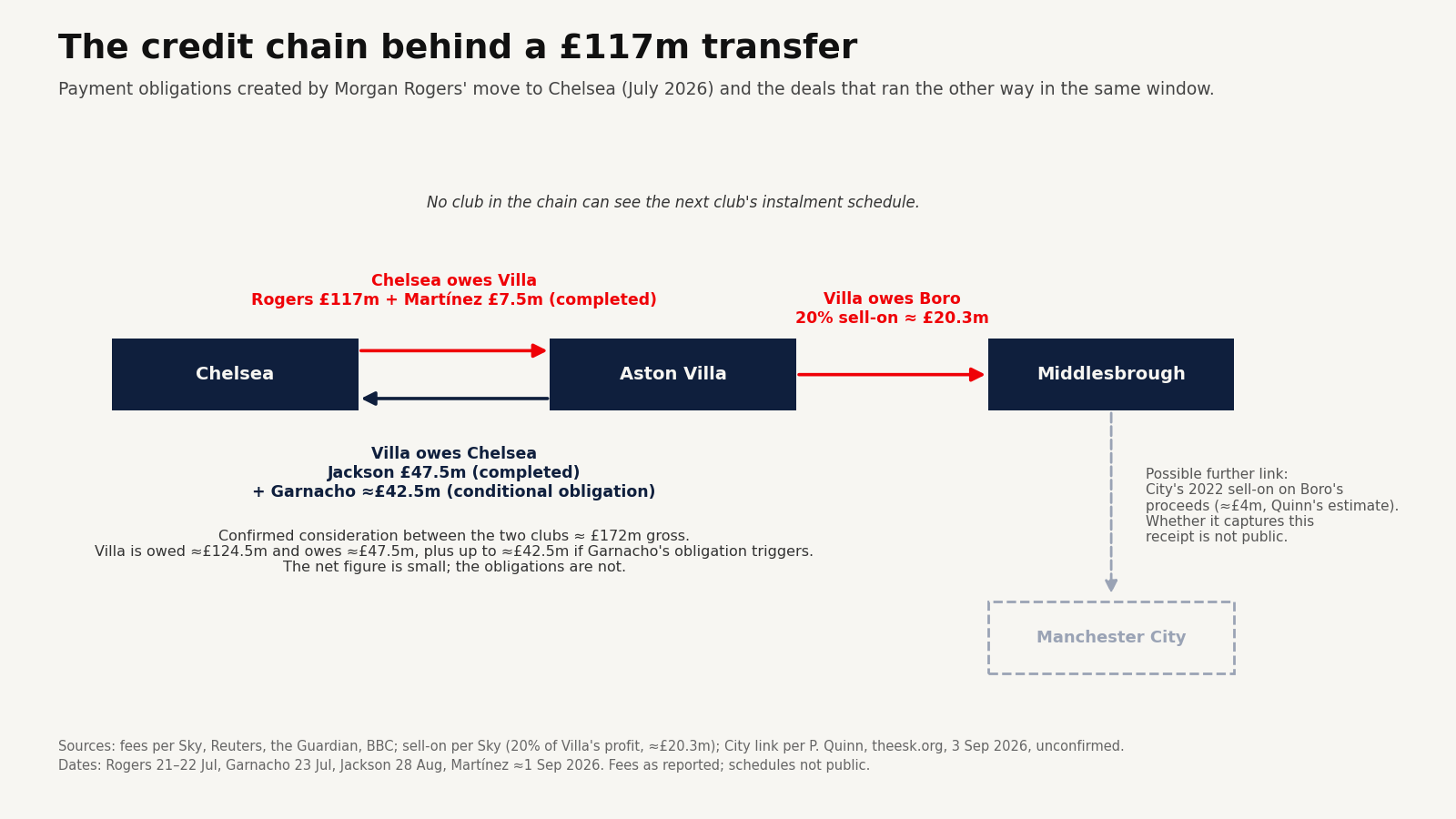
Latest note, 25 October 2026: data correction, no figure changed. All 5 correction notes are at the end.
The headline was simple: Morgan Rogers, Aston Villa to Chelsea, £117m, a British record for an English player. The money is not simple. It arrives in instalments over several years. It triggered a payment from Villa to Middlesbrough, a club that had nothing to do with the deal. And within six weeks Villa had agreed to pay Chelsea roughly £47.5m the other way for Nicolas Jackson, had sold Emiliano Martínez to Chelsea for about £7.5m, and had taken Alejandro Garnacho on loan with a conditional obligation to buy, in a package reported to meet Chelsea’s £42.6m valuation. By September the two clubs had roughly £172m of confirmed consideration running between them, and a third club was waiting on money whose timing depended on terms that are not public.
Paul Quinn drew this chain in his paper on the shadow credit market. I want to walk it link by link, separating what is reported from what is estimated, because it’s the best small example I know of why transfer debt is a network and not a number.
The chain
Chelsea owe Villa. £117m for Rogers, completed on 21 and 22 July, plus about £7.5m for Emiliano Martínez at the end of the window. Both are completed, permanent transfers, paid in instalments on schedules that are private.
Villa owe Middlesbrough. Villa bought Rogers from Boro in February 2024 for an initial £8m, with add-ons reported to take it to as much as £16m, and Boro negotiated a 20% share of Villa’s future profit on him. Sky’s calculation on the Chelsea fee puts that at about £20.3m. Whether it falls due as Villa receive each Chelsea instalment or on its own schedule depends on wording that isn’t public.
Villa owe Chelsea. Jackson, permanent, £47.5m initial (Reuters), completed on 28 August. Garnacho arrived on loan on 23 July with a conditional obligation to buy, whose conditions are not public. Sky reported that the loan fee and the purchase together meet Chelsea’s £42.6m valuation, so that figure is the value of the whole package, not a single payment that falls due if the obligation is triggered. The Jackson fee is confirmed consideration; Garnacho’s is contingent, and the two should be kept apart.
A possible fourth link. Quinn’s paper adds about £4m from Middlesbrough to Manchester City, on his reading that City kept 20% of everything Middlesbrough receives for Rogers. Reporting of Rogers’s move from City to Middlesbrough in July 2023 described the clause differently, as a 25% share of Middlesbrough’s profit on a future sale, and reporting of the 2024 sale to Villa confirms City were paid under it. Whether it also captures Boro’s later sell-on receipt from Villa is not established in anything I can find, and Sky’s calculation stops at Boro. I’ve left City in the diagram as an unconfirmed link rather than a creditor.
These are the agreed fees as reported, not balances outstanding: how much of each has been paid by any given date is not public.
So Chelsea’s £117m purchase triggered a second obligation of about £20.3m from Villa to Middlesbrough: roughly £137m of gross contractual payment obligations flowing out of one registration. That £20.3m is a share of Villa’s proceeds rather than new value the transfer created, but it is also a separate promise, to a separate club, on a separate schedule.
Gross, not net
Villa’s position with Chelsea looks simple on a napkin. Chelsea agreed to pay about £124.5m for Rogers and Martínez; Villa agreed to pay about £47.5m for Jackson, plus a Garnacho package reported at £42.6m, part of which is the loan fee and the rest payable if the obligation to buy is triggered. On those reported totals the difference is about £77m before Garnacho and about £34m with his whole package. That is arithmetic on agreed fees, not a confirmed net debt at any date, and the napkin is misleading in almost every scenario that matters.
If Chelsea are merely slow, Villa still have to pay their own instalments on time. The League’s and UEFA’s overdue-payables rules create powerful incentives for Chelsea to pay, but they don’t allow Villa to withhold their Jackson instalments merely because a Rogers instalment is late, and they don’t guarantee payment by a club that has stopped being able to. Villa live with the gross number.
Formal insolvency can introduce mandatory set-off of qualifying mutual dealings under English insolvency law, which would make the net position more relevant. Whether particular transfer obligations qualify depends on their legal structure and timing, and that’s a question for an insolvency lawyer, not for this piece. It is also the one scenario everyone involved hopes never to test.
Between those two cases sits the one that is actually on the calendar. Chelsea’s holding company, BlueCo 22, had a senior facility of about £794m at 30 June 2025, maturing on 13 July 2027, according to the group’s filed accounts. On 16 September 2026 Chelsea announced that minority co-owners Todd Boehly and Mark Walter were selling their stakes to Clearlake Capital, giving it full control. How a failed refinancing would play out would depend on facility documents, football regulations and any restructuring agreed at the time, none of which is public, and our article on the Clearlake deal sets out the group’s debt in detail. What can be said here is only that the transfer contracts would not disappear, so Villa’s exposure stays gross in that scenario too.
Meanwhile Villa’s sell-on to Middlesbrough is Villa’s own obligation. It falls due on Villa’s schedule whether or not Chelsea have paid Villa, unless the contract says otherwise, so Boro’s exposure is to Villa, and Villa carry the timing risk in the middle. Chelsea’s instalment dates are not public, and nothing public shows what Boro know of them or are entitled to see. From outside the clubs, nobody can see the whole chain.
The 45-day rule
UEFA’s accounting rules require clubs to assess whether opposite-direction transfers between the same two clubs constitute a single “exchange transaction”. Completion within 45 days of each other is one of four specified indicators; the others are transfers in the same or linked contracts, deals involving little or no cash, and deals with matching payment obligations or deadlines. The 45-day wording was sharpened in the 2026 edition of the regulations; the 2025 text referred more loosely to the same registration period. None of the indicators is determinative on its own. The classification is for UEFA’s Club Financial Control Body, the CFCB, the panel that applies the financial rules and issued June’s fines.
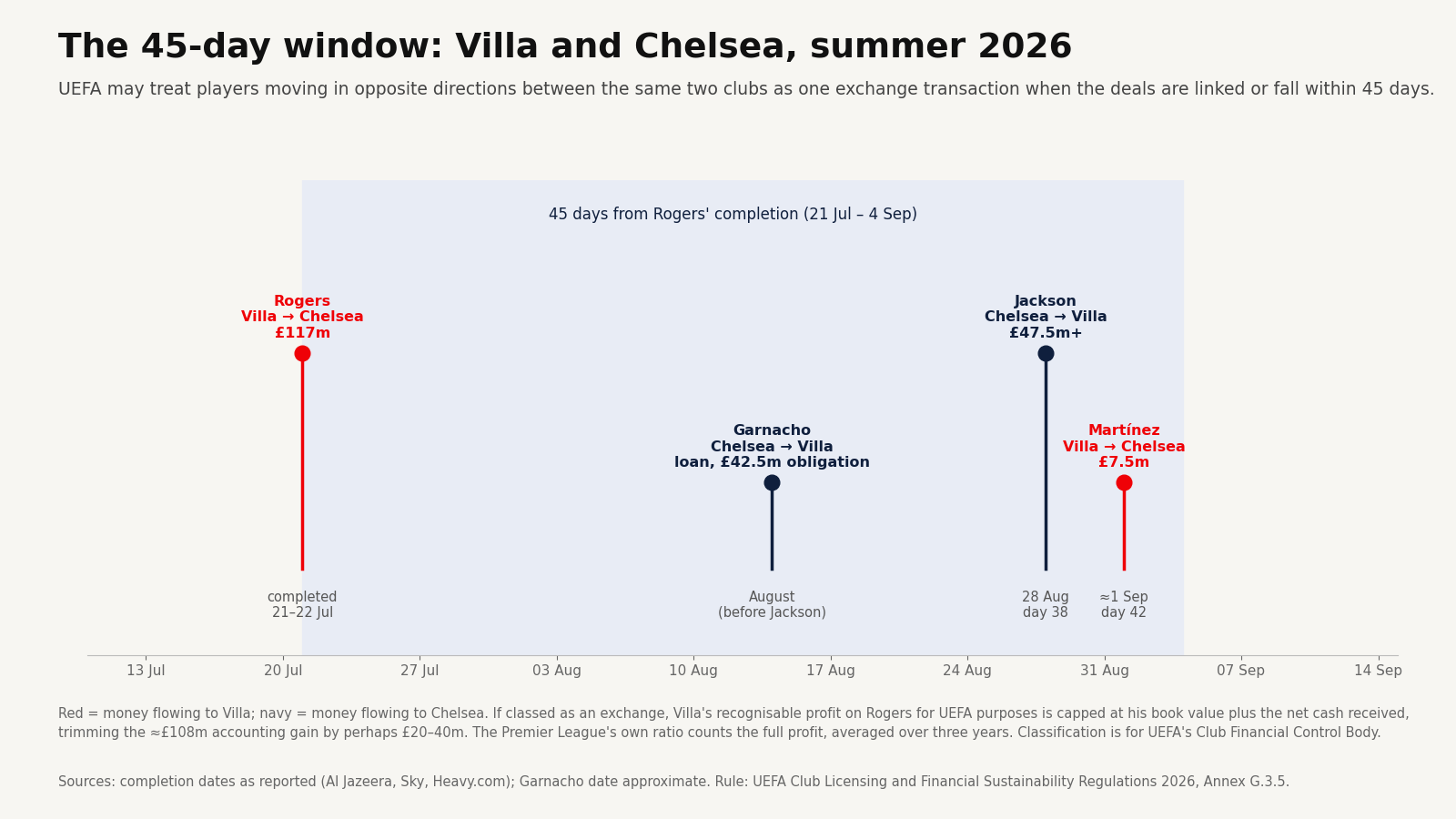
Rogers to Chelsea completed on 21 and 22 July. Garnacho arrived on loan on 23 July; Jackson on 28 August, 37 days later; and Martínez, moving the same way as Rogers, joined Chelsea on 30 August, 39 days later. All four fall inside the window, and Sky reported at the time that the Garnacho structure had been considered with this rule in mind.
Garnacho is the complication. His move was structured as a loan with a conditional obligation to buy, and the exchange rule (Annex G.3.5) is an accounting rule for permanent transfers. Under Annex G.4.6, a conditional-obligation loan is treated as a permanent transfer from inception only where the purchase condition is considered virtually certain; if it cannot be assessed with sufficient certainty, it remains a loan until the condition is met. Whether Garnacho belongs in the exchange analysis from day one therefore turns on how UEFA assesses that condition, which is not public.
If the CFCB treats the relevant permanent transfers as an exchange, together with Garnacho where G.4.6 is satisfied, Villa’s recognisable proceeds on Rogers for UEFA purposes are capped at his book value adjusted for the net cash Villa received or are due to receive. That trims the profit UEFA will count. The timing alone does not decide it: falling within 45 days is evidence the CFCB weighs, not a finding. The size of any trim depends on which deals are pulled in and on the net cash, so the arithmetic is shown below rather than a number asserted.
What Villa’s profit actually is
Start from £117m. UEFA’s rules (Annex G.3.6) require profit on disposal to be calculated net of amounts directly attributable to the sale, and they name a sell-on fee to another club as an example. So the £20.3m to Middlesbrough comes off first. Agents’ fees on a deal of this size come off next. Then comes Rogers’s remaining book value: an initial £8m in February 2024, on a contract to 2029 that was extended to 2030 in November 2024 and to 2031 in November 2025, leaves about £5m by July 2026, more if add-ons had been triggered and capitalised. The BBC’s reporting at the time put Villa’s likely profit at £80m to £90m after those deductions, and that range is consistent with the arithmetic. Our own Aston Villa reconstruction, which deducts the same £20.3m sell-on, puts the profit at about £85m.
That is the profit before any exchange-transaction adjustment. Under the Premier League’s squad cost rule, the profit counts toward Villa’s ratio, but not all at once. Rule A.1.13 adds up a club’s profit or loss across the last six transfer windows and divides it by three, so a gain of £80m to £90m adds roughly £27m to £30m to the revenue the rule counts in each of three seasons, and then drops out. If UEFA’s exchange provisions apply, it may count less of the profit, depending on whether the deals are grouped as one exchange, with Rogers and Martínez going one way and Jackson and Garnacho the other, rather than treated as separate transfers. A reduction in the tens of millions is plausible; the exact figure isn’t knowable from outside, and I’d distrust anyone who gives one.
Appendix 2 of the Premier League Handbook has no equivalent of UEFA’s exchange adjustment, and Chelsea and Villa are not associated parties, so no standalone fair-value test attaches to this deal (UEFA explainer).
The same transaction is therefore potentially worth different amounts to Villa under two rulebooks, and the difference was set by the deals that ran the other way. Domestic recognition is not necessarily UEFA recognition. Villa have a UEFA settlement to satisfy, and so do Chelsea. Both clubs reportedly took advice on this and proceeded.
Why it matters beyond three clubs
Multiply this by a league. Quinn estimates Premier League clubs’ gross transfer payables at about £3.5bn at the last audited year-end, heading toward £5.5bn by June 2027, with net transfer debt of around £3.3bn. He puts about £1.1bn of net instalments falling due in 2025/26, against aggregate operating cash flow of under £200m in 2024/25, the latest year filed. The £3.5bn is his aggregation of audited accounts; the £5.5bn, the £3.3bn and the £1.1bn are his models. None is a League disclosure, and there are no League disclosures to check them against. Forty per cent of this summer’s spending was between Premier League clubs, on my own count from the transfer data, so more clubs than before may be both owed instalments by, and owing them to, other clubs in the same league. How much of that is still unpaid, and who owes whom across the whole stock of debt, is not public.
A transfer is now a fee, a schedule, a sell-on behind it, a counterparty whose ability to pay the third instalment depends on things that haven’t happened yet, and a rulebook that values the same profit differently depending on what else the two clubs did that summer. The selling club is a creditor for years. The club behind it is a creditor of a creditor.
Quinn’s proposal is a register of inter-club obligations so that the chain can be seen. Until it exists, the closest anyone outside the clubs can get is this: reported fees, reported dates, and arithmetic with the assumptions shown.
Caveats.
Fees and dates. As reported by Sky, Reuters, the Guardian, the BBC and the clubs. Instalment schedules, the sell-on wording and the Garnacho obligation conditions are private. The Middlesbrough sell-on figure is Sky's calculation; the Garnacho package value is as reported by Sky; the City link is Paul Quinn's estimate and unconfirmed. Chelsea's ownership change is from the club's announcement of 16 September 2026, and BlueCo 22's facility from the group's filed accounts for the year to 30 June 2025.
The rules. The UEFA exchange-transaction rule is Annex G.3.5, the conditional-obligation loan treatment Annex G.4.6, and the net-of-sell-on rule Annex G.3.6, of the 2026 Club Licensing and Financial Sustainability Regulations; their application to these deals is my reading, not a CFCB decision. The Premier League's associated party transaction and fair market value rules sit outside Appendix 2 and are described from the League's published material; Chelsea and Aston Villa are not associated parties, and nothing here suggests otherwise. The domestic treatment cites Rule A.1.13 of Appendix 2 of the 2026/27 Premier League Handbook.
Estimates. Villa's squad cost ratio is set out separately in the Aston Villa reconstruction; the annualised figures above are arithmetic on the reported profit range. Quinn's figures for payables at the last year-end and for cash flow aggregate filed accounts; his forward payables, net debt and instalments are models (theesk.org, 3 and 10 September 2026). The set-off and refinancing paragraphs describe possibilities in general terms and are not legal advice.
Independent analysis, not an official calculation.
Corrections and updates (5)
2 October 2026 · Data correction · several figures: see the note
Update, 2 October 2026. Three details are brought up to date, and none changes the argument. Rogers’s contract was extended twice, to 2030 in November 2024 and to 2031 in November 2025, so about £5m of his book value remained at the sale, not an amount in the low single millions. The add-ons on his original fee are reported as taking it to as much as £16m, rather than towards £15m. And Aston Villa has since been rebuilt on this site’s engine: that reconstruction deducts the same £20.3m sell-on and puts Villa’s profit on Rogers at about £86m, inside the £80–90m range quoted below.
5 October 2026 · Methodology change · several figures: see the note
Update, 5 October 2026. Villa’s profit on Rogers in the Aston Villa reconstruction is now about £85m, from about £86m, after contract lengths were measured from their dates (the engine changelog). The move is about £0.05m, from £85.50m to £85.45m, and it shows only because the figure sat on a rounding line. It is still inside the £80–90m range quoted below.
22 October 2026 · Data correction · several figures: see the note
Correction, 22 October 2026. Several statements are corrected or brought up to date. The argument is unchanged.
- Rogers’s move to Middlesbrough. The article dated it to 2022. It was July 2023.
- Manchester City’s clause. The article said Quinn’s £4m rested on the 25% sell-on City kept. Quinn’s figure assumes City take 20% of everything Middlesbrough receive for Rogers. Reporting of the 2023 move described a 25% share of Middlesbrough’s profit on a future sale. The link stays unconfirmed.
- Garnacho. The article described an obligation to buy “at around £42.5m”. Sky reported that the loan fee and the purchase together meet Chelsea’s £42.6m valuation, so the figure is the value of the whole package rather than one future payment. Villa’s net position against Chelsea, on reported totals, is still between about £34m and £77m.
- Chelsea’s ownership. The article said Todd Boehly and Mark Walter were reported to be nearing the sale of their stakes to Clearlake Capital. Chelsea announced the sale on 16 September 2026. The discussion of a failed refinancing is shortened, with a link to our article on the group’s debt.
- UEFA’s exchange rule. The article capped Villa’s proceeds at book value plus the net cash Villa “received”. Annex G.3.5 counts net cash received or receivable, which matters for a deal paid in instalments. The article also now says that the 45-day timing is evidence the CFCB weighs, not a finding.
- Who owes whom. The article said that because 40% of this summer’s spending was between Premier League clubs, “most of those instalments” are owed between clubs that are also owed by others in the league. A summer’s spending does not show how the stock of unpaid instalments is split. The article now describes the potential for such positions and says the full picture is not public.
- Cash flow. The article set £1.1bn of instalments due in 2025/26 against operating cash flow without saying the cash-flow figure is from 2024/25. It now says so.
- Directions of the deals. The article described three deals running “the other way” and treated Martínez as consideration for Rogers. Martínez moved from Villa to Chelsea, the same way as Rogers; only Jackson and Garnacho went the other way. Martínez joined Chelsea on 30 August, 39 days after Rogers, not around 1 September.
- Agreed fees, not balances. The article described Villa as “owed” £124.5m and “owing” £47.5m. These are reported agreed fees, not balances outstanding at any date, and the Garnacho package includes a loan fee that is due whether or not the obligation is triggered. The £34m to £77m comparison is now described as arithmetic on reported totals.
- What Middlesbrough can see. The article said Middlesbrough “cannot see” Chelsea’s instalment dates and had “never seen” the contract. Those terms are not public, but nothing public shows what Middlesbrough know or can ask to see.
These were our errors in reading the reporting and the rules, apart from the ownership change, which happened after publication.
22 October 2026 (second) · Editorial · no figure changed
Editorial, 22 October 2026. Wording only; no figure changed.
- Our own estimate of Villa’s profit on Rogers, about £85m, is moved from the caveats into the body.
- The squad cost rule is linked and its averaging explained without “denominator”.
- Clubs take the plural.
- Em dashes, a signpost, bolded sentences and “not X but Y” constructions are removed.
- Ranges are written with “to”.
- The caveats are divided into headed paragraphs.
25 October 2026 · Data correction · no figure changed
Correction, 25 October 2026. No figure changed. The article said that completion within 45 days is one of five indicators of an exchange and then listed three others: there are four, as the UEFA explainer gives them (Annex G.3.5). It also called all of Paul Quinn’s figures estimates from filed accounts. His £3.5bn of payables at the last year-end aggregates audited accounts; the £5.5bn by June 2027, the £3.3bn of net transfer debt and the £1.1bn of instalments are his models, as the window piece of 8 September says. The sentence and the sources now say which is which.